


The Taipei Fine Arts Museum (TFAM,台北市立美術館) is currently showing a large-scale retrospective exhibition on the life and work of Taiwanese photographer Chang Chao-tang (張照堂).
Time: The Images of Chang Chao-tang, 1959 to 2013 (歲月/照堂:1959-2013影像展) presents over 400 objects covering the photographer’s career from 1959 to the present.
The exhibition contains six sections, four of which are arranged chronologically; the other two exhibit portraits, installation works, sketches and manuscripts. Black and white photography comprises the majority of the work, with one exception — The Sleepwalking Before … (夢遊—遠行之前…) — a montage of abstract photos in color, a style Chang began to experiment with after 2005.
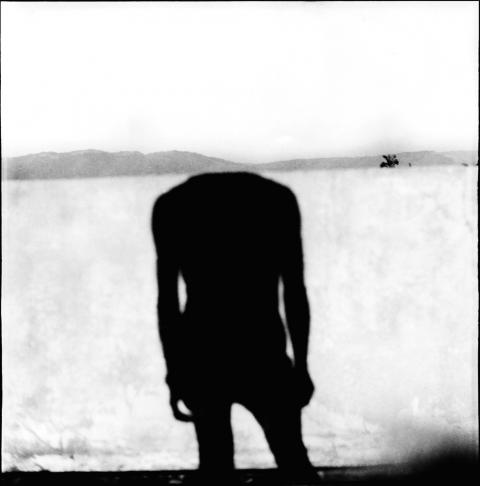
Photo courtesy of TFAM
Images of Youth and Existential Voices showcase Chang’s early works. Panchiao, Taiwan (板橋) shows the back of an undressed plastic doll attached to a pull-up bar in the park. Chang was a teenager when he shot the staged image, demonstrating a fertile mind adept at composition.
Chang came under the influence of existentialism and surrealism in his early twenties, further refining his unique style. These images are intentionally out-of-focus, blurred or, in the case of the portraits, headless. Later, he will make a person’s face or head blurry, covered or hooded in a plastic bag, yielding a sense of suffocation.
He uses the idea of faceless figures in the series Taiwan — And then Nuclear Disaster (台灣 核災之後, 2005-2013), which shows phantoms standing in the wilderness in black robes, their faces overexposed as though reflecting the violent flash of a nuclear explosion.
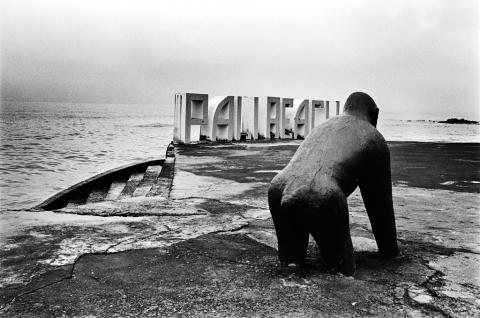
Photo courtesy of TFAM
In Social Memories / Inner Landscapes, Chang dabbles in realistic street photography and eery landscapes that often include statues of animals.
Chang wasn’t just a photographer, but also a documentary filmmaker, typically shooting works that examine Taiwan’s rich folk culture. The Golden Bell Award-winning The Boat-Burning Festival (王船祭典), for example, was made in 1979 in collaboration with cinematographer Christopher Doyle. Chang later cut the original one-hour film down to about 20 minutes, got rid of all sound and added music.
The exhibition also features Chang’s photo collages, manuscripts, sketches and two reconstructed art installations: Happy Birthday (生日快樂) and Unfinished (未完成). The former adds dimensions to a horizontal photo by attaching them to a chair, broom and bucket while the latter has a stack of scorched remains of books and newspapers on a canvas.
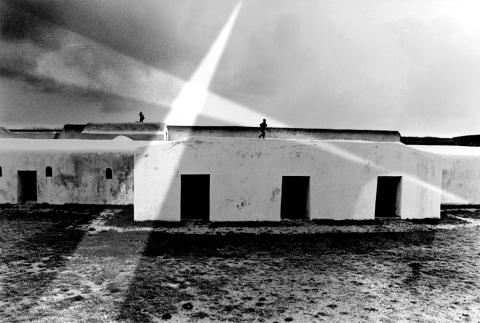
Photo courtesy of TFAM
For this reviewer, Faces in Time is the most interesting section of the exhibition because it displays photos of cultural figures and celebrities that Chang shot between 1962 to the present. The wall of fame includes author Kenneth Pai (白先勇) and choreographer Lin Hwai-min (林懷民), among many others in their younger days.
Time: The Images of Chang Chao-tang is an enjoyable exhibition, providing an exhaustive, though at times exhausting, look at the evolution of a photographer. Indeed, the sheer number of objects displayed creates an almost assembly line atmosphere; TFAM could have exhibited half the number of photographs and fulfilled their hagiography of the photographer. As it is, without a theme, one walks out of the museum feeling somewhat dizzy with information overload.
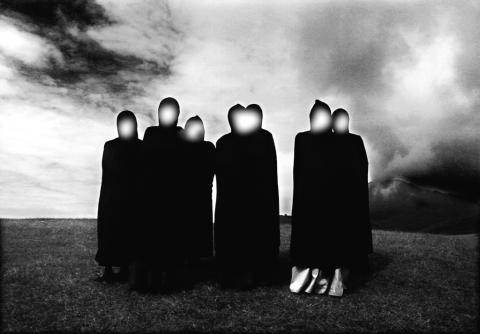
Photo courtesy of TFAM
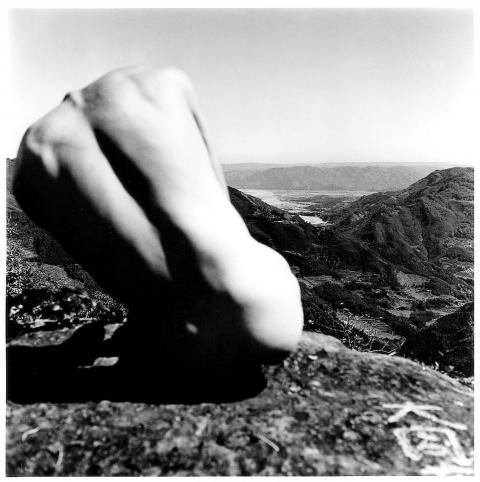
Photo courtesy of TFAM

Taiwan’s English education system is being pulled apart by three opposing forces. Bilingual Nation 2030 pulls students toward English and global communication. Artificial Intelligence (AI) readiness pulls them toward digital judgment, verification and AI-mediated work. But Taiwan’s old exam culture pulls them back toward memorization, grammar drills, timed reading and correct answers. If the education system keeps using old exams to define success, it risks producing graduates who are neither genuinely bilingual nor genuinely AI-ready, but trained for tasks machines can already perform. The first force is Bilingual Nation 2030. Launched in 2018, the policy aimed to “help Taiwan’s workforce connect

It seems every few days one bumps into one of those “real man” comments in which Taiwan is urged to “face reality” or similar, and “make a deal,” with the speaker implying that soon it will be too late. “Deal” advocates always present themselves as having a superior grip on reality, and the manly ability to make the “hard choice.” Their testosterone-laden language often echoes that of Taiwan sellout advocates. Note that such commentary always specifies a process (“make a deal, work with, make progress”), never the end state of what occupation by a violent authoritarian colonialist state will entail. In
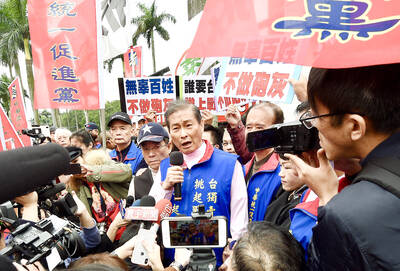
There are shadowy cabals plotting to sell out Taiwan to be annexed by China, by invasion if necessary. Fortunately, they are buffoons. In 2019, former Bamboo Union gangster and founder of the China Unification Promotion Party (CUPP), Chang An-le (張安樂, colorfully known as “White Wolf”), led a protest at the Legislative Yuan against comments made by then-premier Su Tseng-chang (蘇貞昌) that in the event of an attack by China, he would never surrender, but would protect the nation by fighting to the end, even if he only had a broom. Chang had party members bring a wooden casket that they
June 1 to June 7 "If all Taiwanese were as afraid of dying as you, then what would happen?” Physician Shih Chiang-nan (施江南) reportedly said this to his wife Chen Chiao-tung (陳焦桐) after she urged him to stop intervening on behalf of Taiwanese soldiers stranded overseas after serving in the Japanese Army during World War II. Shih had clashed with high-ranking officials over the issue, engaged in several heated arguments with Taiwan governor-general Chen Yi (陳儀) and allegedly shouted at general Ko Yuan-fen (柯遠芬), chief of staff of the Taiwan Garrison Command, over


 RSS
RSS