


Sex and bibliography are a potent mix for a certain kind of mind. Such a person will be fascinated by Decadence Mandchoue, an extraordinary, astonishing and altogether exceptional book that has had a strange history and was at first considered too pornographic to publish. It was later judged to consist largely of fantasy wish-fulfillment, which delayed its appearance even longer. Now it has finally been issued complete, and few will believe it isn’t, in all the ways that matter, essentially a record of fact.
Edmund Trelawny Backhouse left Oxford without a degree in 1895, having helped raise money for the defense of Oscar Wilde and, according to his own account, had sex with him. He then traveled east, was granted an audience with the Tzar (arranged for him by Tolstoy), and arrived in Beijing in 1898. He lived there, largely eschewing the company of other Westerners, and becoming fluent in Chinese, Manchu and Mongolian, with a modicum of Tibetan, until his death in 1944.
In the early 1940s, however, he met the Swiss honorary consul, Dr. Reinhard Hoeppli, and started talking to him about his past. Hoeppli was so astonished he begged him to write it all down, and offered to pay him for any resulting manuscripts. Backhouse consequently produced The Dead Past and Decadence Mandchoue, the former dealing with his youth in England and Europe, the latter with his first decade in China, from 1899 to the death of the Empress Dowager in 1908.
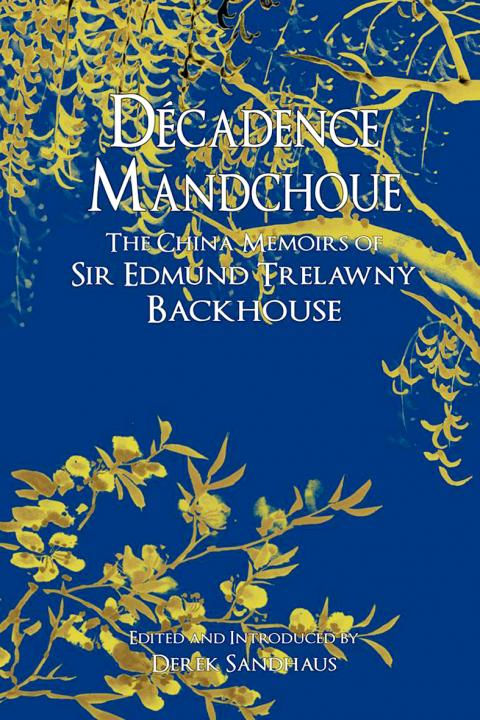
The reason both books were considered too erotic to publish were that Backhouse was an out-and-out homosexual and an enthusiast for flagellation, with both interests extensively displayed in Decadence Mandchoue, and that he claimed to have been summoned for sex by the Empress Dowager — on account of his linguistic fluency, pro-China stance and generously-sized genitalia — somewhere between 150 and 200 times over a period of five years.
The Dead Past still awaits publication, though editor Derek Sandhaus has examined the manuscripts and typescripts that Hoeppli deposited on Backhouse’s instructions in Oxford’s Bodleian Library. (Copies of the final typescripts were also sent to libraries in London, Paris and at Harvard.) But Decadence Mandchoue, excellently edited, is now available for all to read.
An important factor in these books’ neglect up to now is that six months after Hoeppli’s death in 1973 the Backhouse manuscripts were handed, at Basle Airport, to the Oxford historian Hugh Trevor-Roper. Though originally planning to have them published, Trevor-Roper found the material distasteful, and on investigating Backhouse further found him to be a habitual liar and a fraud. He published these conclusions in his damning 1976 book Hermit of Peking, which essentially consigned the previously esteemed Sinophile to the scrap-heap for 35 years.
Today, historians are far more inclined to take Backhouse’s memoirs at face value. Frank Dikotter, for instance, writes as follows: “Trevor-Roper’s best-selling Hermit of Peking turned Sir Edmund Backhouse, a playful and eccentric sinologist, into a caricature of deception. Through a combination of painstaking archival research and brilliant scholarship, Sandhaus not only rights the historical record, but also makes a persuasive case for the historical veracity of what must count as one of the most outrageous, colorful and hilarious memoirs ever written, so pornographic that they make Burroughs’ Naked Lunch look like a fairy tale for children.”
What, then, makes Decadence Mandchoue so outrageous?
First, the Empress Dowager. She was 67 when Backhouse met her in 1902; he was 29. The age difference, plus the fact that Backhouse was essentially gay, may appear unfavorable circumstances. But the Empress Dowager was sexually voracious, we’re told, going into the city in disguise at night, high on opium, to seek out men. Besides, an order from such eminence couldn’t easily be refused. To facilitate the arrangement, Backhouse would be provided with cups of aphrodisiac drugs by her attendants (which acted “most potently in my person”), and in addition she was fully aware of his sexual tastes and did her best to satisfy them. Details are too specific to print here, but in his book Backhouse displays no such reluctance.
It’s Backhouse’s gay experiences, though, that get most detailed coverage, so much so that Hoeppli detects an element of boasting. Even so, the first chapter (on a gay brothel, the “Hall of Chaste Pleasures”) and the sixth, on a gay bath-house, are extraordinary for any era. Princes, eunuchs, Peking-opera stars and notably helpful attendants all combine in orgies of sexual stimulation.
The greatest climax at the bath-house, however, occurs when the Empress Dowager arrives on the premises in disguise (quickly discarded) and demands to see the various gay ways of making love. She applauds each demonstration and hands out gratuities. Everything appears acceptable to her, so long, she says, as the participants didn’t neglect their conjugal responsibilities (the traditional Chinese obligation, in other words, to marry and produce offspring).
How much of this is true? Probably almost all of it. There’s a long tradition of heterosexuals refusing to believe the sheer numbers of contacts many gays have, or even that people who they respect in other ways could be gay at all. Few believed in Roger Casement’s “black diaries” — listing almost daily erotic acts with men whose names he never discovered — except when it was politically advantageous to do so. A. J. Ayer refused to believe his fellow philosopher Wittgenstein was gay when it was first mooted. Similarly, Trevor-Roper perhaps found Backhouse’s recollections unbelievable because they were, to him, so improbable, not to say deeply uncongenial. A man who has had two or three sexual contacts in a lifetime can’t easily credit someone who freely admits to thousands.
Hoeppli does recall Backhouse agreeing to change details in his book when it was pointed out they were contradicted by the facts, but he didn’t think this cast doubt on the memoirs as a whole. Backhouse may have had a strong imagination, and he certainly did describe some scenes that others who were present had told him about, in the way a historian might. But what motive would someone like Backhouse, aged 70, have had for whole-scale invention? My view is that these memoirs are essentially truthful, with an artist’s touching-up of minor details. Both Hoeppli and the editor at Earnshaw Books, Derek Sandhaus, concur in essence with this position.
There were other reasons, though, why Trevor-Roper — not a man to be dismissed lightly — distrusted Backhouse. These involved schemes to buy and sell armaments and certain imperial treasures. On these matters it’s impossible to make any independent judgment. But there’s also the issue of the diary of one Ching Shan, a high court official. Backhouse included it in his 1910 co-authored book China Under the Empress Dowager, and when challenged about its authenticity by Hoeppli replied that if it was a forgery, he, Backhouse, hadn’t forged it. Lastly there are the voluminous diaries of the Chief Eunuch at the turn of the century, Li Lianying (李蓮英), one of this book’s great characters. He’d given them to Backhouse who took them to the UK in 1921, depositing them at Lloyds Bank. According to Trevor-Roper they’ve never surfaced.
Backhouse wasn’t someone to act from acquisitive motives. Between 1913 and 1922 he donated to the Bodleian Library over 17,000 Chinese books and manuscripts that today it considers “one of the finest and most generous gifts in the Library’s history.” Considering what other benefactions the Bodleian must have received in its time, this is high praise.
Edmund Backhouse lived in a vanished world that was cruel, but also brilliant in art and literature. Now his uniquely revealing memoirs have been published by Hong Kong’s Earnshaw Books. “An erotic love letter to a bygone era,” as the editor remarks, and a sensation in every sense, they’re surely the jewel in their pioneering publisher’s crown.

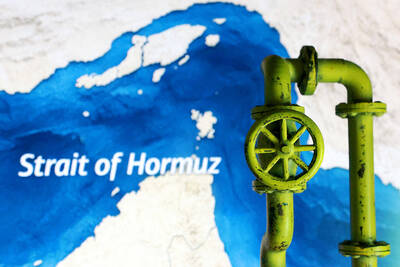
The US war on Iran has illuminated the deep interdependence of Asia on flows of oil and related items as raw materials that become the basis of modern human civilization. Australians and New Zealanders had a wake up call. The crisis also emphasizes how the Philippines is a swatch of islands linked by jet fuel. These revelations have deep implications for an invasion of Taiwan. Much of the commentary on the Taiwan scenario has looked at the disruptions to world trade, which will be in the trillions. However, the Iran war offers additional specific lessons for a Taiwan scenario. An insightful
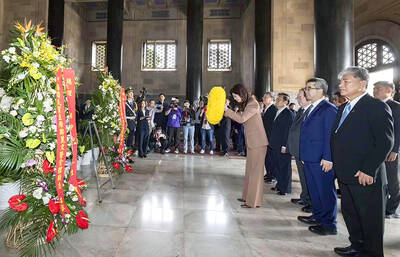
The problem with Marx’s famous remark that history repeats itself, first as tragedy, the second time as farce, is that the first time is usually farce as well. This week Chinese Nationalist Party (KMT) Chair Cheng Li-wun (鄭麗文) made a pilgrimage to the People’s Republic of China (PRC) “to confer, converse and otherwise hob-nob” with Chinese Communist Party (CCP) officials. The visit was an instant international media hit, with major media reporting almost entirely shorn of context. “Taiwan’s main opposition leader landed in China Tuesday for a rare visit aimed at cross-strait ‘peace’”, crowed Agence-France Presse (AFP) from Shanghai. Rare!
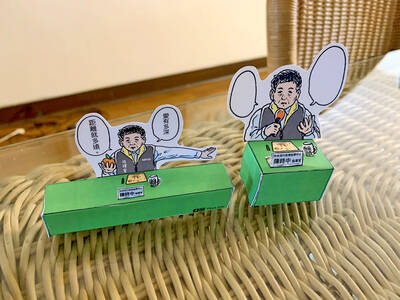
Sunflower movement superstar Lin Fei-fan (林飛帆) once quipped that the Democratic Progressive Party (DPP) could nominate a watermelon to run for Tainan mayor and win. Conversely, the DPP could run a living saint for mayor in Taipei and still lose. In 2022, the DPP ran with the closest thing to a living saint they could find: former Minister of Health and Welfare Chen Shih-chung (陳時中). During the pandemic, his polling was astronomically high, with the approval of his performance reaching as high as 91 percent in one TVBS poll. He was such a phenomenon that people printed out pop-up cartoon
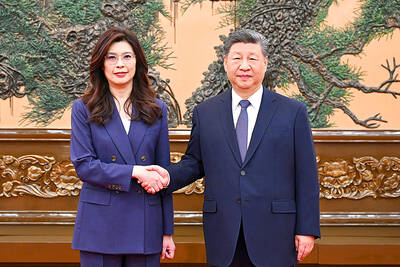
What is the importance within the Chinese Nationalist Party (KMT) of the meeting between Xi Jinping (習近平), the leader Chinese Communist Party (CCP), and Cheng Li-wun (鄭麗文), the leader of the KMT? Local media is an excellent guide to determine how important — or unimportant — a news event is to the public. Taiwan has a vast online media ecosystem, and if a news item is gaining traction among readers, editors shift resources in near real time to boost coverage to meet the demand and drive up traffic. Cheng’s China trip is among the top headlines, but by no means


 RSS
RSS