


Liu Hsing (劉興) has worked in the restaurant industry for over 10 years. He started at a small eatery and, two years ago, moved up to a mid-scale Thai restaurant where he works 9.5 hours a day, five or six days a week. His salary rose along the way, though not by much: from NT$22,000 to NT$27,000.
“It could be that I’m paid more now because this restaurant includes a service charge,” Liu said to the Taipei Times just before the lunch rush. But Liu, like other waiters and waitresses, is not sure.
Employees in the dark
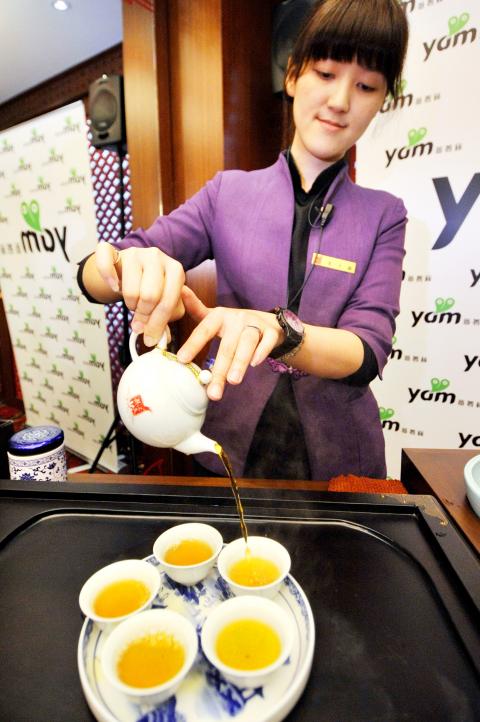
Photo: Taipei Times
Twenty years ago, a service charge was rare and almost exciting, the touchstone of newfangled Western-style restaurants. Today, nearly all mid to high-end Taipei restaurants have one, whether their cuisine is American, Japanese or Thai, or presented as a buffet, waited dinner or hot pot. Typically, it’s a flat rate of 10 percent of the bill.
The name itself is somewhat misleading because it implies that the money is for the server, or for the service team. In Europe, where the service charge system emerged, that is often true: The fee is divided and directly disbursed to service staff.
But under Taiwanese law, the service charge is considered general restaurant revenue, and the owner is not obligated to pay all or any amount directly to the servers, the cooks, the dishwashers or any member of the service team. And it seems that few restaurant operators are doing so.
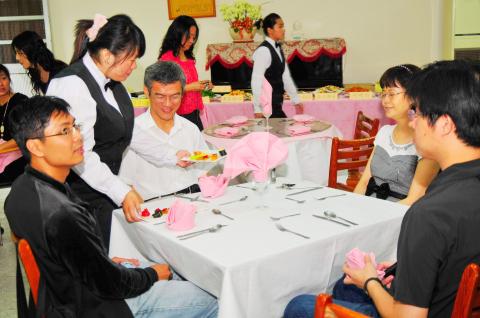
Photo: Taipei Times
“That income isn’t for the servers — it’s so that restaurants can balance their budgets. The profit margin of restaurants is actually extremely low,” explained the owner of Ishizen Japanese Restaurant (石膳相撲火鍋), who asked not to be named.
Her restaurant is not alone. In a telephone survey of 17 self-identified employees at randomly selected Taipei restaurants that have a service charge, all respondents said that the revenue goes to the owner.
Of the 17, 12 respondents told the Taipei Times that they are “unsure where the money goes after that.”
Only five said they think the service charge is benefiting servers. One of them — at Robin’s Teppan (Robin’s 鐵板燒) — said the charge is directly passed on to the service team. Employees at Kitchen Pucci (葡吉小廚) and Schwarzwald (黑森林德式美食) said that the money pays for staff meals and holiday events. The remaining two employees said they believe the charge subsidizes wages: They are uncertain how much the service charge contributes, because it’s not listed on the paycheck as an item added to a stated base salary.
Higher wages?
A service charge probably does boost wages — if only a bit. At Robin’s Teppan, Top Thai and Chef King, employees reported that their starting salary had been above NT$23,780, which is the average starting salary in Taipei’s dining and hospitality industry, according to a 2012 survey by the Taipei City Employment Services Office (勞工局就業服務處).
Take Wow Prime (王品), where the lowest starting salary is reportedly NT$27,000 a month. The server can tell himself, if he wishes, that the additional NT$3,220 is a bonus for memorizing ingredients, walking like a butler and coping with motley crises with elan and a smile.
But he probably won’t, because the bonus is not identified on the paycheck, and because the bonus doesn’t correlate with his performance from month to month. If displeased customers complain that they ought to be getting better service for that 10 percent, they are holding him accountable to a fee that, in the server’s mind, benefits him only if he strains his imagination.
Tips
In 12 of the 17 restaurants surveyed, customers do have the option of directly tipping the server. In all 12, tips are added to a pool and evenly divided among those on the shift.
But customers rarely choose to tip after already paying the 10 percent service charge. “To be truthful, nobody tips us besides foreigners,” said a server at Trio Bistro Bakery & Cafe (TRIO義式庭園).
In some restaurants, like Wow Prime and Ishizen Japanese Restaurant, tips are refused outright.
“Tips are a bad idea invented by Americans, and our waiters are forbidden to accept them,” said the Japanese restaurant’s owner.
“Look at it this way: There is one person who serves you at the table, but behind him there are nine people who provide service. Why should just the one person receive a tip for service?” she said.
Liu, whose employer also enforces a no-tip policy, said that the effect of tips can be achieved in other ways.
“Restaurants can give servers the service charge, or offer good wages and benefits. Treat employees like a golden egg,” he said. “I think that if we had things like that, we would feel more of an incentive when we are on the job.”

Just after 6am, I walked up to the ticket gate at Taipei Main Station and entered the Taiwan Railway platform without scanning any ticket; instead, I flashed the Sanrio Fun Rail pass on my phone to the gate worker and was admitted. I found my train and prepared to board. My destination? This very same station. I was embarking on a 13-hour journey on one of two round-the-island trains operated by ezTravel. They run each day, one counterclockwise around the island and one clockwise. They differ in a number of ways from an ordinary Taiwan Railway train and can make for
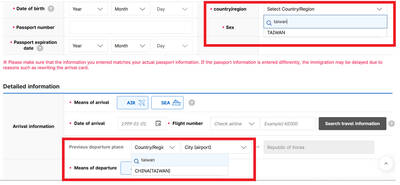
Jason Han says that the e-arrival card spat between South Korea and Taiwan shows that Seoul is signaling adherence to its “one-China” policy, while Taiwan’s response reflects a reciprocal approach. “Attempts to alter the diplomatic status quo often lead to tit-for-tat responses,” the analyst on international affairs tells the Taipei Times, adding that Taiwan may become more cautious in its dealings with South Korea going forward. Taipei has called on Seoul to correct its electronic entry system, which currently lists Taiwan as “China (Taiwan),” warning that reciprocal measures may follow if the wording is not changed before March 31. As of yesterday,

The Portuguese never established a presence on Taiwan, but they must have traded with the indigenous people because later traders reported that the locals referred to parts of deer using Portuguese words. What goods might the Portuguese have offered their indigenous trade partners? Among them must have been slaves, for the Portuguese dealt slaves across Asia. Though we often speak of “Portuguese” ships, imagining them as picturesque vessels manned by pointy-bearded Iberians, in Asia Portuguese shipping between local destinations was crewed by Asian seamen, with a handful of white or Eurasian officers. “Even the great carracks of 1,000-2,000 tons which plied

On Thursday, former Taipei mayor and founder of the Taiwan People’s Party (TPP) Ko Wen-je (柯文哲) was sentenced to 17 years in prison and had his civil rights suspended for six years over corruption, embezzlement and other charges. Seven others related to the case were also handed prison sentences, while two were found not guilty. It has been a bad week for the TPP. On Tuesday, prosecutors charged Chinese immigrant Xu Chunying (徐春鶯) with suspicion of taking part in Beijing-directed election interference. Xu has strong links to the TPP, which once offered her a party list legislator nomination. Tuesday also


 RSS
RSS