


One of the most secretive and least publicized of Taiwan’s myriad folk festivals will take place tomorrow in a rural village in Pingtung County. The Makatao, one of 10 remaining Pingpu (平埔) lowland indigenous tribes, will reenact its Tale of the Sacred Egg (仙蛋傳奇), an annual ceremony that falls on the same day as the Lantern Festival and celebrates the beginning of the new year.
The festival begins at 5pm at the Temple of Immortal Maidens (仙姑廟) in the isolated farming hamlet of Jiapaolang (加匏朗, or Gabulong in Hoklo, also known as Taiwanese) and pays respect to the Celestial Grandmother Goddess (仙姑祖). It also marks the Makatao community’s ritual of rebirth as symbolized by their Tale of the Sacred Egg, from which the tribe believes their ancestors originated.
The “eggs” are represented by sticky rice that is fashioned into oval shapes and then eaten in the hopes of a bountiful harvest for the coming year. It ends when the eggs are washed down with fiery fermented-rice liquor.
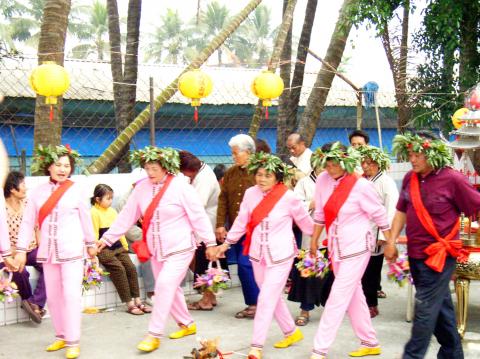
Photo: Jason Pan, Taipei Times
Still retaining the matriarchal social customs from the ancient Austronesian Pingpu culture, the main rituals, ceremonial worship service, chanting and traditional dance are all led by female shamans — an important role passed down from mother to daughter within the matriarchal line.
After the ceremony ends, visitors are invited to sit with tribal members for a banquet and toasting of rice liquor to ensure good fortune and happiness for the coming year.
If you go:
Address: Temple of Immortal Maidens (仙姑廟), Jiapaolang Hamlet (加匏朗), Sincuo Village (新厝村), Manluan Township (萬巒鄉), Pingtung County; tel, (08) 783-5127
On the Net: old.tncsec.gov.tw/wks/pt10/home.php?page=page4.php&a01=0101&c03=&wks=pt10&page_key=1810
Getting there:
By Car: Take National Highway No. 3 to Pingtung and take the Linluo (麟洛) exit to Provincial Road No. 1 to Neipu (內埔), County Road No. 187 to Wanchin (萬金). From there take the local Jiansin Road (建興路) to Sincuo Village (新厝村) and to Jiapaolang (加匏朗) Hamlet
Public Transportation: Opposite the Pingtung railway station is the bus depot. Take buses (8212, 8235 or 8236) going to Wanchin (萬金) and Gazao (佳佐) and get off at Gazao, or go to Wanchin Holy Mother Basilica (萬金聖母聖殿) and take a taxi to Jiapaolang. Buses depart at noon and in the early evening.
Ajay Verma, a consultant gastroenterologist at Kettering general hospital in Northamptonshire, says our gut is a “complex machine.” “It is constantly providing us with the nutrition we need, initially to grow and develop, and then for us to survive, thrive and repair from injury and illness.” How can we keep it functioning well? Put simply: “Make sure what you put into it is balanced, and that you clear out its waste products adequately,” Verma says. “In a general gastroenterology clinic, the most common conditions we see are irritable bowel syndrome (IBS), gastroesophageal reflux disease, inflammatory bowel disease and constipation,” says Nisha

And so, in the wake of US President Donald Trump’s trip to the People’s Republic of China (PRC), all the experts on the Strait of Hormuz suddenly became experts on US-China-Taiwan relations. The Internet has certainly expanded human knowledge. Lots of these sudden experts made noise this week about Trump’s words after the meeting with PRC dictator Xi Jin-ping (習近平). Trump is going to sell out Taiwan! Longtime Taiwan commentator J. Michael Cole summed the situation up neatly in the Guardian: “We need to keep in mind that he has a tendency to say many things — sometimes contradicting himself within

Last week US President Donald Trump was asked by a reporter whether he would speak on the phone to the President of Taiwan. “l’ll speak to him. I speak to everybody. We have that situation very well in hand,” Trump said. This marked the second time in a couple of weeks he had said he would talk to the President of Taiwan. In 2016 he famously took a call from then-president Tsai Ing-wen (蔡英文), when he was president-elect. Despite warnings that the apocalypse was nigh because of a phone call, the world quickly forgot about the conversation between two democratically-elected presidents.
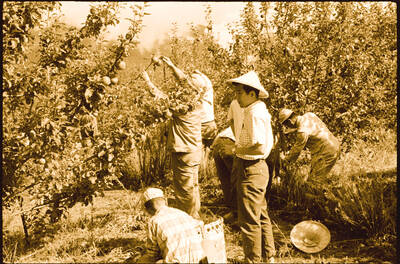
May 25 to May 31 Few believed that apples could be cultivated on a commercial scale in Taiwan’s high mountains. When horticulturalist Cheng Chao-hsiung (程兆熊) first proposed the idea in 1955, both American and Taiwanese colleagues dismissed it as implausible, arguing that temperate fruit could not be reliably grown on a subtropical island, especially on rugged terrain. However, it was this terrain in the Central Mountain Range where many Chinese Civil War veterans were resettled in the late 1950s. With limited job prospects and no family in Taiwan, they were placed on cooperative farms aimed toward self-sufficiency. Some say the conditions


 RSS
RSS