


The crowd trying to get into the new Pearl Lam Gallery was so big that people blocked all the elevators of the elegant prewar Pedder Building. A line snaked out of the lobby and down the street, past the alley where the shoe repairmen work.
Those who opted to walk up found the stairs in a serious state of disrepair. Even Magnus Renfrew, director of the ART HK fair, had to squeeze past bamboo scaffolding. Women in stilettos minced around tubs of plaster. French art dealers smoked with Chinese painters in the stairwell as if they were high school delinquents instead of art world luminaries.
The scene nicely summed up Hong Kong’s cultural ambitions: There was plenty of interest and potential, not to mention plenty of money, but the infrastructure was clearly nowhere near being done.
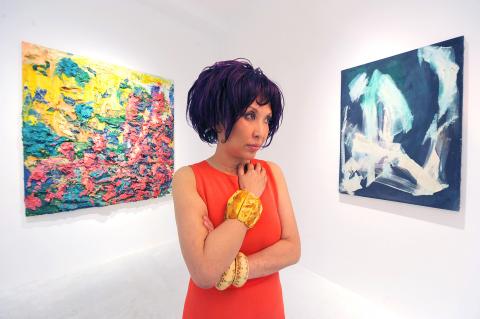
Photo: AFP
Those who made it to Pearl Lam’s (林明珠) big space six flights up were rewarded with the best gallery show this year. The art scene veteran — an eccentric, petite figure with bouffant violet hair — eschewed the trends that made contemporary Chinese art so popular.
There were no Mao caricatures, no garish rainbow shades, no cartoon faces, no cynical commentaries on modern life.
Lam put on a subdued, nuanced group show of Chinese abstract works, a breath of fresh air in a city where galleries usually go for the eye-popping. The show, “Mindmap,” which runs until July 15, was beautifully curated by Gao Minglu (高名潞), who worked closely with Paul Moorhouse of the National Portrait Gallery in London. The two collaborated on the show — which gave a gentle nod to Chinese calligraphy, ink-brush painting and landscapes — after Lam invited them on a tour of artists’ studios in Beijing, Shanghai and Chengdu in Sichuan Province.
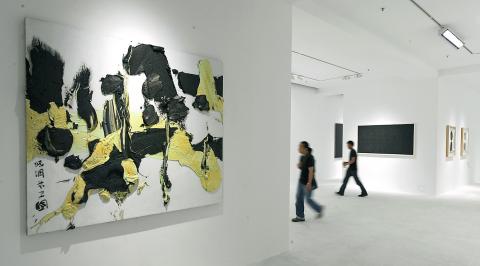
Photo: AFP
“For some time, Chinese abstraction was considered second-hand and derivative. But we have a sense of abstraction that is distinct to ourselves,” said Lam, who has long had galleries in Shanghai. “My first show had to help bring international audiences in, to help them understand a type of Chinese art that is not Pop, not political, but rooted in Chinese literati culture.”
The opening had an intellectual air that has been missing from the Hong Kong scene. Claude Hudelot, a French historian of China, arrived with a pile of the English-language version of his illustrated book, “Mao,” which had been delivered from the printer’s that morning. “This is the show to be at,” he said. “It is a piece of technical mastery.”
Hong Kong’s evolving cultural landscape experienced another seismic shift last month when five new galleries opened in a week just as ART HK was under way. (That fair has been taken over by Art Basel, which will organize it from now on.)
Much has been made of the spending power of newly moneyed Chinese collectors, at Hong Kong auctions and the fair. The strength of the art scene here, however, cannot be judged on the revenues of one five-day event, but on what is left behind after the dust settles.
Downstairs from Pearl Lam was a new addition by the London dealer Simon Lee. Lee was chatting with potential buyers next to eerie cast-bronze animals by the American artist Sherrie Levine.
Lee decided to establish a small foothold in Asia because his business in Britain was seeing increased interest from Asian buyers.
“We didn’t feel like we needed a huge space, not like in London,” he said. “We’ve always worked with collectors in some Asian countries. In Korea and Taiwan, collectors are quite sophisticated. And now, with our shows in London, we’re getting quite significant business from mainland Chinese.”
He brushed off the stereotype that new Chinese collectors had the money, but not the understanding. “I’m impressed with the way mainland Chinese engage with work that, in my ignorance, I didn’t think they would engage in,” he said.
For now, Lee represents mostly American, British and European artists. He would consider representing Asian names, but it would take time. “We see it as a dating process. We want a one-on-one relationship. We don’t want 90 artists.” He added that he wanted his gallery to be part of the local scene, and not a mere showroom. “I don’t want to be an absentee landlord,” he said.
Lam and Lee both are in the Pedder Building, which is mostly known for clothing shops but is starting to become an art destination. Gagosian, the only gallery that managed to snag an entire floor of the 1920s building, took the opportunity to hold Andreas Gursky’s first solo show in Asia, timed with the art fair and Lam’s splashy opening. Ben Brown had wonderful works by the 20th-century Italian artist Alighiero Boetti.
Also in Central, at the 50 Connaught Road high-rise, Galerie Perrotin of Paris celebrated the opening of its impressive new gallery, which has floor-to-ceiling windows looking out onto the harbor and the skyline. Spotted at the party were artists like Takashi Murakami, though the media seemed more interested in the Canto-pop star Edison Chen (陳冠希).
Security guards stood by to prevent tipsy partygoers from falling into the series of 50 seven-foot-tall paintings – looking not unlike enormous vertical blinds — by Kaws, a New York graffiti artist who created cartoony new works for the Hong Kong show. Afterward, everyone headed to the Dragon-I nightclub for a private concert by the New York band HeartsRevolution.
Bright and early the next morning, hard-core gallery-goers — or those who had not gone to bed — made their way to the oddly timed 9 a.m. “brunch opening” of the new Platform China.
Platform, whose main showrooms and studios are in Beijing, is known for cutting-edge contemporary Chinese works. Its new Hong Kong space — in Chai Wan, an industrial area whose former warehouses are increasingly being used by artists — had a much grittier feel that the international galleries opening downtown.
A few days later, a very different crowd showed up for the biggest opening in the city, at least in terms of real estate. Sotheby’s unveiled its permanent showroom at the upscale Pacific Place complex, which will allow it to conduct business year-round instead of only during auction season.
Lam was already thinking ahead to how she could improve art offerings here. Instead of showing high-priced international works, she is focusing on a summer solo show for a hot new Hong Kong artist, Tsang Kin-wah (曾建華).
“Hong Kong has a good art market,” she said. “That’s not the same as a good art scene. Next year, galleries should coordinate even more openings. It will be better next year.”

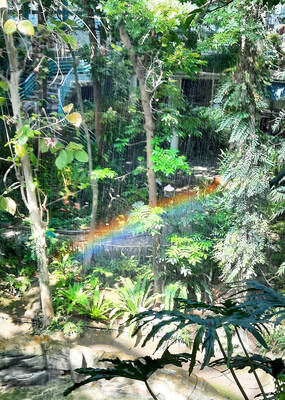
It’s only half the size of its more famous counterpart in Taipei, but the Botanical Garden of the National Museum of Nature Science (NMNS, 國立自然科學博物館植物園) is surely one of urban Taiwan’s most inviting green spaces. Covering 4.5 hectares immediately northeast of the government-run museum in Taichung’s North District (北區), the garden features more than 700 plant species, many of which are labeled in Chinese but not in English. Since its establishment in 1999, the site’s managers have done their best to replicate a number of native ecosystems, dividing the site into eight areas. The name of the Coral Atoll Zone might
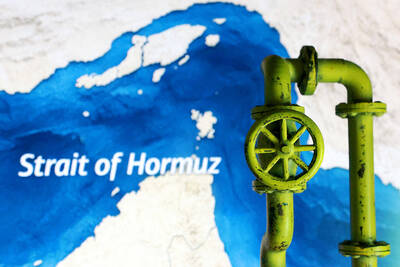
The US war on Iran has illuminated the deep interdependence of Asia on flows of oil and related items as raw materials that become the basis of modern human civilization. Australians and New Zealanders had a wake up call. The crisis also emphasizes how the Philippines is a swatch of islands linked by jet fuel. These revelations have deep implications for an invasion of Taiwan. Much of the commentary on the Taiwan scenario has looked at the disruptions to world trade, which will be in the trillions. However, the Iran war offers additional specific lessons for a Taiwan scenario. An insightful
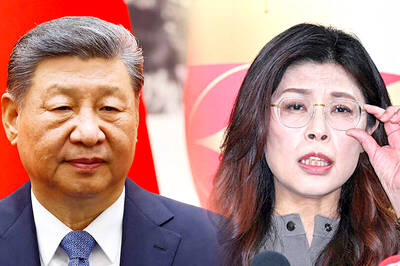
On Monday morning, in quick succession, the Chinese Communist Party (CCP) and the Chinese Nationalist Party (KMT) released statements announcing “that the Central Committee of the Communist Party of China and General Secretary Xi Jinping (習近平) have invited KMT Chairwoman Cheng Li-wun (鄭麗文) to lead a delegation on a visit to the mainland” as the KMT’s press release worded it. The KMT’s press release added “Chairwoman Cheng expressed her gratitude for the invitation and has gladly accepted it.” Beijing’s official Xinhua news release described Song Tao (宋濤), head of the Taiwan Work Office of the CCP Central Committee, as
Polling data often confirms what we expect, but sometimes it throws up surprises. When examined over time, some patterns appear that speak to something bigger going on. In this column, whenever possible, Formosa’s polls are used. Despite the sometimes cringeworthy antics of Formosa’s Chairman, Wu Tzu-Chia (吳子嘉), the data produced includes detailed breakdowns crucial for analysis. It has also been conducted monthly 11-12 times a year for many years with many of the same questions, allowing for analysis over time. When big shifts do occur between one month and the next it is usually in response to some event in


 RSS
RSS