


When Siok Siok Tan first joined Twitter in 2007, she was confused by the then-fledgling microblogging site.
“I remember in the first two weeks I was on Twitter, I had a tweet saying that Twitter is the weirdest application on the planet,” said Tan in a phone interview from Singapore. While working on a documentary about the 2008 Olympic Games, however, Tan was struck by the willingness of fellow Twitter users to help her promote the film.
“That planted the seed for the idea of making a film about Twitter, simply because I was surprised by the connections that can be made through Twitter and social media,” said Tan, whose Twitter handle is sioksiok. Her film Twittamentary screens Sunday night as the closing film of the Urban Nomad film festival.
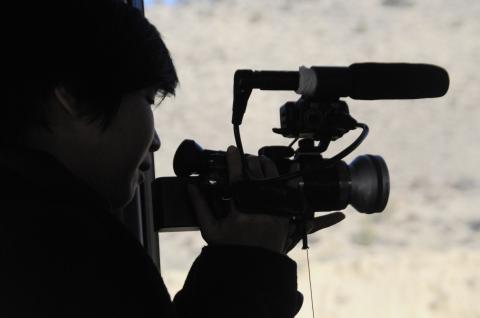
Photo courtesy of Twittamentary
Twitter has become an integral part of Internet culture since its launch in 2006 (users played a key role in enabling the Arab Spring uprisings, for example), but it still has plenty of detractors. Getting started on Twitter is not intuitive for many people, Tan noted, and once they do manage to decipher the various hashtags, acronyms and abbreviations on the site, they are put off by the stream-of-consciousness style of many Twitter feeds.
“What people struggle with is that they look at the text of what people tweet about and they think it is very trivial,” said Tan. “But what is powerful is not the text but the subtext of the connections that you build over time, and the hypertext linking you to all this information, all these windows to many worlds that you have never been granted entry to before.”
Twittamentary follows several users whose lives have been changed by Twitter. They include AnnMarie Walsh (whose Twitter handle is padschicago), a Chicago woman who used Twitter to help escape homelessness, and sex worker Mika Tan (mika_tan), who relied on followers for directions when she got lost while on her way to a strip club.
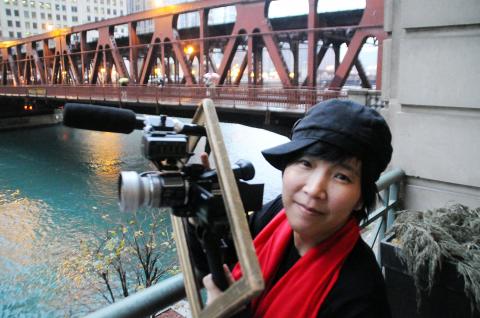
Photo courtesy of Twittamentary
The documentary’s own filming process encapsulates the possibilities of Twitter to such an extent that it was written up as a case study by a professor at Singapore Management University. Tan found most of the people she interviewed on the site, as well as key members of her crew like executive producer and camera operator Geo Geller (geogeller) and producer StJohn Deakins (StJohnDeakins), who joined the project after catching an early screening in Singapore.
“I felt intuitively that for a film about Twitter to succeed, it can’t just be a good film, it has to mirror and celebrate the open culture on Twitter,” said Tan.
A key element of each Twittamentary showing is a screen that displays tweets marked with the twittamentary hashtag. Not only can viewers see what other audience members are posting, but they can also communicate with crew members like Tan and her interview subjects.
Mirroring the content of Twitter, the twittamentary hashtag can sometimes turn into a free for all. During a screening in Tel Aviv, one user wrote “I challenge Twitter to get me laid.” In Los Angeles, tweets about the film were upbeat and numerous (pushing Twittamentary up the list of the site’s trending topics for that day), but in London they were very cynical in tone.
“We got a good review in the Guardian, but if I had looked at the tweets only, I would have wanted to slash my own wrists,” said Tan.
Though Tan and Deakins debated whether or not they should moderate the content shown on Twitter screens during each viewing of the film, they ultimately decided to leave it as a representation of the site’s open and free-spirited culture.
“There is a lot of advice on how to get more followers and represent yourself on Twitter. You can go for the more formulaic way of sharing useful quotes every day or be an expert on Chinese current affairs, things like that,” said Tan. “Or there is also the other way, in which what you are interested in may be quite niche but by being yourself you draw unexpected friendships to you, and that is an equally exciting opportunity.”

The Lee (李) family migrated to Taiwan in trickles many decades ago. Born in Myanmar, they are ethnically Chinese and their first language is Yunnanese, from China’s Yunnan Province. Today, they run a cozy little restaurant in Taipei’s student stomping ground, near National Taiwan University (NTU), serving up a daily pre-selected menu that pays homage to their blended Yunnan-Burmese heritage, where lemongrass and curry leaves sit beside century egg and pickled woodear mushrooms. Wu Yun (巫雲) is more akin to a family home that has set up tables and chairs and welcomed strangers to cozy up and share a meal
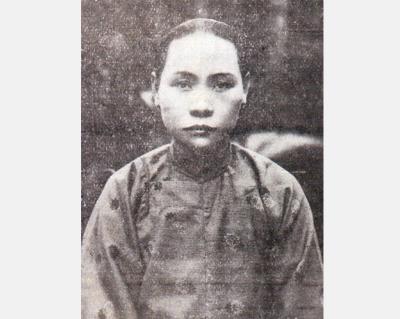
Dec. 8 to Dec. 14 Chang-Lee Te-ho (張李德和) had her father’s words etched into stone as her personal motto: “Even as a woman, you should master at least one art.” She went on to excel in seven — classical poetry, lyrical poetry, calligraphy, painting, music, chess and embroidery — and was also a respected educator, charity organizer and provincial assemblywoman. Among her many monikers was “Poetry Mother” (詩媽). While her father Lee Chao-yuan’s (李昭元) phrasing reflected the social norms of the 1890s, it was relatively progressive for the time. He personally taught Chang-Lee the Chinese classics until she entered public

Last week writer Wei Lingling (魏玲靈) unloaded a remarkably conventional pro-China column in the Wall Street Journal (“From Bush’s Rebuke to Trump’s Whisper: Navigating a Geopolitical Flashpoint,” Dec 2, 2025). Wei alleged that in a phone call, US President Donald Trump advised Japanese Prime Minister Sanae Takaichi not to provoke the People’s Republic of China (PRC) over Taiwan. Wei’s claim was categorically denied by Japanese government sources. Trump’s call to Takaichi, Wei said, was just like the moment in 2003 when former US president George Bush stood next to former Chinese premier Wen Jia-bao (溫家寶) and criticized former president Chen

President William Lai (賴清德) has proposed a NT$1.25 trillion (US$40 billion) special eight-year budget that intends to bolster Taiwan’s national defense, with a “T-Dome” plan to create “an unassailable Taiwan, safeguarded by innovation and technology” as its centerpiece. This is an interesting test for the Chinese Nationalist Party (KMT), and how they handle it will likely provide some answers as to where the party currently stands. Naturally, the Lai administration and his Democratic Progressive Party (DPP) are for it, as are the Americans. The Chinese Communist Party (CCP) is not. The interests and agendas of those three are clear, but


 RSS
RSS