


Provocative, sassy and engaging are three words that properly describe San Fransisco’s feLNLuv (aka Felicia Wang), who will be headlining 18 Group’s various venues around the country for the next two weeks.
Born in Taiwan, but relocated by her folks to the US in third grade, feLNLuv had just gotten acclimated to the life there when she returned to Taiwan for high school. “My parents wanted me to learn Chinese,” feLNLuv said. “It was very tough for me in the beginning, but I survived.”
After high school, feLNLuv moved to California and knew she wanted to be involved in the music industry.

Photo courtesy of Room 18
“I’ve always loved music. I started to play piano at the age of five. I joined my first singing competition at my high school in Taiwan and made it to the final but I didn’t win,” she said. “I then entered another signing competition here in San Francisco. I made it to the final stage again, but I didn’t win. Then I realized there was a bit of politics involved. So I decided to start modeling and make my way up in the entertainment industry. I modeled for a few year, did video hosting, video directing, and even my own events in the nightlife scene.”
After running into Tall Sasha, one of San Francisco’s preeminent DJs in the progressive and trance scene, feLNLuv decided to take some lessons and get behind the decks herself.
“My real name is Felicia and so a lot of friends they called me ‘Fel,’” she said. “In the beginning, I went by DJ Felicia Wang. Then the more involved I got with deejaying, I fell more in love with the music and people, so feLNLove was the best name I could think of that truly described myself.”
Although she started out mixing trance, feLNLuv’s repertoire has expanded.
“I was a big raver at the age of 19, so trance is one of my faves,” she said. “Last year I got more into electro, so most of the time at clubs I play a lot of the harder stuff.”
She’s done her research on the music scene in Taiwan and has gotten some advice from local residents, but feLNLuv believes Taiwanese partiers will love what they hear.
“I will go with my own style, my type of music, but at the same time feel what the crowd likes,” she said. “With the energy that I’ll be bringing, hopefully they’ll feed off it and dance. Music is like a language, sometimes. We feel it and it’s what brings our souls together.”
FeLNLuv’s performances:
‧ Tonight, grand opening of Room 18 in Greater Taichung
‧ March 26 at Barcode in Greater Kaohsiung
‧ March 30, April 6 and April 9 at Room 18 in Taipei
‧ April 1 at Room 18 in Greater Taichung
‧ April 8 at Barcode in Taipei
Room 18 Taichung is located at 38 Dachuan St, Greater Taichung (台中市大川街38號); Room 18 is located at B1, 88 Songren Rd, Taipei City (台北市松仁路88號B1); Barcode is located at 5F 88 Songren Rd, Taipei City (台北市松仁路88號5F); and Barcode Kaohsiung is located at 130, Siwei 3rd Rd, Lingya Dist, Greater Kaohsiung (高雄市苓雅區四維三路130號).
Tonight, a party crew that has been dormant for seven years, AB Koo, awakes from its slumber to spew out I七CH at Pipe. AB Koo helped popularize drum and bass and threw parties at various venues that have long been closed like Rock Candy and 2F. Now they hope to reacquaint themselves to the Taiwan massive with DJs Danjah, Umbra, @llen, Lai, Legacy, and Discoattack.
I七CH: An Evening of Drum ’n’ Bass, Dubstep, Future Garage and House Music, tonight from 10pm at Pipe, 1 Siyuan St, Taipei City (台北市思源街1號), tel: (02) 2364-8198. On the Net: www.pipemusic.com.tw. Admission is NT$350 with a drink.

Ajay Verma, a consultant gastroenterologist at Kettering general hospital in Northamptonshire, says our gut is a “complex machine.” “It is constantly providing us with the nutrition we need, initially to grow and develop, and then for us to survive, thrive and repair from injury and illness.” How can we keep it functioning well? Put simply: “Make sure what you put into it is balanced, and that you clear out its waste products adequately,” Verma says. “In a general gastroenterology clinic, the most common conditions we see are irritable bowel syndrome (IBS), gastroesophageal reflux disease, inflammatory bowel disease and constipation,” says Nisha
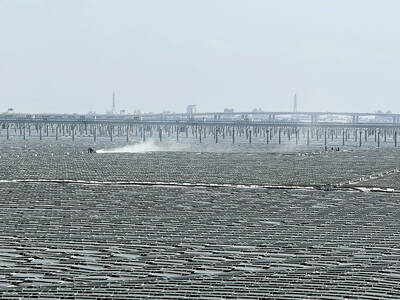
The arithmetic is straightforward and uncomfortable. By the end of 2025, Taiwan had committed itself to a 50-30-20 electricity mix — half natural gas, 30 per cent coal, 20 per cent renewables. The Ministry of Economic Affairs’s (MOEA) own monthly energy reports tell a different story. Natural gas reached 47.8 per cent of generation last year. Coal stood at 35.4 per cent, comfortably above its target ceiling. Renewables came in at 13.1 per cent, well short of the 20 per cent Taipei had pledged a decade earlier. Installed renewable capacity reached roughly half of the 12 gigawatts (GW) the government

Last week US President Donald Trump was asked by a reporter whether he would speak on the phone to the President of Taiwan. “l’ll speak to him. I speak to everybody. We have that situation very well in hand,” Trump said. This marked the second time in a couple of weeks he had said he would talk to the President of Taiwan. In 2016 he famously took a call from then-president Tsai Ing-wen (蔡英文), when he was president-elect. Despite warnings that the apocalypse was nigh because of a phone call, the world quickly forgot about the conversation between two democratically-elected presidents.

May 25 to May 31 Few believed that apples could be cultivated on a commercial scale in Taiwan’s high mountains. When horticulturalist Cheng Chao-hsiung (程兆熊) first proposed the idea in 1955, both American and Taiwanese colleagues dismissed it as implausible, arguing that temperate fruit could not be reliably grown on a subtropical island, especially on rugged terrain. However, it was this terrain in the Central Mountain Range where many Chinese Civil War veterans were resettled in the late 1950s. With limited job prospects and no family in Taiwan, they were placed on cooperative farms aimed toward self-sufficiency. Some say the conditions


 RSS
RSS