


Goober Gun, a trio composed of two brothers and a childhood friend, was named after a slime-filled squirt gun from the 1980s. While the toy has yet to resurface, the group from Southampton, England promises to drench fans with 1980s-style rock fused with pop melodies at Vicious Circle in Taipei tonight.
All three members contribute vocals and have unabashedly highlighted, fringe-heavy hairstyles.
The group is known for its lighthearted and friendly performances. Bassist Ian Hardwick began playing with drummer and older brother Tim Hardwick and guitarist Jon Reynolds aged 13.

Photo Courtesy of Goober Gun
“We all met at school and grew up together, but obviously Tim and I are brothers so I probably met him at our parents’ at some point,” Ian Hardwick said.
“We all have our roles to play within the band,” Tim Hardwick said. “Mine is to work my ass off [while] the rest take the credit.”
Front man Ian Hardwick describes Goober Gun’s sound as “classic rock with a modern twist.”

Photo Courtesy of Goober Gun
“Think Jimmy Eat World meets Def Leppard,” he said. Most of his lyrics come “from personal experiences, be that women, death or women.”
One of Goober Gun’s most pleasing songs is about the death of the Hardwicks’ grandmother who “helped the band in the early days by paying for our first recording,” Ian said. The title, Monster, “was not meant in a negative way, more in the sense of being larger than life and a powerful force.”
While touring Asia earlier this year Goober Gun had to cancel shows when Ian was hospitalized in Taiwan with a stomach virus for several weeks. “Everyone was so kind and I was really well looked after,” he said. “I’m fit now, thinner, and raring to go!”
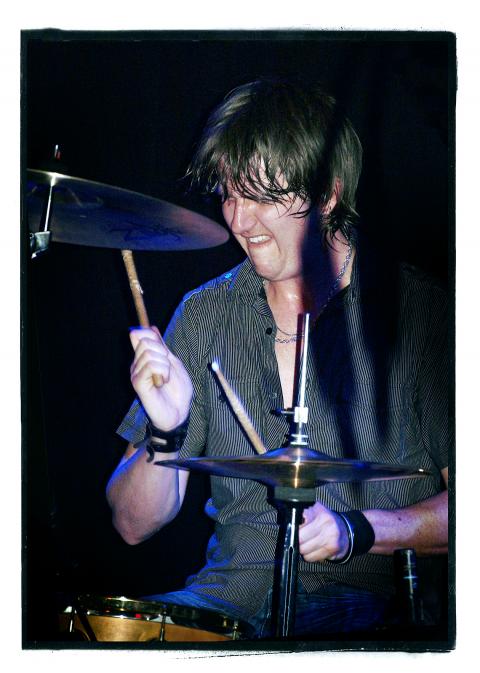
Photo Courtesy of Goober Gun
The Hardwick brothers and Reynolds have just finished a series of gigs in Thailand and plan on checking out Taiwan during their five-show tour, which starts tonight with indie synth band The Looking Glass. Tomorrow they’ll play at Emerge Live House in Taichung County, with stops in Tainan City on Wednesday, Kaohsiung on Nov. 26, and a final Taiwan gig in Taichung City on Nov. 27 before heading off to Vietnam, Thailand again, and then China.
The band is hoping to relocate to Asia more permanently if all goes well, and its Web site has been revamped in English, Thai, and Mandarin with a focus on connecting and interacting with its fan base in Asia.
Additional Shows:
Tomorrow at Emerge Live House (浮現藝文展演空間), 12, Ln 55, Sinsing Rd, Longjing Township, Taichung County (台中縣龍井鄉新興路55巷12號), tel: (04) 2631-3286; on Wednesday at the Red Wolf Tavern, 229 Gongyuan Rd, Tainan City (台南市公園路229號); Nov. 26 at Brickyard, 507, Jhongshan 2nd Rd, Cianjin Dist, Kaohsiung City (高雄市前金區中山二路507號); and a final show on Nov. 27 at 89K, 21 Daguan Rd, Nantun Dist, Taichung City (台中市南屯區大觀路21號)

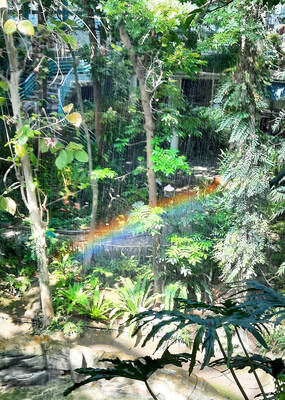
It’s only half the size of its more famous counterpart in Taipei, but the Botanical Garden of the National Museum of Nature Science (NMNS, 國立自然科學博物館植物園) is surely one of urban Taiwan’s most inviting green spaces. Covering 4.5 hectares immediately northeast of the government-run museum in Taichung’s North District (北區), the garden features more than 700 plant species, many of which are labeled in Chinese but not in English. Since its establishment in 1999, the site’s managers have done their best to replicate a number of native ecosystems, dividing the site into eight areas. The name of the Coral Atoll Zone might

The US war on Iran has illuminated the deep interdependence of Asia on flows of oil and related items as raw materials that become the basis of modern human civilization. Australians and New Zealanders had a wake up call. The crisis also emphasizes how the Philippines is a swatch of islands linked by jet fuel. These revelations have deep implications for an invasion of Taiwan. Much of the commentary on the Taiwan scenario has looked at the disruptions to world trade, which will be in the trillions. However, the Iran war offers additional specific lessons for a Taiwan scenario. An insightful

On Monday morning, in quick succession, the Chinese Communist Party (CCP) and the Chinese Nationalist Party (KMT) released statements announcing “that the Central Committee of the Communist Party of China and General Secretary Xi Jinping (習近平) have invited KMT Chairwoman Cheng Li-wun (鄭麗文) to lead a delegation on a visit to the mainland” as the KMT’s press release worded it. The KMT’s press release added “Chairwoman Cheng expressed her gratitude for the invitation and has gladly accepted it.” Beijing’s official Xinhua news release described Song Tao (宋濤), head of the Taiwan Work Office of the CCP Central Committee, as

Polling data often confirms what we expect, but sometimes it throws up surprises. When examined over time, some patterns appear that speak to something bigger going on. In this column, whenever possible, Formosa’s polls are used. Despite the sometimes cringeworthy antics of Formosa’s Chairman, Wu Tzu-Chia (吳子嘉), the data produced includes detailed breakdowns crucial for analysis. It has also been conducted monthly 11-12 times a year for many years with many of the same questions, allowing for analysis over time. When big shifts do occur between one month and the next it is usually in response to some event in


 RSS
RSS