


Although his career started off with a bang in the 1980s and fizzled out in the 1990s, Stanley Jordan still stands out among an ever-growing sea of guitar heroes.
The American jazz musician, who returned to recording and performing in 2008 after spending nearly a decade studying music therapy, performs solo in Taipei tomorrow at Riverside Live House, as part of a tour of East Asia and Russia.
Jordan remains one of a kind for his unusual “touch” technique on the guitar. Instead of strumming, he taps out notes and chords on the fretboard, almost as if he were playing a piano.

Photos by Tom Cheswick, courtesy of Mack Avenue Records
At a glance, the effect looks like a grandstanding gimmick or perhaps a non-stop, heavy-metal inspired frenzy. Yet the sound Jordan has mastered is impressive. He sounds like multiple guitarists playing at the same time, and his balance of virtuosity and soul have won him a loyal following.
Jordan, who started piano at age 7 and picked up guitar at age 11, says he developed his guitar technique because he missed “the possibilities of the piano.”
“So it’s very expressive like a guitar but it’s also orchestral like a piano,” Jordan said of his style in a telephone interview last week while on a visit to southern California. “In a way, it’s almost like a new instrument — what it feels like to me is a new instrument.”
Jordan, 51, also enjoyed a level of mainstream success rare for a jazz musician in the 1980s. One reason was his accessible repertoire. In addition to Tin Pan Alley-era songs that make up the bulk of jazz standards, he recorded and performed contemporary hits like The Lady In My Life, first recorded by Michael Jackson, Simon and Garfunkel’s Sound of Silence and Led Zeppelin’s Stairway To Heaven.
Jordan’s musical background is wide-ranging. He studied classical piano, grew up listening to rock, R ’n’ B, and blues, and immersed himself in jazz with the guitar. He later combined an interest in math and computers with music theory as a digital music major at Princeton University.
But it was busking on the streets of New York City that shaped his artistic path.
“What playing in the street really did for me, more than anything else, was it gave me a sense that my music was universal,” he said. “Because I discovered that I could play for anybody, I could play a lot of different styles of music so ... I wasn’t really sort of constrained to play any particular venue. So I started to think of my music in a broader sense.”
His career was propelled by albums like Magic Touch (1985) and Standards Vol. One (1986), which were released by Blue Note Records. Regular appearances on late night talk shows helped cement his stardom. By the 1990s, an overworked Jordan became frustrated with the “rat race” mentality of the music industry and withdrew to “explore intellectual pursuits and work on my spiritual life.”
This led him to music therapy, which he continues to study today and is working towards a master’s degree at Arizona State University. But he put his academic work on hold after releasing his first major label album in a decade, State of Nature (2008).
“To be honest, it’s not so much about the degree for me. It’s just something I’m really fascinated by and I think it’s wonderful stuff and I want to learn about it and I want to talk about it. So that’s what the degree is more about,” he said.
Jordan is an official artist spokesperson for the American Music Therapy Association, and he plays the part well during our interview. “Almost every area of health and healing can be helped by music,” he said.
Jordan says live music can be “very beneficial to people who are in difficult situations,” such as patients undergoing chemotherapy treatments for cancer.
“Singing or playing an instrument can help respiratory conditions like asthma, for example, because it opens the breathing passages and it also releases emotion,” he said.
Jordan says that music therapy has improved his own performances, as it has taught him mental preparation techniques such as meditation and how to stay better focused..
“[Music therapy] really showed me the importance of clarifying my intention,” he said. “So when I go on to the stage to play, [I ask myself] what am I doing? Am I doing this just to play a gig and make some money or am I trying to give people a profound performance?”
Jordan applied techniques from music therapy in making State of Nature, which he describes as an album that ponders environmental destruction and “the relationship between humans and the natural world.” He is currently writing a book based on a similar theme, which will be tied to his next album, slated for release next year.
Jordan says that from his perspective as a musician — he used to write his own software and uses computers in his music — he sees a similar need to address the balance between technology and spirituality.
“I remember when I had this realization, I guess I was around 13, when I realized that I was very much interested in music and in science and technology,” he said.
“Well, if I had to choose between the two, which would I choose? I decided I would go with the music if I had to choose. And the reason was because I felt that the music had this power to touch people instantly. You could make an invention and down the road it might help society — and all of that is good — but I felt that with music, the benefits are immediate and really profound. And so, I decided I would continue with the science and technology and that would go into the service of the music.”

Taiwan’s overtaking of South Korea in GDP per capita is not a temporary anomaly, but the result of deeper structural problems in the South Korean economy says Chang Young-chul, the former CEO of Korea Asset Management Corp. Chang says that while it reflects Taiwan’s own gains, it also highlights weakening growth momentum in South Korea. As design and foundry capabilities become more important in the AI era, Seoul risks losing competitiveness if it relies too heavily on memory chips. IMF forecasts showing Taiwan widening its lead over South Korea have fueled debate in Seoul over memory chip dependence, industrial policy and

“China wants to unify with Taiwan at the lowest possible cost, and it currently believes that unification will become easier and less costly as time passes,” wrote Amanda Hsiao (蕭嫣然) and Bonnie Glaser in Foreign Affairs (“Why China Waits”) this month, describing how the People’s Republic of China (PRC) is playing the long game in its quest to seize Taiwan. This has been a favorite claim of many writers over the years, easy to argue because it is so trite. Very obviously, if the PRC isn’t attacking Taiwan, it is waiting. But for what? Hsiao and Glaser’s main point is trivial,
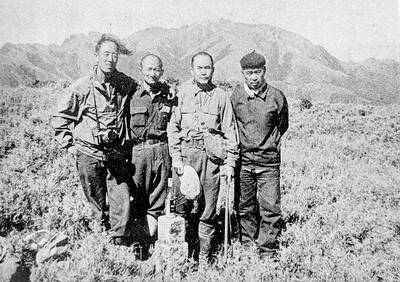
May 18 to May 24 Gathered on Yangtou Mountain (羊頭山) on Dec. 5, 1972, Taiwan’s hiking enthusiasts formally declared the formation of the “100 Peaks Club” (百岳俱樂部) and unveiled the final list of mountains. Famed mountaineer Lin Wen-an (林文安) led this effort for the Chinese Alpine Association (中華山岳協會). Working with other experienced climbers, he chose 100 peaks above 10,000 feet (3,048m) that featured triangulation points and varied in difficulty and character. The list sparked an alpine hiking craze, inspiring many to take up mountaineering and competing to “conquer” the summits. A common misconception is that the 100 Peaks represent Taiwan’s 100 tallest

The Chinese Nationalist Party (KMT), alongside their smaller allies the Taiwan People’s Party (TPP), are often accused of acting on behalf of the Chinese Communist Party (CCP). Some go so far as to call them “traitors.” It is not hard to see why. They regularly pass legislation to stymie the normal functioning of the ruling Democratic Progressive Party’s (DPP) administration, and they have yet to pass this year’s annual budget. They slashed key elements of the government’s proposed NT$1.25 trillion (US$40 billion) special military budget, and in the smaller NT$780 billion package they did pass, it is riddled with provisions that


 RSS
RSS