


You never forget your first Ed Kienholz. Mine was The Beanery in Amsterdam, a lifesize tableau of three-dimensional figures hunched over their drinks in the yellow fug of an American dive, sweaty, listless, plausibly real right down to the beer gut and drool, except that each face was a stopped clock reading 10 past 10: large as life, but vastly more melodramatic.
In the 1960s, when the work was made, you could enter the swing doors of this little hell and pass among the lifelike effigies. People say the detail was stupendous. Even when I saw it, decades later with conservators’ cordons now in place, a damp warmth exuded from within and the stench of beer was so powerful it felt as if real drink had been spilled. The opaque glint on the fried eggs indicated how long they had been waiting for trade.
True to life? Indubitably so, but no matter how realistic The Beanery seemed, you were clearly not to think it was all about ingenious facsimile. Unlike his fellow American Duane Hanson, Kienholz was by no means a hyper-realist sculptor. And unlike Hanson, he did not express complex feelings about the inner lives of his blue-collar figures.
Each Beanery face told you time was slipping away by the glass. The whole scene appeared to be oozing sticky fluids, as if the drinkers were pickling themselves. Even if you didn’t notice the horrifying Vietnam headlines on the newspaper hoarding outside, it was obvious that shock, horror, disgust, a sense of urgency — perhaps even shame — were the prescribed response. This was the melodrama of a militant moralist.
And so it is at the National Gallery, where Kienholz’s immense street scene of 1980s Amsterdam by night has been installed among the old master art, a juxtaposition that could hardly be more advantageous to his enterprise. For even those familiar with his work will surely get a jolt passing from the careful conditions of the main galleries, with their still, silent paintings, to the garish, noisy, cruddy, lifesize shocker of a peep-show that is The Hoerengracht.
The title is a blunt pun, turning the real Herengracht (gentlemen’s canal) into a whores’ canal with the addition of a single letter. But the street conjured here is really an entire district compressed into a couple of corners and some alleys. All is highly realistic to the point of actual reality — real dead leaves, silted litter, gum stains on the pavements, real china dogs on window sills and bicycles chained to racks. And in the pitch dark, red lights pullulate around doorways and glow inside the prostitutes’ windows, enticing you to peer in and see the half-naked women themselves waiting for another client.
But here the realism ends, for although the figures looking back at you are cast from the bodies of real women, and clad in actual underwear, they each have a mannequin head. The faces are highly painted, resin streaks the cheeks like still-wet tears, the eyes are wide and imploring. And if that makes you think of the sacred statues in the tremendous show of Spanish art simultaneously running in the Sainsbury Wing, then the artists (Kienholz died in 1994, but his collaborator, Nancy Reddin Kienholz, continues their work) would no doubt be pleased. For whatever else these women may be — a hybrid of waxwork, statue, dummy and doll — they are undoubtedly presented as martyrs.
The middle-aged prostitute in her ratty coat and headscarf who has to go out into the streets to scratch up some trade; the girl in her tiny cell, back turned but looking anxiously out at the world through a strategically angled mirror; the final face jammed up at the grille of her door as if imprisoned. Each is suffering, abused, entombed, and the wallpaper in one bed-sitter sings a song of lament to these women. “Darling” runs the refrain, over and again, in snow-white letters on a blood-red ground.
In short, The Hoerengracht is a highly sententious work, and not just because it puts you in the position of a client — an intention, in fact, that is effectively thwarted. Certainly, the tableau presents the women as spectacle and you as the viewer, but only in the sense of a tourist doing the Amsterdam sights. If you could walk in among them, see the world as they see it, then the effect might be different. But as it is, there is no sense of tension and whatever outrage or grief the expressions, poses, props and decor should prompt is stifled by the fairground-cum-Hammer-Horror closed shop.
This is a pity because it is so good to see Ed Kienholz in the National Gallery. Not only is he the forefather of an important generation of contemporary artists — Americans like Mike Kelley and Paul McCarthy, Europeans such as Gregor Schneider, Sarah Lucas and Mike Nelson — he is one of the great political artists of the 20th century, raging against everything from Vietnam to backstreet abortions, state asylums, police brutality, the cant of the art world itself.
But even the Dutch paintings displayed alongside The Hoerengracht in this show offer a more complex view of prostitution as a business, with its own degrees of supply and demand, volition, control and necessity. For Kienholz, the women viewed through the Amsterdam windows are no more individual than the dummies he displays: not-quite-living dolls in fragile glass boxes.

Just after 6am, I walked up to the ticket gate at Taipei Main Station and entered the Taiwan Railway platform without scanning any ticket; instead, I flashed the Sanrio Fun Rail pass on my phone to the gate worker and was admitted. I found my train and prepared to board. My destination? This very same station. I was embarking on a 13-hour journey on one of two round-the-island trains operated by ezTravel. They run each day, one counterclockwise around the island and one clockwise. They differ in a number of ways from an ordinary Taiwan Railway train and can make for

Jason Han says that the e-arrival card spat between South Korea and Taiwan shows that Seoul is signaling adherence to its “one-China” policy, while Taiwan’s response reflects a reciprocal approach. “Attempts to alter the diplomatic status quo often lead to tit-for-tat responses,” the analyst on international affairs tells the Taipei Times, adding that Taiwan may become more cautious in its dealings with South Korea going forward. Taipei has called on Seoul to correct its electronic entry system, which currently lists Taiwan as “China (Taiwan),” warning that reciprocal measures may follow if the wording is not changed before March 31. As of yesterday,
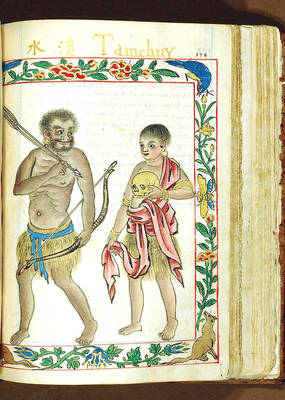
The Portuguese never established a presence on Taiwan, but they must have traded with the indigenous people because later traders reported that the locals referred to parts of deer using Portuguese words. What goods might the Portuguese have offered their indigenous trade partners? Among them must have been slaves, for the Portuguese dealt slaves across Asia. Though we often speak of “Portuguese” ships, imagining them as picturesque vessels manned by pointy-bearded Iberians, in Asia Portuguese shipping between local destinations was crewed by Asian seamen, with a handful of white or Eurasian officers. “Even the great carracks of 1,000-2,000 tons which plied

On Thursday, former Taipei mayor and founder of the Taiwan People’s Party (TPP) Ko Wen-je (柯文哲) was sentenced to 17 years in prison and had his civil rights suspended for six years over corruption, embezzlement and other charges. Seven others related to the case were also handed prison sentences, while two were found not guilty. It has been a bad week for the TPP. On Tuesday, prosecutors charged Chinese immigrant Xu Chunying (徐春鶯) with suspicion of taking part in Beijing-directed election interference. Xu has strong links to the TPP, which once offered her a party list legislator nomination. Tuesday also


 RSS
RSS