


Myriad customers, even more goods and a rare peak of sunshine set the scene on Dihua Street (迪化街) last Friday afternoon. This traditional market isn't the only place to buy New Year's necessities: Ningxia Night Market (寧夏夜市), Taipei City Mall (台北地下街) and other commercial venues are part of the Taipei Big Street New Year Shopping Festival (台北年貨大街).
During the 19-day shopping marathon, Dihua Street, the main thoroughfare, is lined with stalls and hawkers peddling nuts, candy, fried snacks, sausages, Chinese herbs and teas, preserved fruits and decorations. Goods pitched as quality imports - ice wine from Canada, Iranian dates and health food from New Zealand - add a cosmopolitan flavor, but the authenticity of the merchandise is a matter of debate.
The hub is best known for traditional items, but novelty still abounds. One vendor, for example, sings to a techno beat, touting beef jerky and fried fish at Xiahai Chenghuang Temple (霞海城隍廟), an oft-visited spot which dates back to 1859 and is home to more than 600 statues of deities.
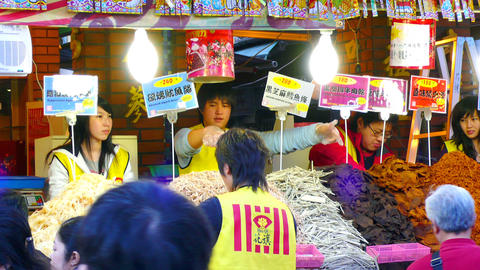
PHOTO: HO YI, TAIPEI TIMES
Despite the occasional avant-garde manifestations, though, tradition is still valued and preserved. Visitors eat their way through bins of Taiwanese sweets as traders give away samples of their wares. However, those who come back for seconds may be called out, as one shopper was. "Did you see that woman?" said a vendor, rolling his eyes and pointing a finger, "She just put all the samples in her plastic bag and left."
To accommodate serious buyers, postal and express delivery services are available to send anything that can't be carried anywhere in the world.
Besides free eats and party supplies, the street also offers a taste of yesteryear.
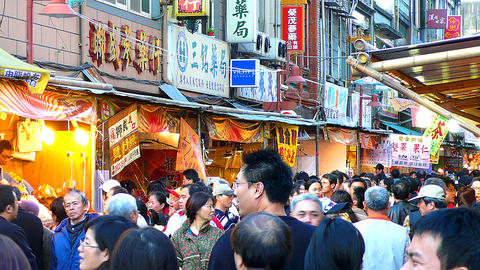
PHOTO: HO YI, TAIPEI TIMES
To look for true traditional holiday treats, one needs to step away from street stalls and into the shops steeped in history such as Lin Fu Chen Company (林復振商行). Trading traditional foodstuffs since 1853, the store is part business, part tourist attraction. It takes its trade seriously: premium abalone, shark fin, sea cucumber and snakehead fish roe (烏魚子) stacked up on the shelves can fetch up to NT$18,500 per jin (斤, or 600g).
Qian Yuan Hang (乾元行), a Chinese medicine store, is a textbook example of the colonial Baroque architecture of the Japanese period, which has been in operation for more than a century. This time of year, though, business is slow.
"Lunar New Year holiday is a low season for us since old people follow the taboo of not taking medicine during this time of the year," one of the shop staff explained.
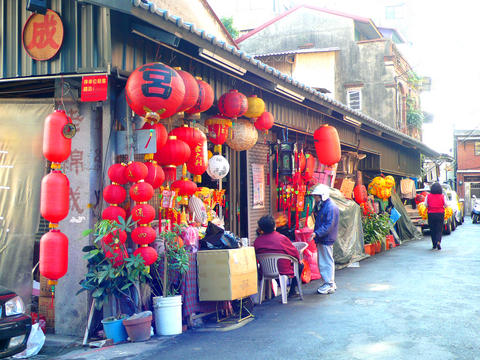
PHOTO: HO YI, TAIPEI TIMES
Many other Chinese medicine stores, however, try to minimize profit loss by branching out to sell holiday specialties such as dried mushrooms, dried jellyfish (海蜇皮), Chinese herbs, grains, nuts and other nutritious items.
On Guisui Street (歸綏街), which intersects Dihua Street the holiday racket ceases. Here, time takes its toll on incense shops, lantern and oil stores, farming-implement businesses and a poultry depot reminiscent of Fujian-style architecture and the Western-style two-story buildings dating back to the 1860s.
One of the few businesses that draws holiday shoppers on the northern section of the street is Li Ting Hsiang Bakery (李亭香餅舖), which has become famous for traditional pastries over the last 60 years.
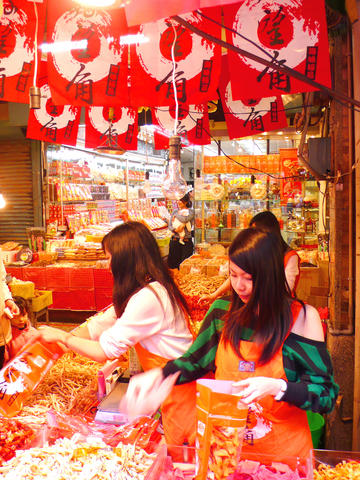
PHOTO: HO YI, TAIPEI TIMES
Provender and history aside, performances add to the festival cheer and keep the shoppers entertained. The playbill (available in full at www.2008tpe-bigstreet.tw) announces glove puppet shows, ballroom and belly dancing, tea appreciation lessons as well as cooking demonstrations that will take place on the plaza in front of the Yongle Market building (永樂市場), Dadaocheng Park (大稻埕公園) on Guisui Street and the square at Taipei City Mall starting today.
While Dihua Street satisfies the appetite, Huayin Street between Chongqing North (重慶北路) and Taiyuan (太原路) Roads looks after appearances: clothes, shoes, leather goods and accessories are the themes here. At the commercial circle behind Taipei Main Train Station (後火車站商圈), located on Chongqing N Road between Changan West (長安西路) and Zhengzhou (鄭州路) roads, stores supply general merchandise - toys, clothing, bling, ornaments and cosmetics. Both places are wholesale markets and will appeal to bargain hunters.
The easiest way to get around the shopping zones is by MRT. The Shuanglian, Taipei Main Station and Zhongshan stations are the nearest exits. A special Lunar New Year Shop-Around bus, number 518, runs through the Neihu District, Minsheng East and West roads and Taipei Main Station to drop shoppers off at the doors of commercial venues.
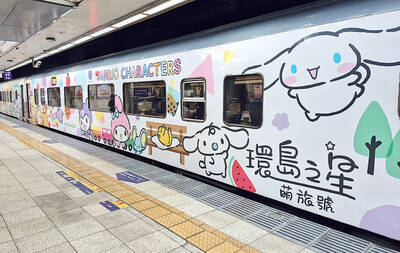
Just after 6am, I walked up to the ticket gate at Taipei Main Station and entered the Taiwan Railway platform without scanning any ticket; instead, I flashed the Sanrio Fun Rail pass on my phone to the gate worker and was admitted. I found my train and prepared to board. My destination? This very same station. I was embarking on a 13-hour journey on one of two round-the-island trains operated by ezTravel. They run each day, one counterclockwise around the island and one clockwise. They differ in a number of ways from an ordinary Taiwan Railway train and can make for
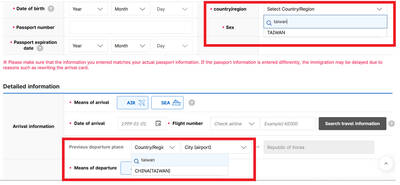
Jason Han says that the e-arrival card spat between South Korea and Taiwan shows that Seoul is signaling adherence to its “one-China” policy, while Taiwan’s response reflects a reciprocal approach. “Attempts to alter the diplomatic status quo often lead to tit-for-tat responses,” the analyst on international affairs tells the Taipei Times, adding that Taiwan may become more cautious in its dealings with South Korea going forward. Taipei has called on Seoul to correct its electronic entry system, which currently lists Taiwan as “China (Taiwan),” warning that reciprocal measures may follow if the wording is not changed before March 31. As of yesterday,
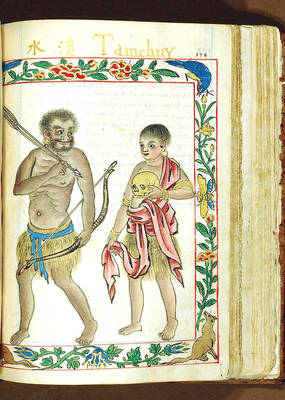
The Portuguese never established a presence on Taiwan, but they must have traded with the indigenous people because later traders reported that the locals referred to parts of deer using Portuguese words. What goods might the Portuguese have offered their indigenous trade partners? Among them must have been slaves, for the Portuguese dealt slaves across Asia. Though we often speak of “Portuguese” ships, imagining them as picturesque vessels manned by pointy-bearded Iberians, in Asia Portuguese shipping between local destinations was crewed by Asian seamen, with a handful of white or Eurasian officers. “Even the great carracks of 1,000-2,000 tons which plied
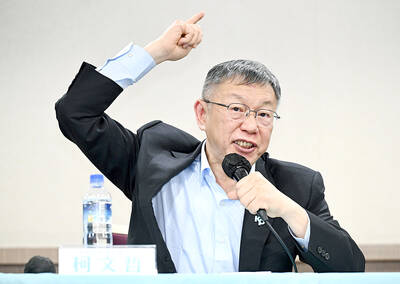
On Thursday, former Taipei mayor and founder of the Taiwan People’s Party (TPP) Ko Wen-je (柯文哲) was sentenced to 17 years in prison and had his civil rights suspended for six years over corruption, embezzlement and other charges. Seven others related to the case were also handed prison sentences, while two were found not guilty. It has been a bad week for the TPP. On Tuesday, prosecutors charged Chinese immigrant Xu Chunying (徐春鶯) with suspicion of taking part in Beijing-directed election interference. Xu has strong links to the TPP, which once offered her a party list legislator nomination. Tuesday also


 RSS
RSS