


Skip Snow, a federal biologist in Everglades National Park, would love to spend his days monitoring the dizzying array of native wildlife across this 607,000-hectare "river of grass" west of the ever-expanding Miami metropolis.
Lately, however, he has been spending ever more time studying the remains of the park's birds and animals, extracted from the stomachs of captured or road-killed Burmese pythons, the latest - and most spectacular - addition to Florida's growing list of biological interlopers.
Opening a packed freezer in a park laboratory, Snow sifted dated plastic bags containing fur, feathers, bones and other vestiges of recent python prey.
PHOTOS: NY TIMES NEWS SERVICE
"We've found everything, from very small mammals - native cotton mice, native cotton rats, rabbits, squirrels, possums, raccoons, even a bobcat, most recently the hooves of a deer," Snow said. "Wading birds and water birds, pipe-billed grebes, coots, egrets, limpkins and at least one big alligator."
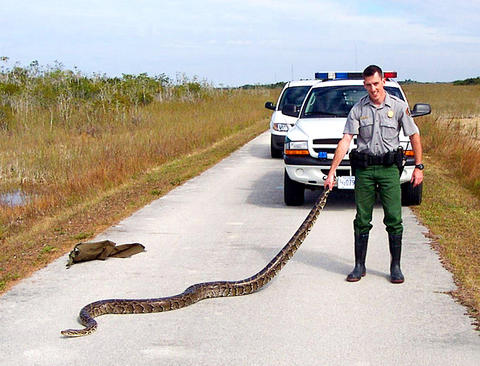
The South Asian snakes, which can top 90kg and 6m, probably entered the park as discards or escapees from the bustling global trade in exotic pets. Year-old, 30cm-long pythons are a popular US$70 item at reptile fairs and on the Web but in a few years can reach room-spanning, cat-munching size, prompting some owners to abandon them by the roadside. That practice may not pose an ecological problem in Detroit, Snow said, but in a near-tropical Florida park, it is an unfolding nightmare.
Some very rough estimates put the state's pet python population above 5,000. More than 350 have been found in the park since 2002, with others showing up in mangroves along Florida's west coast and farther north in the state. There are perhaps 10 more for every one that is seen, Snow said.
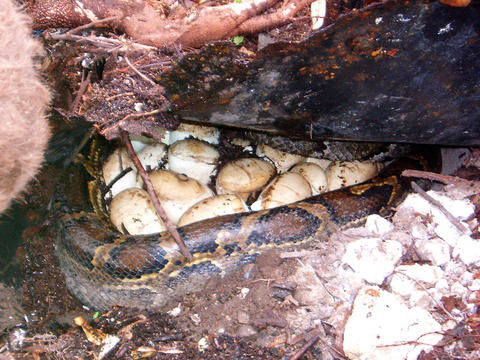
Last May, biologists confirmed that Everglades pythons were not a transient curiosity when they found the first eggs. "There were 46 eggs, 44 fertile," Snow said. Shortly afterward, they found another clutch of two dozen, already hatched.
Signs abound, he said, that the pythons are still colonizing new terrain. "This is a species that is really made for invading."
Snow and other wildlife biologists have been on something of a crusade of late, pressing federal and state governments to crack down on the trade in such species, quicken responses when an invader appears in the wild and expand federal preventive screening to identify - ahead of time - imported animals and plants that are most apt to spread in this country.
While there is a National Invasive Species Council whose membership includes cabinet-level officials, the grunt work of preventive species screening is done by a handful of biologists at the Fish and Wildlife Service, the Department of Agriculture and the Department of Health and Human Services.
The vast majority of the US$1 billion or so the government spends each year on invasive species goes to managing existing problems, with about 10 percent, according to a recent government report, going to prevention. In the meantime, the government estimates that invasive species cost the economy US$100 billion a year.
The python may be a marquee-quality "spokes-snake" for invasive species, Snow said, but it is hardly alone in its potential - once established - to disrupt ecosystems and pose a possible threat to people and the economy. Along with hundreds of accidental immigrants like zebra mussels, there have been innumerable intentionally imported plants and animals that have become vexing, expensive problems. Once they are noticed, it is almost always too late, or too costly, to eradicate them, experts say.

Still, such species tend to become a priority only after the fact, biologists say. It was not until this year that a new Florida law established a list of six "reptiles of concern" (including the python). The state will soon require US$100-a-year owners' permits and the insertion of identifying microchips under the skin of the purchased pets.
This year, the South Florida Water Management District petitioned the federal Fish and Wildlife Service to add Burmese pythons to a list of "injurious wildlife" maintained under the 107-year-old Lacey Act.
David Lodge, the director of the Center for Aquatic Conservation at the University of Notre Dame, has been an author on a series of recent studies of the issue, including a position paper last year from the Ecological Society of America pressing for much stronger federal investment and action.
"When it comes to importing live organisms, our policies are entirely reactive," Lodge said. "It's as if in the drug realm we were to allow any new drug or food product on the market until it kills someone and then consider a regulation to ban it."
With invasive species, though, the situation is actually potentially worse, he said, because banning them after the fact does not eliminate the threat.
As Snow put it, "Invasives are the gift that keeps on giving, because of the biological imperative to reproduce."
While Snow is hunting whatever pythons he can find and pushing for new laws and more money for preventive programs, he is also working at the grassroots level.
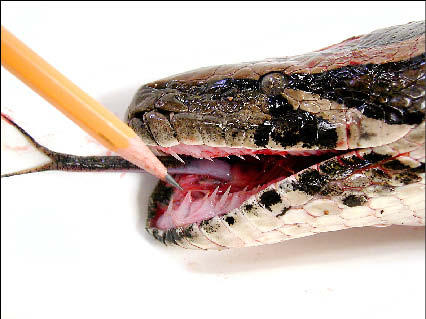
In frequent slide presentations to community groups, he pulls no punches, describing how the snakes seize prey with small sharp teeth and suffocate it with muscular coils. There are several recorded deaths of pet owners in the US strangled or suffocated by pythons.
One slide says: "Do you really want a snake that may grow more than 6m long or weigh 90kg, urinate and defecate like a horse, live more than 25 years and for whom you will have to kill mice, rats and, eventually, rabbits?"

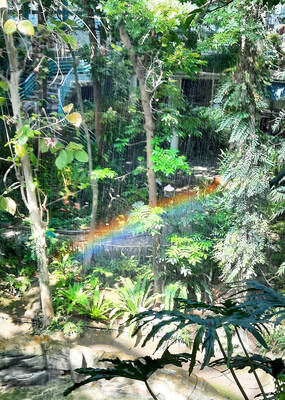
It’s only half the size of its more famous counterpart in Taipei, but the Botanical Garden of the National Museum of Nature Science (NMNS, 國立自然科學博物館植物園) is surely one of urban Taiwan’s most inviting green spaces. Covering 4.5 hectares immediately northeast of the government-run museum in Taichung’s North District (北區), the garden features more than 700 plant species, many of which are labeled in Chinese but not in English. Since its establishment in 1999, the site’s managers have done their best to replicate a number of native ecosystems, dividing the site into eight areas. The name of the Coral Atoll Zone might

The US war on Iran has illuminated the deep interdependence of Asia on flows of oil and related items as raw materials that become the basis of modern human civilization. Australians and New Zealanders had a wake up call. The crisis also emphasizes how the Philippines is a swatch of islands linked by jet fuel. These revelations have deep implications for an invasion of Taiwan. Much of the commentary on the Taiwan scenario has looked at the disruptions to world trade, which will be in the trillions. However, the Iran war offers additional specific lessons for a Taiwan scenario. An insightful

On Monday morning, in quick succession, the Chinese Communist Party (CCP) and the Chinese Nationalist Party (KMT) released statements announcing “that the Central Committee of the Communist Party of China and General Secretary Xi Jinping (習近平) have invited KMT Chairwoman Cheng Li-wun (鄭麗文) to lead a delegation on a visit to the mainland” as the KMT’s press release worded it. The KMT’s press release added “Chairwoman Cheng expressed her gratitude for the invitation and has gladly accepted it.” Beijing’s official Xinhua news release described Song Tao (宋濤), head of the Taiwan Work Office of the CCP Central Committee, as

Polling data often confirms what we expect, but sometimes it throws up surprises. When examined over time, some patterns appear that speak to something bigger going on. In this column, whenever possible, Formosa’s polls are used. Despite the sometimes cringeworthy antics of Formosa’s Chairman, Wu Tzu-Chia (吳子嘉), the data produced includes detailed breakdowns crucial for analysis. It has also been conducted monthly 11-12 times a year for many years with many of the same questions, allowing for analysis over time. When big shifts do occur between one month and the next it is usually in response to some event in


 RSS
RSS