


Martin Scorsese won the top honor from the Directors Guild of America for his mob saga The Departed, moving him a step closer to finally receiving Hollywood's biggest filmmaking prize at the Academy Awards.
Scorsese was chosen as filmmaker of the year by his peers on Saturday, his first win at the guild awards after six previous nominations. The guild winner usually goes on to win the best-director Oscar.
The self-deprecating Scorsese said he was pleased at the apparent success of the film but that he only became convinced it was doing well when the studio called with box-office revenues from the first couple of weekends.
"If you look at the graph at the spikes at where the picture is doing really great figures, it's like looking at a veritable map of the American underworld," such as Boca Raton, Florida, Scorsese said. "Vegas, forget about it, it was amazing." Adapted from the Hong Kong crime thriller Infernal Affairs, The Departed stars Leonardo DiCaprio as a cop who is undercover in a Boston crime outfit, Matt Damon as a mob mole who has infiltrated the police, and Jack Nicholson as the merciless gang leader pulling everyone's strings.
It has become Scorsese's biggest commercial hit, and critics praised it as a welcome return to the vivid, bloody crime genre whose modern conventions the director helped pioneer in such films as Taxi Driver and Goodfellas. "I started watching his work when I was 15 years old," said DiCaprio, who has starred in Scorsese's last three films and introduced the director to the guild audience earlier in the evening. "It was like entering a seamless cinematic reality." Walter Hill won the guild's directing honor for TV movies for the Western Broken Trail. Other TV winners included Richard Shepard for comedy directing on the pilot episode of Ugly Betty, Jon Cassar for drama directing for an episode of 24, and Chicago filmmaker Rob Marshall for musical variety directing for Tony Bennett: An American Classic. Arunas Matelis won for feature-film documentary for Before Flying Back to the Earth, a portrait of children hospitalized with leukemia. The film won over two Oscar nominees, Deliver Us From Evil and Iraq in Fragments. The Departed marked Scorsese's sixth nomination for best director at the Academy Awards, an honor that also has eluded him. A sixth loss at the Oscars would put Scorsese in the record books as the filmmaker with the most nominations without winning.
But many awards watchers feel this is Scorsese's year, labeling him the front-runner for the Feb. 25 Oscars. A Directors Guild win helps give him the inside track.
The guild prize is a solid forecast for who might win the directing honor at the Academy Awards. Only six times in the 58-year history of the guild awards has the winner failed to go on to receive the directing Oscar.
The other guild nominees were Bill Condon for the musical Dreamgirls, Jonathan Dayton and Valerie Faris for the road-trip tale Little Miss Sunshine, Stephen Frears for the British palace saga The Queen and Alejandro Gonzalez Inarritu for the multinational ensemble drama Babel. Scorsese, Mexico native Inarritu and Frears, a Briton, were the only three of the five guild nominees who also earned best-director slots for the Oscars. The other Oscar nominations went to Clint Eastwood for the World War II epic Letters From Iwo Jima and Paul Greengrass for the Sept. 11 docudrama United 93. Dreamgirls had been viewed as a potential best-picture favorite at the Oscars, but it missed out on a nomination, as did director Condon. With Condon out of the race, Scorsese's path to Oscar victory could prove a bit easier.
Scorsese was coy backstage when asked if it was his year to win at the Oscars. "I don't know," Scorsese said. "It's good to have a nomination, especially for this picture."

Taiwan’s overtaking of South Korea in GDP per capita is not a temporary anomaly, but the result of deeper structural problems in the South Korean economy says Chang Young-chul, the former CEO of Korea Asset Management Corp. Chang says that while it reflects Taiwan’s own gains, it also highlights weakening growth momentum in South Korea. As design and foundry capabilities become more important in the AI era, Seoul risks losing competitiveness if it relies too heavily on memory chips. IMF forecasts showing Taiwan widening its lead over South Korea have fueled debate in Seoul over memory chip dependence, industrial policy and
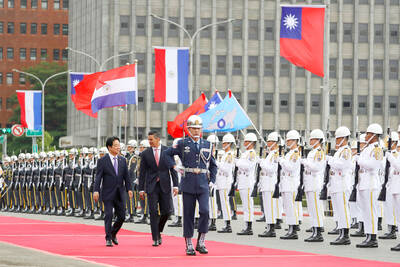
“China wants to unify with Taiwan at the lowest possible cost, and it currently believes that unification will become easier and less costly as time passes,” wrote Amanda Hsiao (蕭嫣然) and Bonnie Glaser in Foreign Affairs (“Why China Waits”) this month, describing how the People’s Republic of China (PRC) is playing the long game in its quest to seize Taiwan. This has been a favorite claim of many writers over the years, easy to argue because it is so trite. Very obviously, if the PRC isn’t attacking Taiwan, it is waiting. But for what? Hsiao and Glaser’s main point is trivial,
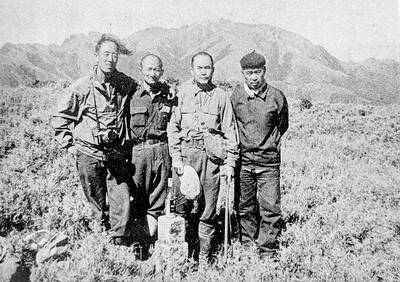
May 18 to May 24 Gathered on Yangtou Mountain (羊頭山) on Dec. 5, 1972, Taiwan’s hiking enthusiasts formally declared the formation of the “100 Peaks Club” (百岳俱樂部) and unveiled the final list of mountains. Famed mountaineer Lin Wen-an (林文安) led this effort for the Chinese Alpine Association (中華山岳協會). Working with other experienced climbers, he chose 100 peaks above 10,000 feet (3,048m) that featured triangulation points and varied in difficulty and character. The list sparked an alpine hiking craze, inspiring many to take up mountaineering and competing to “conquer” the summits. A common misconception is that the 100 Peaks represent Taiwan’s 100 tallest

The Chinese Nationalist Party (KMT), alongside their smaller allies the Taiwan People’s Party (TPP), are often accused of acting on behalf of the Chinese Communist Party (CCP). Some go so far as to call them “traitors.” It is not hard to see why. They regularly pass legislation to stymie the normal functioning of the ruling Democratic Progressive Party’s (DPP) administration, and they have yet to pass this year’s annual budget. They slashed key elements of the government’s proposed NT$1.25 trillion (US$40 billion) special military budget, and in the smaller NT$780 billion package they did pass, it is riddled with provisions that


 RSS
RSS