


If you think the famed jadeite cabbage with insects is the National Palace Museum's (NPM) most treasured possession then the Grand View: Painting, Calligraphy and Ju Ware from the Northern Song Dynasty and Song Dynasty Rare Books (大觀—北宋書畫、汝窯、宋版圖書) exhibition starting Monday and running through March 25 will come as a revelation. To celebrate the completion of extensive renovations, the NPM is putting on an exhibition of rarely seen treasures from the Northern Song (960-1127) and Southern Song Dynasties (1127-1279), a high point of China's civilization.
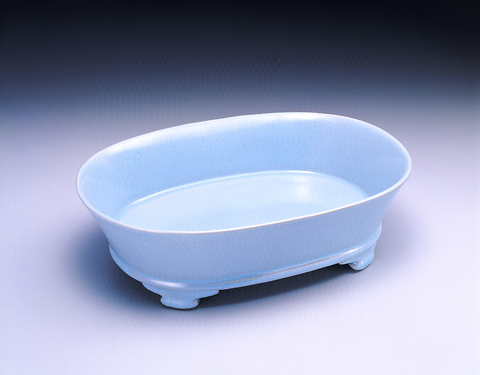
The biggest draw of the exhibition is the museum's 21 pieces of Ju ware as only 70 examples of the extremely rare celadon glazed ceramic survive. Fired at the Ju kiln located at the Chingliang Temple in Paofeng County, Henan Province (河南省寶豐縣清涼寺) during the reigns of emperors Zhezong (哲宗) and Huizong (徽宗) — 1086 to 1106 — Ju ware was made for the imperial family and quickly became collectors' items due to its rarity and peerless artistry.
One of the unique characteristics of Ju ware is its greenish-blue glaze, which sparkles faintly with a rose pink luster that is said to resemble the color of the sky after rain stops and clouds break through. The technological innovations that enabled ceramicists to use celadon glaze are considered great advancements in ceramic firing. The spurs that separated the wares from the saggar, or box made of fireclay in which delicate ceramic pieces are fired, only left tiny marks the size of sesame seeds at the work's base and allowed the glaze to cover virtually the whole vessel.
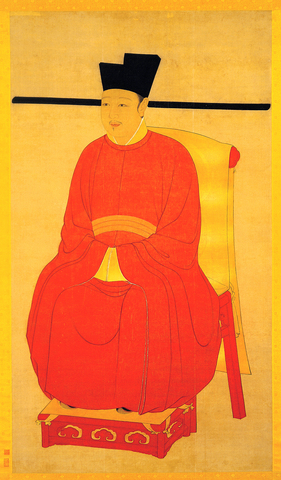
PHOTOS COURTESY OF THE NATIONAL PALACE MUSEUM
While most Ju ware has cracks on the surface, a feature much appreciated by connoisseurs, the exhibition has a single example of a plain narcissus planter without any marks. It is considered the highest achievement in Chinese ceramic history. Other vessels show how foreign influences from neighboring kingdoms such as the Korean peninsula were incorporated into Chinese art.
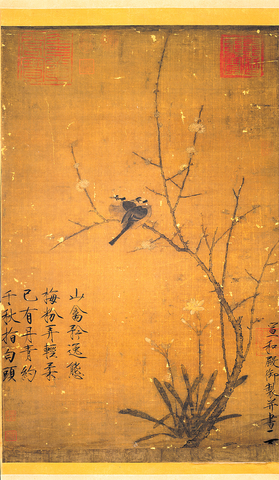
It is commonly agreed that Chinese painting reached its maturity during the Northern Song Dynasty and established a foundation that remained little changed for centuries after.
The NPM's exhibition includes Travelers Among Mountains and Streams (谿山行旅圖), Early Spring (早春) and Windy Pines Among a Myriad Valleys (萬壑松風圖). These important and rarely shown paintings are "distant views from multiple focal points," a style employed by Northern Sung landscape painters to emphasize the grandeur of mountains and the harmonious relation between nature and humans.
In the case of calligraphy, the pursuit of technical perfection devoid of artists' personality gave way to the expression of individual language on inner thoughts and emotions, resulting in personalized styles that set Northern Song calligraphy apart from that of previous times.
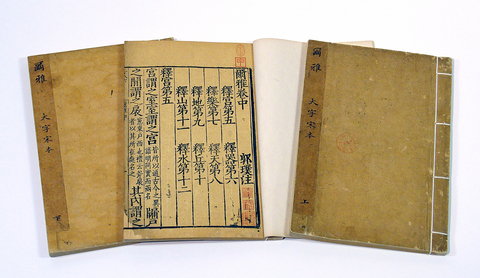
Woodblock printing technology also made great strides during this period. Not only did central and local governments expended considerable efforts in editing and printing books on Confucian classics, official histories of previous dynasties and tomes of classified compilations, scholars would also have their writings and works of their ancestors printed in "private print editions" while bookshops made profit-oriented imprints for those preparing to take civil service examinations. The sudden rise of demand for Buddhist scriptures also prompted many temples to raise funds for woodblock printings of sutras. Again, it was during this time that the foundations of later printing were laid down. The fragility of these works means that they are rarely displayed.
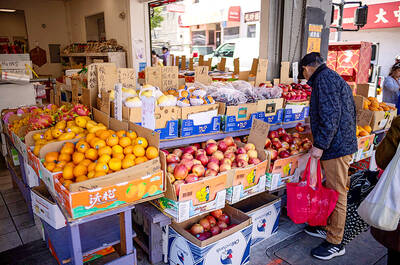
Ajay Verma, a consultant gastroenterologist at Kettering general hospital in Northamptonshire, says our gut is a “complex machine.” “It is constantly providing us with the nutrition we need, initially to grow and develop, and then for us to survive, thrive and repair from injury and illness.” How can we keep it functioning well? Put simply: “Make sure what you put into it is balanced, and that you clear out its waste products adequately,” Verma says. “In a general gastroenterology clinic, the most common conditions we see are irritable bowel syndrome (IBS), gastroesophageal reflux disease, inflammatory bowel disease and constipation,” says Nisha
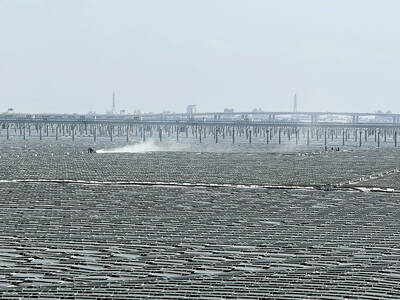
The arithmetic is straightforward and uncomfortable. By the end of 2025, Taiwan had committed itself to a 50-30-20 electricity mix — half natural gas, 30 per cent coal, 20 per cent renewables. The Ministry of Economic Affairs’s (MOEA) own monthly energy reports tell a different story. Natural gas reached 47.8 per cent of generation last year. Coal stood at 35.4 per cent, comfortably above its target ceiling. Renewables came in at 13.1 per cent, well short of the 20 per cent Taipei had pledged a decade earlier. Installed renewable capacity reached roughly half of the 12 gigawatts (GW) the government

Last week US President Donald Trump was asked by a reporter whether he would speak on the phone to the President of Taiwan. “l’ll speak to him. I speak to everybody. We have that situation very well in hand,” Trump said. This marked the second time in a couple of weeks he had said he would talk to the President of Taiwan. In 2016 he famously took a call from then-president Tsai Ing-wen (蔡英文), when he was president-elect. Despite warnings that the apocalypse was nigh because of a phone call, the world quickly forgot about the conversation between two democratically-elected presidents.
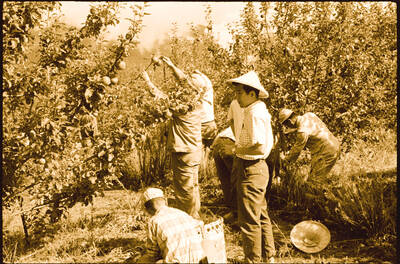
May 25 to May 31 Few believed that apples could be cultivated on a commercial scale in Taiwan’s high mountains. When horticulturalist Cheng Chao-hsiung (程兆熊) first proposed the idea in 1955, both American and Taiwanese colleagues dismissed it as implausible, arguing that temperate fruit could not be reliably grown on a subtropical island, especially on rugged terrain. However, it was this terrain in the Central Mountain Range where many Chinese Civil War veterans were resettled in the late 1950s. With limited job prospects and no family in Taiwan, they were placed on cooperative farms aimed toward self-sufficiency. Some say the conditions


 RSS
RSS