


Boots banked his Cessna Cardinal RG a half-kilometer above the sapphire surf of Southern California.
He’d raced motorcycles and flown all over the world. But for this 60-year-old pilot from North Hills, nothing quite matched the view of the zillion-dollar Malibu coast.
“This is why people love to fly,” said Boots, his legal name, over the intercom of one of the smoothest aircraft in the skies.

PHOTO: NY TIMES NEWS SERVICE
“Nice. Comfortable. It’s like a privilege — something few people in the world can do.”
The airborne exhilaration that inspired Yankees pitcher Cory Lidle is shared by thousands of amateur pilots at Van Nuys Airport, the nation’s biggest general-aviation airport, and other airfields around the San Fernando Valley.
While aviators concede there is danger to their hobby, regulations have minimized flight hazards over populated areas.
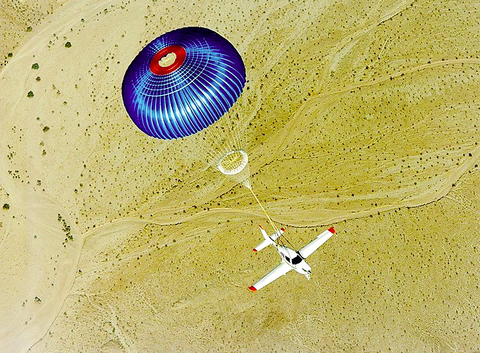
PHOTO: AFP
Lidle and a flight instructor died Wednesday when their single-engine plane crashed into a New York City high-rise.
The pitcher had talked often of his love for flying as an escape from professional ball.
“No matter what’s going on in your life, when you get up in that plane, everything’s gone,” Lidle had said in an interview.
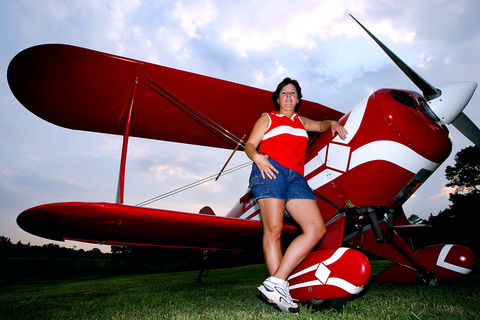
PHOTO: NY TIMES NEWS SERVICE
At Van Nuys Airport on Thursday, pilots awaited the results of the Lidle crash investigation. They also pointed out the relative safety of general aviation — and their exuberance for flight.
“It’s like driving a car and in most cases even easier, and less dangerous,” said Boots, a certified instructor and top-rated airplane mechanic. “But it takes a great deal more knowledge and ability in case of a problem.
“In a car, it’s simply stop and call for help. In the air, it’s fix it and solve the problem in flight.”

PHOTO: AP
Boots, whose pristine plane bears his cowboy boots logo, learned to fly 25 years ago, having never stepped foot in an airplane.
With an instructor by his side, he had mimicked the dual controls: hand on the yoke, feet on the rudder, eyes on the prop as the engine rumbled to life.
“Your adrenaline’s pumping — I’d never been in an airplane in my life. Trepidation. Man wasn’t meant to fly, he was meant to ride motorcycles,” he recalled.
But man was meant to fly.
And before long the 25-year-old businessman was throttling forward — the Cessna 150’s front wheel lifting off the tarmac — and suddenly airborne at 104kph.
“It’s like magic,” beamed Boots. “For the first time, you’re flying.”
Now, he floats over Lake Balboa, following a turquoise necklace of swimming pools, before tipping his wings over the Hollywood Hills and making his way past Malibu mansions and over Simi Valley before making a perfect landing at Van Nuys Airport.
The US has more than 600,000 pilots, 200,000 aircraft and 19,000 landing facilities, according to the Federal Aviation Administration.
Last year at Van Nuys Airport, there were 728 aircraft, of which 428 are piston-driven, according to airport officials.
Private planes make up 77 percent of America’s air traffic.
Last year, those pilots and planes were involved in more than 1,600 accidents, down from nearly 2,600 accidents 20 years ago. Last year, crashes killed 557 private pilots and their passengers, plus five people on the ground. In 1986, a total of 967 people were killed.
Last year, 20 commercial airline passengers and crew died in the US.
“There is an ongoing concern about mid-air collisions over the Valley and this area,” said Gerald Silver, president of Homeowners of Encino, which takes an interest in airport issues. “But I wouldn’t think there is an exorbitant fear here because the planes are in FAA radio tower control.”
At 6am each day, 20-year-old Kevin LaRosa Jr. flies over snarled freeways of Los Angeles reporting the gridlock for Traffic.com.
But what really rocks the manager of Jet Copters Co. is flying the World War II vintage North American P-51D warbird, valued at US$1.2 million, parked in his company hangar at Van Nuys Airport.
The polished fighter, with its 1,500hp V-12 engine, can hit 724kph as it dives toward Earth.
“When the engine revs, you can’t hear yourself think,” said LaRosa, who has flown with his father since he was in diapers. “It really does feel like the top of the world. When you’re on a roll, it’s like the world is circling you.”
For Carmelina Nucci, who learned to fly from a grass strip in Canada and mowed grass in exchange for lessons, it’s a love affair with the clouds.
“My real love, my true passion, is doing aerobatics over Santa Paula with cool music piped into my headset,” said Nucci, a neonatal and intensive care nurse in La Crescenta.
“That’s pretty close to flirting with the sky.”
Len Moore first took off from a cornfield as a 16-year-old kid in Iowa. Now 72, he’s almost got his pilot certification.
He said flying his restored 1946 Ercoupe in US Army Air Corps trim is “indescribable.” Now he hops to airports up and down the coast for “US$100 hamburgers.”
“I [had] trepidations about the whole thing at first,” said Moore.
“It’s a feeling of, ‘I can do this.’ All you can hear is your heart pounding.”
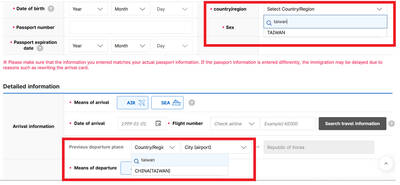
Jason Han says that the e-arrival card spat between South Korea and Taiwan shows that Seoul is signaling adherence to its “one-China” policy, while Taiwan’s response reflects a reciprocal approach. “Attempts to alter the diplomatic status quo often lead to tit-for-tat responses,” the analyst on international affairs tells the Taipei Times, adding that Taiwan may become more cautious in its dealings with South Korea going forward. Taipei has called on Seoul to correct its electronic entry system, which currently lists Taiwan as “China (Taiwan),” warning that reciprocal measures may follow if the wording is not changed before March 31. As of yesterday,
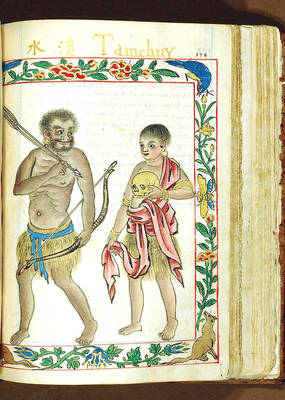
The Portuguese never established a presence on Taiwan, but they must have traded with the indigenous people because later traders reported that the locals referred to parts of deer using Portuguese words. What goods might the Portuguese have offered their indigenous trade partners? Among them must have been slaves, for the Portuguese dealt slaves across Asia. Though we often speak of “Portuguese” ships, imagining them as picturesque vessels manned by pointy-bearded Iberians, in Asia Portuguese shipping between local destinations was crewed by Asian seamen, with a handful of white or Eurasian officers. “Even the great carracks of 1,000-2,000 tons which plied
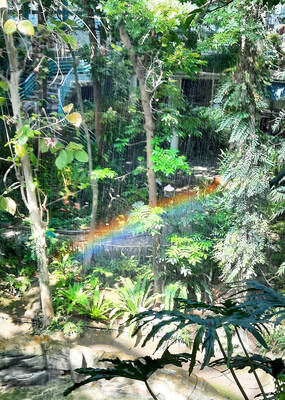
It’s only half the size of its more famous counterpart in Taipei, but the Botanical Garden of the National Museum of Nature Science (NMNS, 國立自然科學博物館植物園) is surely one of urban Taiwan’s most inviting green spaces. Covering 4.5 hectares immediately northeast of the government-run museum in Taichung’s North District (北區), the garden features more than 700 plant species, many of which are labeled in Chinese but not in English. Since its establishment in 1999, the site’s managers have done their best to replicate a number of native ecosystems, dividing the site into eight areas. The name of the Coral Atoll Zone might
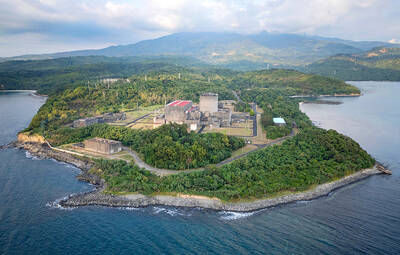
Nuclear power is getting a second look in Southeast Asia as countries prepare to meet surging energy demand as they vie for artificial intelligence-focused data centers. Several Southeast Asian nations are reviving mothballed nuclear plans and setting ambitious targets and nearly half of the region could, if they pursue those goals, have nuclear energy in the 2030s. Even countries without current plans have signaled their interest. Southeast Asia has never produced a single watt of nuclear energy, despite long-held atomic ambitions. But that may soon change as pressure mounts to reduce emissions that contribute to climate change, while meeting growing power needs. The


 RSS
RSS