


The Golden Melody Awards (金曲獎), the annual celebration of Taiwan's music industry, rarely offers many surprises when the nominations are announced. This year, how-ever, was different. High on the list of nominees was Aboriginal activist/folksinger Kimbo, also known as Hu De-fu (胡德夫), who was named in six categories, including Best Male Singer, Best Chinese-Language Album, Best Lyricist and Best Composer.
It's not that Kimbo 56, is a stranger to either the music industry or to the Golden Melody awards. He's been singing for decades, as a child outside Taitung, in church choirs, in college and on stages around the country. He has also been to the Golden Melody awards before. He served as a judge two years ago and last year he appeared as a special guest at the ceremony.
The main reason his nomi-nations were so surprising is that the CD, In a Flash, for which the singer was nominated, was the Puyuma singer's first album.
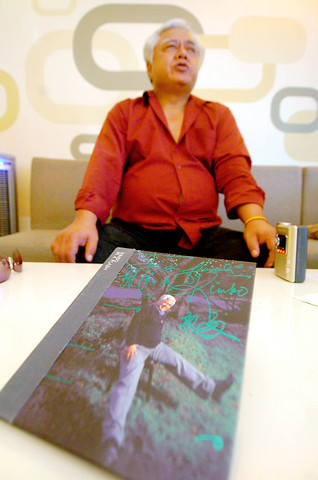
PHOTO: SEAN CHAO, TAIPEI TIMES
The 12-track CD includes many of the songs that made Kimbo famous -- or in the eyes of the former Chinese Nationalist Party (KMT) government, infamous -- for, including Meilidao (美麗島, Formosa).
After Kimbo premiered Meilidao at the 1977 funeral of his friend, the composer Lee Shuang-tze (李雙澤), it quickly became popular with students and political activists. But after the 1979 Kaohsiung Incident, the song was firmly linked -- at least by KMT officials -- with the banned Formosa magazine, and Meilidao was blacklisted.
Kimbo found himself in the same situation -- he and his music blacklisted from the radio and TV. But he continued to perform in small cafes, at rallies, and he kept writing songs -- songs for the Northern Students Alliance (a group of Aboriginal university students), for the Aboriginal miners killed in the 1984 Haishan mining disaster, for the Tao people fighting construction of a nuclear waste dump on Lanyu Island.
He stepped up his political work. In 1982 he helped found the Minority Affairs Council and became its convener; two years later he helped establish the Alliance of Taiwan Aborigines, which pushed for the nation's native peoples to be called "Aborigines" instead of the derogatory "Mountain People."
But the years of political struggle took their emotional toll, while his years as a rugby player in high school and university and the resulting injuries, exacted an equally heavy toll on his body. He suffered major back problems and ended up needing a walker or crutches to get around. Despite the pain rugby has caused him, Kimbo remembers his glory days on the field with great pride.
"I loved it. I was fast!," he said. "If I could have died on the field I would have died happy."
He thought about dying, about committing suicide, several years ago after his physical pain and depression drove him back to Taitung.
"I couldn't walk, couldn't sing anymore. I left Taipei with my two youngest kids," he said. "I wasn't Kimbo anymore, so I just wanted to sit on the beach with the sun and the sand."
"I had some dynamite ... put it on my stomach and was ready [to light it]," he said.
But it was the young people of his tribe who got him going again.
"When I was at the bottom of my life I saw the young men; I saw them working on their art, I saw them work together to face the future of their own village." he said. "They called me `National father of our people.' I was very touched.'"
"I thought that if I come out from the bottom of this valley, I will have my songs. For Aborigines, our songs come from our daily life, our daily work. It's not about our personal life, not about friendships, not about women," he said. "If I hadn't been that low, I wouldn't have gotten strong songs. I prayed to God to let me sing again."
He also learned a lot from his elders, especially Difeng (郭英男), who gained worldwide fame when one of his songs was sampled by the German group Enigma and became the theme for the Atlanta Olympics.
"Even when I couldn't walk, I insisted on being carried to Difeng's side. I learned so much from him, not just his words, but from his eyes, his attitude," Kimbo said.
He began his return to his musical career after the 9/21 Earthquake, when he put together a group of young Aborigines to perform in the quake-ravaged villages of the Central Mountain Range. His friends encouraged him to keep singing, and several got together to get an old piano for his apartment so he could work out some new material.
When asked about his musical influences, Kimbo mentions Difeng, his mother, Miss Taylor -- his Canadian-born English teacher at Tamkang Middle School in Danshuei -- but most of all his grandfather.
"He sang a lot. He sang so much, he was so alive to our form, so close to how a person reacts ... so close to the spiritual. My grandfather was the `bluesiest' person. I tell my friends that my people have been singing for a thousand years already," he said.
He also likes the traditional African-American spirituals, which he first heard on a record from Miss Taylor's collection, and which inspired him to form a quartet with three other Aboriginal boys at school.
He is self-taught on the guitar and the piano and never learned to read music. In fact he has a deeply felt aversion to "formal" music, a dislike that goes back to his childhood, when he remembers being told by his teachers that his people's singing wasn't really music.
"I refused to believe what they told our people, that our [Aboriginal] music in the mountains wasn't music. Our mamas went to night school to learn Chinese and to learn `music,' so they had to learn `DoReMiFa.' But they were so upset. There is no hymn or song higher than our songs ... We sing to the creator when we go to get water, to have a better millet harvest. How can you say that that is not music? Kimbo asked.
"So I can't read music, I just have my own scale," he said.
"I just try to finger the songs out on the piano. That gave me the habit of closing my eyes [when playing]," he said.
When asked about the Golden Melody nominations, Kimbo said he was embarrassed.
He said it felt funny because so many younger singers have worked so hard to develop their own style and their careers, and here comes this old guy who had to be talked into returning to his music, to the stage and into doing the album.
But he is hoping to take home one award.
"If I am going to win, I want it to be for best album because my friends [the Wild Fire Music Troupe and others ] worked so very hard on it," he said.
And he is already thinking about making another CD.
"I over-recorded for this one. There are another 10 songs [recorded] already. But it's very important for me to listen to the young people. I would like to write some new songs -- about 2006, about the last 10 years. This would be a good thing, to talk with the young guys," he said.
"Even now, I can't believe it [the CD], that it's not too late for me. That's what our young people have taught me -- just stand up and release what you have."
"I call my album `a small suspended bridge,'" he said, a shaky bridge that spans the decades of his life and carries him toward the younger generation of Aboriginal musicians.

Just after 6am, I walked up to the ticket gate at Taipei Main Station and entered the Taiwan Railway platform without scanning any ticket; instead, I flashed the Sanrio Fun Rail pass on my phone to the gate worker and was admitted. I found my train and prepared to board. My destination? This very same station. I was embarking on a 13-hour journey on one of two round-the-island trains operated by ezTravel. They run each day, one counterclockwise around the island and one clockwise. They differ in a number of ways from an ordinary Taiwan Railway train and can make for
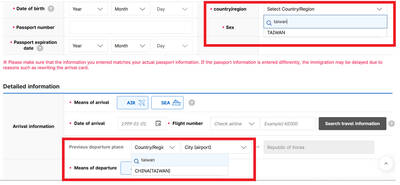
Jason Han says that the e-arrival card spat between South Korea and Taiwan shows that Seoul is signaling adherence to its “one-China” policy, while Taiwan’s response reflects a reciprocal approach. “Attempts to alter the diplomatic status quo often lead to tit-for-tat responses,” the analyst on international affairs tells the Taipei Times, adding that Taiwan may become more cautious in its dealings with South Korea going forward. Taipei has called on Seoul to correct its electronic entry system, which currently lists Taiwan as “China (Taiwan),” warning that reciprocal measures may follow if the wording is not changed before March 31. As of yesterday,
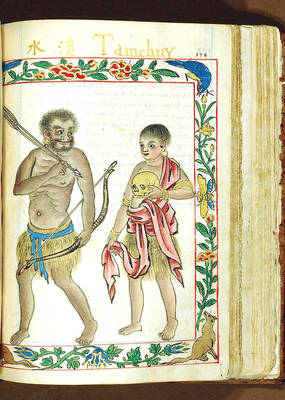
The Portuguese never established a presence on Taiwan, but they must have traded with the indigenous people because later traders reported that the locals referred to parts of deer using Portuguese words. What goods might the Portuguese have offered their indigenous trade partners? Among them must have been slaves, for the Portuguese dealt slaves across Asia. Though we often speak of “Portuguese” ships, imagining them as picturesque vessels manned by pointy-bearded Iberians, in Asia Portuguese shipping between local destinations was crewed by Asian seamen, with a handful of white or Eurasian officers. “Even the great carracks of 1,000-2,000 tons which plied

On Thursday, former Taipei mayor and founder of the Taiwan People’s Party (TPP) Ko Wen-je (柯文哲) was sentenced to 17 years in prison and had his civil rights suspended for six years over corruption, embezzlement and other charges. Seven others related to the case were also handed prison sentences, while two were found not guilty. It has been a bad week for the TPP. On Tuesday, prosecutors charged Chinese immigrant Xu Chunying (徐春鶯) with suspicion of taking part in Beijing-directed election interference. Xu has strong links to the TPP, which once offered her a party list legislator nomination. Tuesday also


 RSS
RSS