


Forget the fancy retirement condo in Florida. Mo and Lin Moser traded their Denver home for a US$1 million recreational vehicle (RV) and four places to park it -- spots worth US$80,000 to US$500,000 each -- at several high-end RV parks around the US.
The RV world was once populated mostly by vacationers who rented spots at modest, woodsy campgrounds. Today, some RV owners are also buying -- rather than renting -- places to park their vehicles, and sometimes with amenities like concierge and room service and full-time tennis instructors.
Many of these parks are more akin to resorts than campgrounds, with manicured lawns and waterfalls, security guards, golf courses, tennis courts, health spas, live entertainment, yoga classes and coffee shops. The price for a parking spot may run from US$75,000 to US$750,000.
PHOTOS: NY TIMES NEWS SERVICE
"Baby boomers are coming in, and they are looking for more," said Linda Profaizer, president of the National Association of RV Parks and Campgrounds, in Falls Church, Virginia. "They want to be entertained. And they need a place to park their big rigs."
High-end RVs, priced from US$175,000 to US$2 million, have become the fastest-growing segment of the industry, although they still account for just a small slice of the overall market. The most recent available data shows that sales of such vehicles grew 19.8 percent from 2002 to 2003, according to the Recreational Vehicle Industry Association.
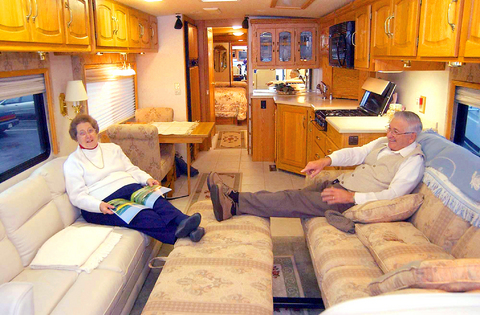
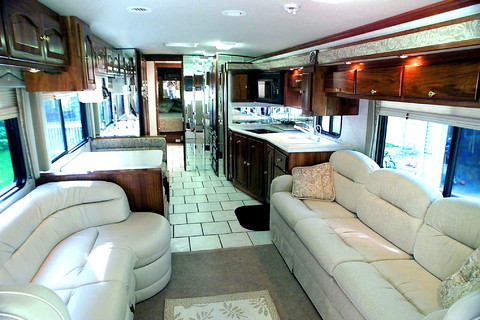
Ten years ago, most of the biggest RVs were around 9.1m long; today they are 13.7m. Some of these rigs, which have quieter diesel engines, have high-speed Internet, satellite television, washing machines, gas fireplaces, hardwood floors and built-in garages for canoes and motorcycles.
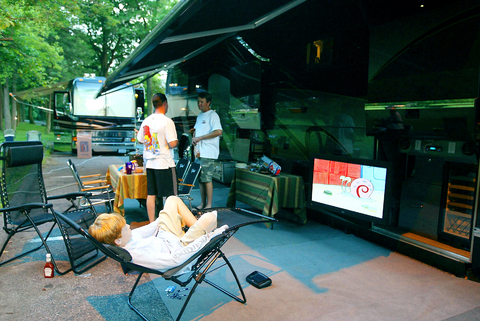
The Mosers didn't cut corners on their RV, which has marble floors and six television sets -- including one that pops out of the exterior for outdoor channel surfing. "It's about as high-end as you can get," Moser said. "It's got all the luxuries of a pretty nice home."
The Mosers bought two RV properties in Breckenridge, Colorado, one in Palm Springs, California, and one in Newport, Oregon, but they are far from just investments. Rather, the couple wanted to buy what Moser called "the RV lifestyle," and the convenience of having several home sites where they know other people. "It's the friendships, the camaraderie," said Moser, 70, a retired real estate developer. "There is always someone to visit and chat with."
One of the couple's future nesting spots will be at Desert Shores Resorts in Palm Springs, where a 650-square-meter RV pad and a private casita are under construction. By the end of the year, they hope to enjoy the casita -- a small building with a private garage, full kitchen, bathroom, closets and living space, as well as a private patio and a private swimming pool.
As sales of luxury vehicles climb, one RV maker, the Monaco Coach Corp, wants to use the driver-owned parks as a way to increase demand for its products. Monaco, of Coburg, Oregon, created a division to develop RV parks with Outdoor Resorts of America and has two under way -- in Indio, California, and Las Vegas, with RV pads selling for US$160,000 to US$330,000 each. The Indio resort, which uses the Outdoor Resorts name, has a restaurant, room service and private docks for electric motorboats.
And across the street from the Indio site, Outdoor Resorts of America is selling spots for US$82,000 to US$275,000 at its own park, called Outdoor Resort Indio. Buyers, screened to ensure that their RVs are no shorter than 13.7m, get unlimited golf privileges and access to full-time tennis and golf instructors; water aerobics classes; a health spa with body wraps and hair and nails services; and a lodge for bingo and dances. Robert Schoellhorn, a former pharmaceutical executive, owns Outdoor Resorts of America as well as Marathon Coach, another RV maker based in Coburg.
Outdoor Resorts of America is building similar parks in California, Oregon, Florida, North Carolina and Missouri.
"There is more money out there, and people want a bit of a different vacation," said Robert Schoellhorn Jr., the son of Schoellhorn and the company's vice president.
Less expensive options still exist. A resort called Whispering Aspen, which opened last summer in Fairplay, Colorado, is appealing to a more low-key buyer, with its RV pads priced at US$50,000 and US$60,000. It offers more traditional RV activities like fishing and hiking, but it recently added a 836-square-meter lodge with a spa, Internet room, pools, hot tubs and a nine-hole putting green.
Thomas Lutes, the marketing director of Whispering Aspen, said that many people bought because they had trouble finding parking spots at campgrounds during the holidays and the summer. Some places are simply too crowded; others limit a visitor's stay to perhaps a couple of weeks, and some RV enthusiasts want to stay longer. In addition, many older campgrounds are not equipped with the concrete pads needed to handle the larger, pricier RVs, which weigh as much as 22.5 tons.
Sometimes buying a lot "is the only way to get that camping experience," said Profaizer of the RV park association. "Down in the Keys in Florida, it's very difficult to find a place to go camping."
More park owners, seeing land prices soar in many vacation hot spots, are selling instead of renting individual RV pads to consumers as a way to reap the financial rewards of their properties without selling the entire park outright.
Still, for buyers, putting tens of thousands of dollars into a spot at an RV park may be risky, said Jim Miller, an investment adviser in Columbiana, Ohio. Before buying, he said, owners should make sure that they are committed enough to the RV life to keep the property several years and that they want to keep returning several times a year.
Resale value will be determined by resort amenities, upkeep and other RV neighbors -- things that may be out of the owner's control. There are also homeowner association regulations about what can be done with a lot. "The RV you can sell, but the lot you're not going to be able to sell to someone who wants to build a house," Miller said.
Individual owners must pay property taxes, some utilities and homeowner association fees that may range from US$100 to US$400 a month and cover water and sewer services, trash pickup and maintenance of the common areas. At many resorts, buyers can rent their lots to visitors when they are not there, through the resort's management company. The company may typically get 40 percent of the daily rental charges, which can run from US$20 to US$100 a night. Individual owners must report income for tax purposes.
Some people join the RV brigade without fully retiring. Three years ago, Fred and Betsy Williamson, both in their 50s, grew weary of their corporate jobs, shed many of their belongings and sold their Phoenix home for US$170,000. Then they bought a 12.2m RV for the same price, as well as a US$92,000 lot at the Tiger Run Resort in Breckenridge.
The two now work at the municipal bus department and in a medical center during the winters in Breckenridge, where they enjoy the resort's hot tubs, swimming pools and lodge. In the summer they rent their lot for three weeks a month, at US$50 a night, and keep 60 percent of the revenue, with the management company receiving the rest. During those periods, they stay at other RV parks and find jobs nearby. Williamson said the rental income helped to offset the US$190 monthly dues, US$70 monthly electricity bills and US$1,200 in annual property taxes.
"We have no regrets," he said. "We've got a mobile cabin. We can go just about anyplace and stay for a while."

Ajay Verma, a consultant gastroenterologist at Kettering general hospital in Northamptonshire, says our gut is a “complex machine.” “It is constantly providing us with the nutrition we need, initially to grow and develop, and then for us to survive, thrive and repair from injury and illness.” How can we keep it functioning well? Put simply: “Make sure what you put into it is balanced, and that you clear out its waste products adequately,” Verma says. “In a general gastroenterology clinic, the most common conditions we see are irritable bowel syndrome (IBS), gastroesophageal reflux disease, inflammatory bowel disease and constipation,” says Nisha
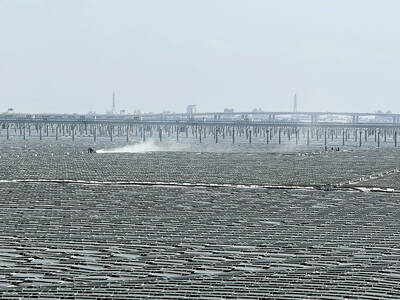
The arithmetic is straightforward and uncomfortable. By the end of 2025, Taiwan had committed itself to a 50-30-20 electricity mix — half natural gas, 30 per cent coal, 20 per cent renewables. The Ministry of Economic Affairs’s (MOEA) own monthly energy reports tell a different story. Natural gas reached 47.8 per cent of generation last year. Coal stood at 35.4 per cent, comfortably above its target ceiling. Renewables came in at 13.1 per cent, well short of the 20 per cent Taipei had pledged a decade earlier. Installed renewable capacity reached roughly half of the 12 gigawatts (GW) the government

Last week US President Donald Trump was asked by a reporter whether he would speak on the phone to the President of Taiwan. “l’ll speak to him. I speak to everybody. We have that situation very well in hand,” Trump said. This marked the second time in a couple of weeks he had said he would talk to the President of Taiwan. In 2016 he famously took a call from then-president Tsai Ing-wen (蔡英文), when he was president-elect. Despite warnings that the apocalypse was nigh because of a phone call, the world quickly forgot about the conversation between two democratically-elected presidents.
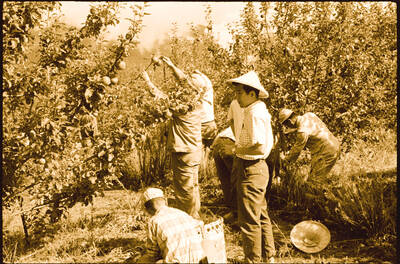
May 25 to May 31 Few believed that apples could be cultivated on a commercial scale in Taiwan’s high mountains. When horticulturalist Cheng Chao-hsiung (程兆熊) first proposed the idea in 1955, both American and Taiwanese colleagues dismissed it as implausible, arguing that temperate fruit could not be reliably grown on a subtropical island, especially on rugged terrain. However, it was this terrain in the Central Mountain Range where many Chinese Civil War veterans were resettled in the late 1950s. With limited job prospects and no family in Taiwan, they were placed on cooperative farms aimed toward self-sufficiency. Some say the conditions


 RSS
RSS