


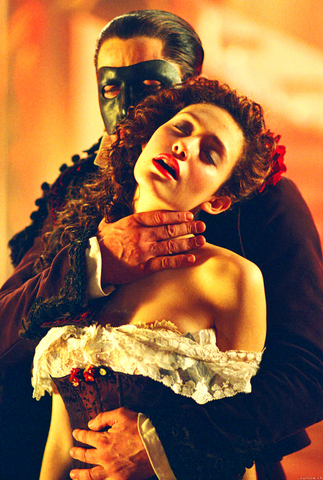
You won't find its picture in the playbill but it's no less a star of the show. The chandelier that crashes onto the stage in the first act of The Phantom of the Opera has delighted -- and frightened -- audiences for nearly 20 years. So when the producers of the giant production set to open next Wednesday at the National Theater held a press conference earlier this week, it's no surprise they decided to let the one-tonne lamp take center stage.
"It's definitely a highlight of the show," said Richard Martin, the technical director for the production. "Phantom has been running a long time and everyone knows the chandelier is going to come crashing down, but it'll still make some people scream."
Dozens of reporters craned their necks to the catwalk and the cue was given. The giant fixture comes unhinged over the audiences' heads and they breathe a collective gasp punctuated by the sound of banging brass and tinkling glass as the chandelier makes its abrupt entrance downstage center.
"I didn't know it hung over our heads," one reporter said.
The chandelier is one of the ways that Phantom continues to captivate audiences and made the musical Sir Andrew Lloyd Webber's most successful. An estimated 80 million people have bought tickets to listen to The Music of the Night for a total of over US$3 billion in box office receipts. Its original recording is the biggest-selling cast album in history. And though it opened in London 20 years ago this coming September and will mark its 18th Broadway anniversary at the end of this month, it shows no sign of giving up the ghost.
For many the thrill of Phantom is its songs and story, for others it's the spectacle, of which the crashing chandelier is only one part. While much of the action takes place in the Paris Opera, audiences are also taken to its roof and to the labyrinth of tunnels beneath it. It all happens in 22 scene changes, 230 costumes put on and taken off, 281 candles burned and 250kg of dry ice spewed through 10 smoke machines.
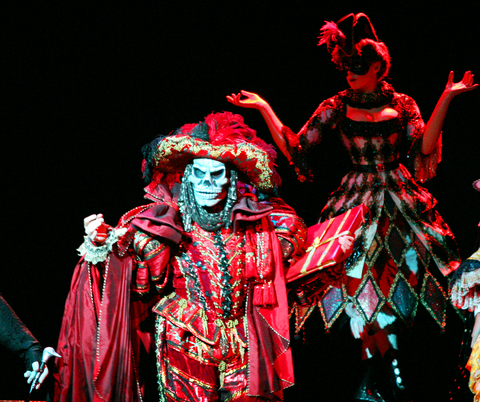
It's a Herculean effort that puts 60 crew members to work each performance. No less than 14 of whom help the dozens of cast members change costumes. An additional 20 people joined the crew in the first week to help load the set into the theater. It came from the airport to the CKS Memorial Hall in 22 trucks after arriving at the airport in two Boeing 747 cargo jets.
And is it, as many have wondered, the same show that audiences elsewhere have seen?
"It's the same show that you'll see anywhere in the world," Martin said of the technical aspects he oversees. "For me the joy of bringing this to a place like Taipei is that it's not compromised in any way, shape or form. There's no compromising here." You might expect Martin's own fascination with the show to be getting the contents of those two jets from one country to another and from theater to theater. Instead, he says it's in what went into filling the jets in the first place.
"The thing that makes Phantom magical is the package," he said. "By that I mean Andrew Lloyd Webber's music, Gaston Leroux's story, Maria Bjornson's set design, Hal Prince's direction, Andrew Bruce's sound design, Andrew Bridge's lighting. The original creative team spent many years refining this before it got to the stage ... The complete package they put together is what creates the magic for Phantom." Asked how many performances of Phantom he's overseen, Martin instead counts the years.
"I spent nine years in Australia and New Zealand, 12 months in South Africa ... and another eight months in Shanghai and Seoul. Eight shows a week ..." he said. "Of course there has been time off, but ... a lot [of performances]." Actors are often a superstitious lot and Martin says the company in Taipei is no exception.
"We have people that have to wear the same slippers before every show or the same dressing gown," he said. "We have others who will go through the stage door walking forward but leave it walking backward; all kinds of superstitions." He said he has no superstitions of his own, nor are anyone's superstitions more pronounced for bringing a "ghost" story to the stage.
Martin will next lead the production crew to Hong Kong, where the show will run from June through August.
Performance Notes:
What: The Phantom of the Opera
Where: The National Theater at CKS Memorial Hall (adjacent Aiguo E and Zhongshan S Rds.)
When: Wednesday, Jan 18 through Sunday, March 12.
Tickets: Higher and lower-priced tickets are sold out for all performances, but mid-range tickets (NT$1,800 and NT$1,900) remain for most dates. Call 02 2341-9898 or visit http://phantom.ntch.edu.tw/ for details.
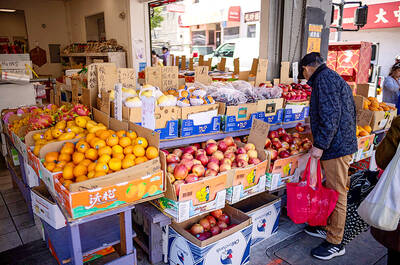
Ajay Verma, a consultant gastroenterologist at Kettering general hospital in Northamptonshire, says our gut is a “complex machine.” “It is constantly providing us with the nutrition we need, initially to grow and develop, and then for us to survive, thrive and repair from injury and illness.” How can we keep it functioning well? Put simply: “Make sure what you put into it is balanced, and that you clear out its waste products adequately,” Verma says. “In a general gastroenterology clinic, the most common conditions we see are irritable bowel syndrome (IBS), gastroesophageal reflux disease, inflammatory bowel disease and constipation,” says Nisha
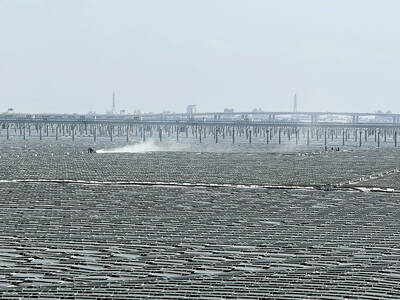
The arithmetic is straightforward and uncomfortable. By the end of 2025, Taiwan had committed itself to a 50-30-20 electricity mix — half natural gas, 30 per cent coal, 20 per cent renewables. The Ministry of Economic Affairs’s (MOEA) own monthly energy reports tell a different story. Natural gas reached 47.8 per cent of generation last year. Coal stood at 35.4 per cent, comfortably above its target ceiling. Renewables came in at 13.1 per cent, well short of the 20 per cent Taipei had pledged a decade earlier. Installed renewable capacity reached roughly half of the 12 gigawatts (GW) the government

Last week US President Donald Trump was asked by a reporter whether he would speak on the phone to the President of Taiwan. “l’ll speak to him. I speak to everybody. We have that situation very well in hand,” Trump said. This marked the second time in a couple of weeks he had said he would talk to the President of Taiwan. In 2016 he famously took a call from then-president Tsai Ing-wen (蔡英文), when he was president-elect. Despite warnings that the apocalypse was nigh because of a phone call, the world quickly forgot about the conversation between two democratically-elected presidents.
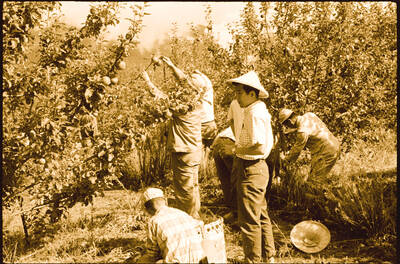
May 25 to May 31 Few believed that apples could be cultivated on a commercial scale in Taiwan’s high mountains. When horticulturalist Cheng Chao-hsiung (程兆熊) first proposed the idea in 1955, both American and Taiwanese colleagues dismissed it as implausible, arguing that temperate fruit could not be reliably grown on a subtropical island, especially on rugged terrain. However, it was this terrain in the Central Mountain Range where many Chinese Civil War veterans were resettled in the late 1950s. With limited job prospects and no family in Taiwan, they were placed on cooperative farms aimed toward self-sufficiency. Some say the conditions


 RSS
RSS