


Starting Tuesday next week, China's best Peking opera troupe is going to give a boost to this traditional Chinese theatrical form in Taiwan, with performances at the National Theater and lectures at local high school campuses.
The 70-person Peking Opera Theater First Troupe (
Meanwhile, the internationally renown troupe master Yu Kui-zhi (
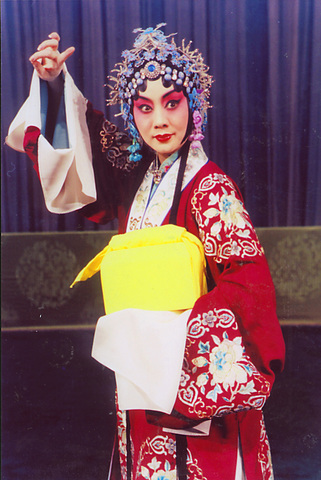
Photos courtesy of the Ars Formosa Company
"Peking opera has a long history of over 200 years. Yet, it needs to constantly recruit young audiences in order to pass on opera's great heritage and tradition forever," Yu said at a press conference earlier this week.
China Peking Opera Theater was set up in 1955 and Mei Lanfang (
In addition to Yu, who comes from the Yu-Yang School (
The theater group has performed in the US, Japan, Germany, France, Italy, the UK, Australia, the former Soviet Union, as well as Hong Kong, Macao and Taiwan. The SARS epidemic prevented the troupe from visiting Taiwan two years ago.
Among the 12 upcoming operas are: Princess Mei (
Performance notes:
China's Peking Opera Theater (
When: Dec. 20 to 23 at 7:30pm; Dec. 24 and 25 at 2:30pm and 7:30pm
Where: National Theater at 21-1, Zhongshan S Rd, Taipei (
Tickets: NT$300 to NT$2,000
Call: (02)2771 5676
Website: www.arsformosa.com.tw
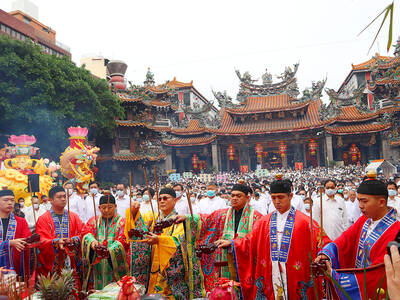
Recently the Chinese Nationalist Party (KMT) and its Mini-Me partner in the legislature, the Taiwan People’s Party (TPP), have been arguing that construction of chip fabs in the US by Taiwan Semiconductor Manufacturing Co (TSMC, 台積電) is little more than stripping Taiwan of its assets. For example, KMT Legislative Caucus First Deputy Secretary-General Lin Pei-hsiang (林沛祥) in January said that “This is not ‘reciprocal cooperation’ ... but a substantial hollowing out of our country.” Similarly, former TPP Chair Ko Wen-je (柯文哲) contended it constitutes “selling Taiwan out to the United States.” The two pro-China parties are proposing a bill that

Institutions signalling a fresh beginning and new spirit often adopt new slogans, symbols and marketing materials, and the Chinese Nationalist Party (KMT) is no exception. Cheng Li-wun (鄭麗文), soon after taking office as KMT chair, released a new slogan that plays on the party’s acronym: “Kind Mindfulness Team.” The party recently released a graphic prominently featuring the red, white and blue of the flag with a Chinese slogan “establishing peace, blessings and fortune marching forth” (締造和平,幸福前行). One part of the graphic also features two hands in blue and white grasping olive branches in a stylized shape of Taiwan. Bonus points for
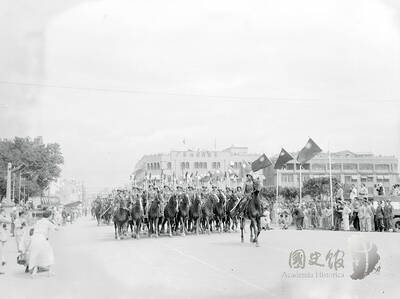
March 9 to March 15 “This land produced no horses,” Qing Dynasty envoy Yu Yung-ho (郁永河) observed when he visited Taiwan in 1697. He didn’t mean that there were no horses at all; it was just difficult to transport them across the sea and raise them in the hot and humid climate. “Although 10,000 soldiers were stationed here, the camps had fewer than 1,000 horses,” Yu added. Starting from the Dutch in the 1600s, each foreign regime brought horses to Taiwan. But they remained rare animals, typically only owned by the government or
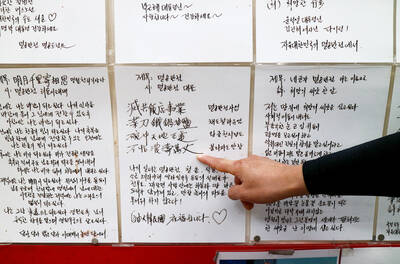
“M yeolgong jajangmyeon (anti-communism zhajiangmian, 滅共炸醬麵), let’s all shout together — myeolgong!” a chef at a Chinese restaurant in Dongtan, located about 35km south of Seoul, South Korea, calls out before serving a bowl of Korean-style zhajiangmian —black bean noodles. Diners repeat the phrase before tucking in. This political-themed restaurant, named Myeolgong Banjeom (滅共飯館, “anti-communism restaurant”), is operated by a single person and does not take reservations; therefore long queues form regularly outside, and most customers appear sympathetic to its political theme. Photos of conservative public figures hang on the walls, alongside political slogans and poems written in Chinese characters; South


 RSS
RSS