


Following the box office success of local horror flick Heirloom (
Falling... In Love (
relationships between men and women who are bound by sexual desire.

PHOTO COURTESY OF GOOD FILM
Fishing Luck (
An award winner at this year's Venice International Film Festival, Falling...In Love is director Wang Ming-tai's (
Alan (played by Lan) is a 27-year-old valet at a love motel who supplements his salary by boxing in underground matches. As a self-abasing, cynical guy Alan doesn't know how to love and tries to run away from his girlfriend Angle (played by Lee) and their tottering relationship.

PHOTO COURTESY OF OCEAN DEEP FILMS
Alan meets a 40-year-old woman who persists in waiting for her mafia boyfriend to return. The two embark on a dangerous affair, finding brief liberation from the daily grind of life in their fiery sexual encounters.
Angle, a 25-year-old hair stylist, is a strong modern woman trapped in her
relationship with Alan. However, she never loses faith in love. Lonely and hurt, she grows close to her new neighbor, Bella, a 29-year-old woman who, while trying to
escape from a broken marriage, also
embarks on an affair with Alan.
Unaware that the subject of their affection is the same man, the two women share their most intimate secrets and try to find the secret of true love.
After having worked in the film industry as a producer, screenwriter and director for over a decade, Wang says he has progressed a great deal from his 2002 debut Brave 20 (
Shot using long close-ups, minimal dialogue and saturated color, his latest release creates a visually astonishing world that successfully portrays the inner states of its protagonists.
Fishing Luck is the first feature film from veteran documentary filmmaker Tseng Wen-chen (
Venturing into drama for the first time, Tseng returns to her favored theme of aboriginal culture. Set on Lanyu island, the film depicts a pure and simple love story between a young woman from Taipei and a local tribesman who leads a tranquil life surrounded by family and friends.
A sophisticated woman from Taipei, Zing (played by Mando-pop singer Linda) visits the island on a business trip to survey the signal coverage of cellular phones in the remote area.
She relies on the cell phone to maintain relations with her boyfriend in Taipei.
Zing accidentally loses her wallet and is left without enough money to pay for her accommodation, or return flight to Taipei. Behong, a young man of the Tao tribe, (played by Aboriginal musician Biung Wang (
Their love gradually blossoms and Zing realizes true love can't be maintained over the telephone.
However, after Zing's wallet is recovered, she returns to Taipei. Upon her departure, Behong gives her a wooden flying fish hairpin as a gift. Time passes, and as the flying fish season looms again Zing and Behong wonder whether they will ever find true love.
Selected for the competition sections by both the Tokyo and Pusan International Film Festivals this year, Fishing Luck successfully juxtaposes a world of innocence and
simplicity against urban life.

Taiwan’s overtaking of South Korea in GDP per capita is not a temporary anomaly, but the result of deeper structural problems in the South Korean economy says Chang Young-chul, the former CEO of Korea Asset Management Corp. Chang says that while it reflects Taiwan’s own gains, it also highlights weakening growth momentum in South Korea. As design and foundry capabilities become more important in the AI era, Seoul risks losing competitiveness if it relies too heavily on memory chips. IMF forecasts showing Taiwan widening its lead over South Korea have fueled debate in Seoul over memory chip dependence, industrial policy and

“China wants to unify with Taiwan at the lowest possible cost, and it currently believes that unification will become easier and less costly as time passes,” wrote Amanda Hsiao (蕭嫣然) and Bonnie Glaser in Foreign Affairs (“Why China Waits”) this month, describing how the People’s Republic of China (PRC) is playing the long game in its quest to seize Taiwan. This has been a favorite claim of many writers over the years, easy to argue because it is so trite. Very obviously, if the PRC isn’t attacking Taiwan, it is waiting. But for what? Hsiao and Glaser’s main point is trivial,
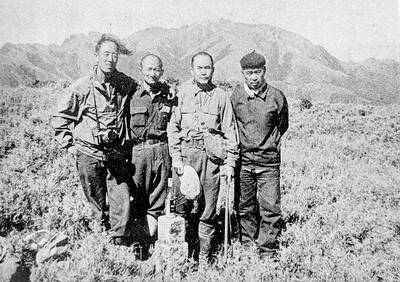
May 18 to May 24 Gathered on Yangtou Mountain (羊頭山) on Dec. 5, 1972, Taiwan’s hiking enthusiasts formally declared the formation of the “100 Peaks Club” (百岳俱樂部) and unveiled the final list of mountains. Famed mountaineer Lin Wen-an (林文安) led this effort for the Chinese Alpine Association (中華山岳協會). Working with other experienced climbers, he chose 100 peaks above 10,000 feet (3,048m) that featured triangulation points and varied in difficulty and character. The list sparked an alpine hiking craze, inspiring many to take up mountaineering and competing to “conquer” the summits. A common misconception is that the 100 Peaks represent Taiwan’s 100 tallest

The Chinese Nationalist Party (KMT), alongside their smaller allies the Taiwan People’s Party (TPP), are often accused of acting on behalf of the Chinese Communist Party (CCP). Some go so far as to call them “traitors.” It is not hard to see why. They regularly pass legislation to stymie the normal functioning of the ruling Democratic Progressive Party’s (DPP) administration, and they have yet to pass this year’s annual budget. They slashed key elements of the government’s proposed NT$1.25 trillion (US$40 billion) special military budget, and in the smaller NT$780 billion package they did pass, it is riddled with provisions that


 RSS
RSS