


A necrophiliac entertainment for the whole family to enjoy, Tim Burton's Corpse Bride marks the director's latest venture into the world of stop-motion animation, following Tim Burton's The Nightmare Before Christmas and James and the Giant Peach. As in Nightmare, kooky and spooky things go bump in the night, this time in the service of a lightly kinked romance about a melancholic boy, the girl he hopes to marry and the bodacious cadaver that accidentally comes between them.
Directed by Burton and Mike Johnson, and written by John August, Caroline Thompson and Pamela Pettler, the story hangs on a timid bachelor with matchstick legs and a pallid complexion, Victor (voiced by Johnny Depp), whose upwardly mobile parents arrange his marriage to Victoria (Emily Watson), the retiring daughter of impoverished gentry. When the wedding rehearsal goes kablooey, Victor retreats into the woods, whereupon he becomes the reluctant object of desire of the Corpse Bride, a blue-tinted beauty with gnawed-through limbs and a miraculously preserved bosom (Helena Bonham Carter, the director's very alive partner). Together, the eerie couple descends into the land of shades, inducing Victor to trade the world of the barely living for the land of the exuberantly dead.
For Victor and for his two directors, the underworld soon proves a more hospitable place than the world above, and far more entertaining. Above, the living shuffle about as somnolently as zombies amid a rainbow of gray, while down below, the walls are splashed with absinthe green, and the skeletons shake, rattle and roll. Bursting with mischief and life of a sort (think the grinning skulls of the Mexican artist Jose Guadalupe Posada), these skeletons dance themselves to pieces for a bravura musical number marred only by the composer Danny Elfman's insistence on recycling the same string of notes again and again.
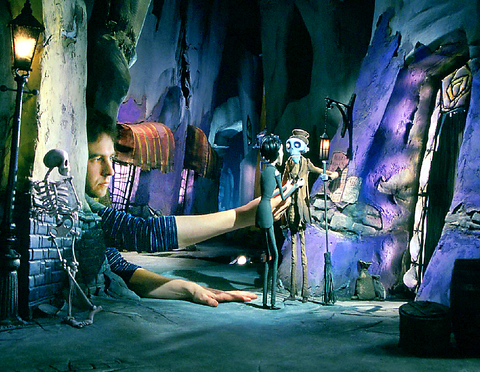
PHOTO: AP
It all ends happily ever after, of course, though not before Burton and company have gathered the dead with the undead. The anticlerical bit gives the story a piquant touch, while the reunion between the corpses and the ostensibly living further swells the numbers of zombies that have lately run amok in the movies. Cinema's reinvigorated fixation with the living dead suggests that we are in the grip of an impossible longing, or perhaps it's just another movie cycle running its course. Whatever the case, there is something heartening about Burton's love for bones and rot here, if only because it suggests, despite some recent evidence, that he is not yet ready to abandon his own dark kingdom.
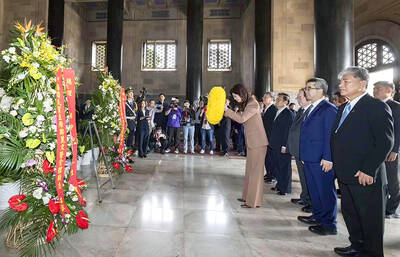
The problem with Marx’s famous remark that history repeats itself, first as tragedy, the second time as farce, is that the first time is usually farce as well. This week Chinese Nationalist Party (KMT) Chair Cheng Li-wun (鄭麗文) made a pilgrimage to the People’s Republic of China (PRC) “to confer, converse and otherwise hob-nob” with Chinese Communist Party (CCP) officials. The visit was an instant international media hit, with major media reporting almost entirely shorn of context. “Taiwan’s main opposition leader landed in China Tuesday for a rare visit aimed at cross-strait ‘peace’”, crowed Agence-France Presse (AFP) from Shanghai. Rare!

What is the importance within the Chinese Nationalist Party (KMT) of the meeting between Xi Jinping (習近平), the leader Chinese Communist Party (CCP), and Cheng Li-wun (鄭麗文), the leader of the KMT? Local media is an excellent guide to determine how important — or unimportant — a news event is to the public. Taiwan has a vast online media ecosystem, and if a news item is gaining traction among readers, editors shift resources in near real time to boost coverage to meet the demand and drive up traffic. Cheng’s China trip is among the top headlines, but by no means

Sunflower movement superstar Lin Fei-fan (林飛帆) once quipped that the Democratic Progressive Party (DPP) could nominate a watermelon to run for Tainan mayor and win. Conversely, the DPP could run a living saint for mayor in Taipei and still lose. In 2022, the DPP ran with the closest thing to a living saint they could find: former Minister of Health and Welfare Chen Shih-chung (陳時中). During the pandemic, his polling was astronomically high, with the approval of his performance reaching as high as 91 percent in one TVBS poll. He was such a phenomenon that people printed out pop-up cartoon
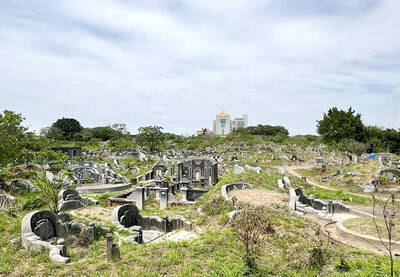
Apr. 13 to Apr. 19 From 17th-century royalty and Presbyterian missionaries to White Terror victims, cultural figures and industrialists, Nanshan Public Cemetery (南山公墓) sprawls across 95 hectares, guarding four centuries of Taiwan’s history. Current estimates show more than 60,000 graves, the earliest dating to 1642. Besides individual tombs, there are also hundreds of family plots, one of which is said to contain around 1,000 remains. As the cemetery occupies valuable land in the heart of Tainan, the government in 2018 began asking families to relocate the graves to make way for development. That


 RSS
RSS