


Did you know that elephants have a sour tooth or that they like daily, hour-long massages, preferably done in a circular motion with a pumice stone? If you own an elephant and don't know how to keep it happy, you could learn a few lessons from Parbati Barua, Asia's only female mahout, or elephant handler, who recently taught 150 mahouts in the northwestern desert state of Rajasthan about elephant management. The talk was sponsored by the government's tourism department and the animal-welfare group Help In Suffering (HIS) in Jaipur.
Barua, 53 years old and barely 150cm, knows her elephants well. She lassoed her first wild elephant at the age of 14.
"You need a little luck and the instinct to read the animal's mind. Catching an elephant is not about strength," she said.
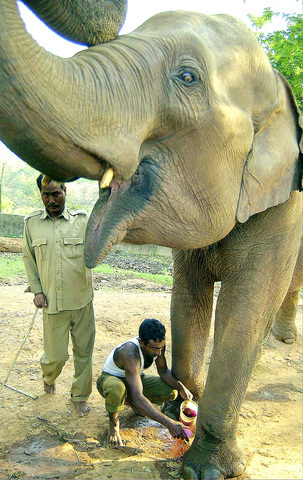
PHOTO: AP
Barua's lessons were given at Amber Fort, an architectural marvel built by Hindu Rajput kings in the 16th century on a hillside that overlooks a lake. Few tourists opt for the 10-minute walk up to the fort -- most enjoy making a grand entrance on elephant back.
Amber Fort employs 103 elephants, with a one-way trip of four people per elephant costing 450 rupees (NT$315). For working eight hours a day, the elephant only gets 20 rupees for its welfare fund.
In a city where temperatures average 40?C through most of the year, the animals suffer from dehydration, upset stomachs, sunburn, foot sores, ulcers, cracked nails from walking on hot asphalt and blindness caused by poor nutrition.
"Captive elephants live longer than those in the wild, with a life span of 60 to 70 years. Most start working at 25 and retire at 55, so it's important to keep them healthy," said HIS veterinarian Madhulal. HIS holds regular elephant health camps at Amber Fort and even has an elephant ambulance.
"Mahouts need training on how to keep their elephants fit, how to ride them, how to use the `ankush' [spear-like device to control the elephant] and `gear' [cotton ropes tied around the elephant's neck to control its movements]," said Pavan Jain, assistant director of the tourism department.
Barua said, "An elephant is a very loving animal. We bring them up like our children: We love them, hit them and shout at them. But, no matter how long we keep an elephant with us, in its heart it is a wild animal and some of that wildness remains. We must always remember this and be careful of it. An elephant can't be domesticated."
Barua gave lessons in tying a howdah, or seat on which the tourists sit, and the most humane way of using the kilawa, or gear.
"They are nocturnal animals and it is cruel to make them work long hours during the day. It's not that we shouldn't entertain tourists, because it's a question of livelihood and survival for the mahouts, but we should treat the animals better," Barua said.
Shahid Khan, a mahout with five elephants, said: "Our family has been in the elephant business for generations. The training was good because we got to share our problems."
Barua said the mahout-elephant bond is based on unconditional trust and understanding. "Elephants are sensitive and cultured. They are my only family."

Taiwan’s overtaking of South Korea in GDP per capita is not a temporary anomaly, but the result of deeper structural problems in the South Korean economy says Chang Young-chul, the former CEO of Korea Asset Management Corp. Chang says that while it reflects Taiwan’s own gains, it also highlights weakening growth momentum in South Korea. As design and foundry capabilities become more important in the AI era, Seoul risks losing competitiveness if it relies too heavily on memory chips. IMF forecasts showing Taiwan widening its lead over South Korea have fueled debate in Seoul over memory chip dependence, industrial policy and

“China wants to unify with Taiwan at the lowest possible cost, and it currently believes that unification will become easier and less costly as time passes,” wrote Amanda Hsiao (蕭嫣然) and Bonnie Glaser in Foreign Affairs (“Why China Waits”) this month, describing how the People’s Republic of China (PRC) is playing the long game in its quest to seize Taiwan. This has been a favorite claim of many writers over the years, easy to argue because it is so trite. Very obviously, if the PRC isn’t attacking Taiwan, it is waiting. But for what? Hsiao and Glaser’s main point is trivial,
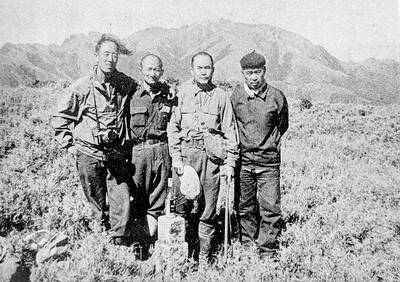
May 18 to May 24 Gathered on Yangtou Mountain (羊頭山) on Dec. 5, 1972, Taiwan’s hiking enthusiasts formally declared the formation of the “100 Peaks Club” (百岳俱樂部) and unveiled the final list of mountains. Famed mountaineer Lin Wen-an (林文安) led this effort for the Chinese Alpine Association (中華山岳協會). Working with other experienced climbers, he chose 100 peaks above 10,000 feet (3,048m) that featured triangulation points and varied in difficulty and character. The list sparked an alpine hiking craze, inspiring many to take up mountaineering and competing to “conquer” the summits. A common misconception is that the 100 Peaks represent Taiwan’s 100 tallest

The Chinese Nationalist Party (KMT), alongside their smaller allies the Taiwan People’s Party (TPP), are often accused of acting on behalf of the Chinese Communist Party (CCP). Some go so far as to call them “traitors.” It is not hard to see why. They regularly pass legislation to stymie the normal functioning of the ruling Democratic Progressive Party’s (DPP) administration, and they have yet to pass this year’s annual budget. They slashed key elements of the government’s proposed NT$1.25 trillion (US$40 billion) special military budget, and in the smaller NT$780 billion package they did pass, it is riddled with provisions that


 RSS
RSS