


It takes about NT$12,800 worth of equipment to climb a tree -- arborist ropes, helmet, climbing saddle, branch protectors, metal loops called carabiners. But when you're 30m up or so and your perch is swaying in the wind, you'll be glad you came prepared.
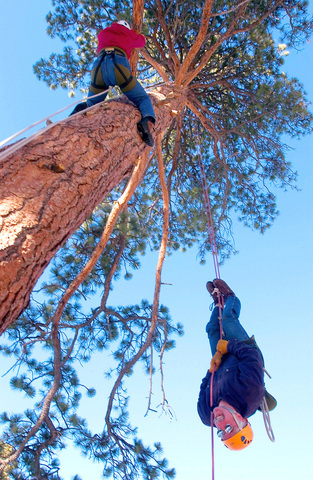
If you really want to do it right, you will also need a nickname. (Remember Julia Hill, aka Butterfly, who sat in a 61m redwood from 1997 to 1999 as a protest against clear cutting?) Harv Teitelbaum's nickname is Ponderosa -- in homage to the western pine that can grow up to 55m -- and you'll rarely find him on the ground. A native of Long Island who now lives in Colorado where the trees grow tall, Teitelbaum enjoys the solace high in the branches after a snowstorm ("So quiet, so beautiful, the snow on the trees."), the sway of a ponderosa during 130kph Chinook winds ("Swinging like a pinata, it was great!") and the view from a redwood toward a nearby forest fire ("Great day! I was all sooty."). Teitelbaum is part of a small but growing community of adults who call themselves recreational tree climbers. He has even found a business in it: teaching others through his company, Tree Climbing Colorado.
PHOTOS: NY TIMES
Italo Calvino, the 20th century Italian writer, wrote a whimsical novel, The Baron in the Trees, about a man who lives his entire life high above the ground, and a fair number of people seem to be trying to live it out. Although hard data about the participants are difficult to come by, New Tribe, an Oregon company that sells equipment for recreational tree climbing, said it sold almost 1,500 tree-climbing saddles last year, up 34 percent from 2003.
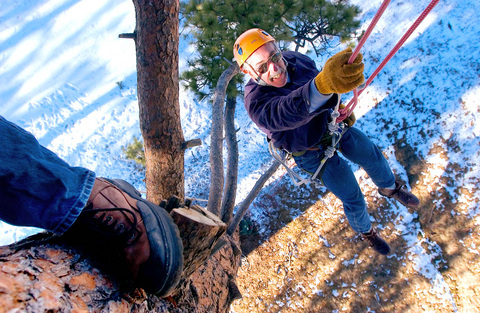
Some ground dwellers might consider tree climbers slightly less evolved than monkeys (Teitelbaum's father has half-teasingly asked his son to change his last name to save the family embarrassment), but Teitelbaum and his colleagues happily spend their leisure hours climbing, and even sometimes camping, in trees.
Using ropes and other climbing gear, they swing from branches for hours, talking to the tree, hugging it, getting a unique perspective on the world. Everyday worries seem to disappear, they say. Teitelbaum does not consider himself an activist or an extreme-sports kind of guy. He just likes being in the trees.
Tree climbing attracts many sorts of people, of course, but commonly its practitioners climbed trees as children and want to recapture the feeling. Nicknames are almost required. Teitelbaum's colleagues include Swampy Joe, Tengu, Xenon, Tree Man. One, called Ai, took the name of a tree sloth distinguished by its greenish coat, tinted by algae that live in its fur.
Many climbers like the wilderness, but instead of setting up tents, they take in the view from on high. "I've seen hummingbird nests, watched parrots fly and seen the wind blow through the trees rippling the leaves in waves," said Iris Turney, a Los Angeles-based tree climber. She volunteered at the UCLA botanical gardens so that she could climb trees and has traveled to Panama for a rain-forest expedition.
Xenon (more formally known as Chris Hanson), a climber who lives in the mountains west of Denver, speculated, "Maybe we evolved swinging in trees and just have a primal wire still hooked up that tells us we ought to get up there and check things out." Hanson, who has started several software companies and refers to himself as a professional geek, likes what he called "the organic complexity" of trees. "They form such cool shapes and structures up in the sky, which we never see from the ground," he said. "It's like exploring a sculpture that's also a jungle gym."
One day last October, Teitelbaum pointed his 1996 Subaru Outback down Interstate 70 from his home in Evergreen, toward Arvada in suburban Denver. Instead of playing one of his Led Zeppelin cassettes, Teitelbaum, 54, talked about some of his favorite trees. In the tradition of mountaineering, the first climber to conquer a tree is understood to have the right to name it. And Teitelbaum has named quite a few. Some of his favorites in Colorado are Lancelot, a lanceleaf cottonwood in Fort Collins; Nameless, a 500-year-old ponderosa near Franktown; and Gramps, a ponderosa near his home. On that October day, Teitelbaum was heading to a Plains cottonwood that he fondly calls Old Scratchy.
For safety and camaraderie, Teitelbaum prefers climbing with someone else, although he can't always find a partner. (He has never been stranded, but he carries a cell phone just in case.) His wife, whose tree name is Hummingbird, does not climb very much. This time, he had agreed to take along a reporter interested in finding out how tree climbing feels firsthand.
At the base of Old Scratchy, which is about four and a half feet in diameter at chest height, Teitelbaum looked things over, something like a pilot looking over a plane. He did a three-point check -- the ground, the trunk and the canopy -- looking for damaged or exposed roots, ground upheaval, fungus, glass, nails, power lines, hollows or missing bark, trunk splits, insects, animals, dead or dying growth, tree lean or anything else that might pose a danger.
Wearing a climbing helmet over his gray hair, he repeatedly emphasized safety, saying, "We don't want people killing themselves, because it gives us a bad name." He is a graduate of a recreational tree-climbing certification program run by Tree Climbing International, an Atlanta-based umbrella organization for recreational tree climbers. In his own NT$12,800 course, he trains people over a weekend, ending in a written test and a climbing test.
Many of the vertically inclined come to tree climbing because it is safer (some might argue wimpier) than its closest cousin, rock climbing. In tree climbing, the risks are more controlled. "It would take a tree to break or the rope to break to create an accident or fatality, which has yet to happen," Peter Jenkins, the founder of Tree Climbing International, said. Rock climbing takes more physical strength and involves the hazard of falling rocks. The rock climber's rope is used as a backup in case of a fall, and tree climbers use the rope to help them ascend.
Approaching Old Scratchy, Teitelbaum threw a 0.4kg shot bag attached to a lead rope up into the branches, trying to get the rope over one of them. (He is an old-school climber; many people use crossbows for this.) "Throwing!" he screamed, and tossed the bag about 18m in the air. There were a few misses and a few yells of "Headache!" before he succeeded. Then he attached a climbing rope to the lead rope with a cambium saver, a piece of material that protects the cambium layer between the outer bark and the wood from scarring, and pulled it up and around the branch.
After hanging from both ropes and doing a bounce test to make sure they were secure, he tied a dizzying array of knots -- friction hitch, figure eight on a bight, slip knot -- into them. The knots allow a climber to move up and down the rope while locked in place in the climbing saddle, a diaper-like contraption. Recreational tree climbers discourage free climbing as too risky.
Although many novices might consider falling to a painful death the biggest danger of tree climbing, experienced climbers say that's a small concern next to the threat of stumbling upon hornets' nests and ant colonies. Turney knows of one person in the Pacific Northwest who climbed near an eagle's nest. ("If the eagle would have come back, it might have pecked him to death," she said.
After climbing up about 9m, Teitelbaum stopped and looked around. "Here we are in an urban area," he said, "but it is an escape." Down below was a suburban landscape with a creek and a park.
"Being up here changes your mind-set, your sense of time," he said. "Tree climbers talk a lot about tree time, the concept that time slows down in a tree. It is a totally different perception to look down on the trunk, to feel the tree move, the universe move."
When you're hanging 18m in the air with your life in someone's hands, you tend to nod in complete agreement with anything he says. He was certainly correct, however, about the different perspective. The rustling leaves were louder in the tree, birds were visible in their habitat, and ducks and ducklings looked peaceful in the creek below.
Just being in a tree feels odd at first. For a novice, sensations go from unease ("I wonder what my face will look like if I land on it?") to boredom ("Why am I hanging from a tree?") to New Age psychosis ("Ahh, like a magic wand I am swaying in the heavens").
Teitelbaum stayed mostly silent; part of the tree-climbing ethos is shutting up and chilling out. But he did demonstrate tree dancing, which means bouncing off the tree by using your legs as springboards.
Teitelbaum discourages wearing a watch, but it's a safe guess that it was an hour before he descended and started packing up the equipment. A post-climb Mexican dinner lay ahead, but before that, he said, it was appropriate to thank the tree.
He put his hand on the trunk, invited his companion to do the same, and closed his eyes. "Thanks, Old Scratchy," he said. "Thank you."

Just after 6am, I walked up to the ticket gate at Taipei Main Station and entered the Taiwan Railway platform without scanning any ticket; instead, I flashed the Sanrio Fun Rail pass on my phone to the gate worker and was admitted. I found my train and prepared to board. My destination? This very same station. I was embarking on a 13-hour journey on one of two round-the-island trains operated by ezTravel. They run each day, one counterclockwise around the island and one clockwise. They differ in a number of ways from an ordinary Taiwan Railway train and can make for

Jason Han says that the e-arrival card spat between South Korea and Taiwan shows that Seoul is signaling adherence to its “one-China” policy, while Taiwan’s response reflects a reciprocal approach. “Attempts to alter the diplomatic status quo often lead to tit-for-tat responses,” the analyst on international affairs tells the Taipei Times, adding that Taiwan may become more cautious in its dealings with South Korea going forward. Taipei has called on Seoul to correct its electronic entry system, which currently lists Taiwan as “China (Taiwan),” warning that reciprocal measures may follow if the wording is not changed before March 31. As of yesterday,

The Portuguese never established a presence on Taiwan, but they must have traded with the indigenous people because later traders reported that the locals referred to parts of deer using Portuguese words. What goods might the Portuguese have offered their indigenous trade partners? Among them must have been slaves, for the Portuguese dealt slaves across Asia. Though we often speak of “Portuguese” ships, imagining them as picturesque vessels manned by pointy-bearded Iberians, in Asia Portuguese shipping between local destinations was crewed by Asian seamen, with a handful of white or Eurasian officers. “Even the great carracks of 1,000-2,000 tons which plied

On Thursday, former Taipei mayor and founder of the Taiwan People’s Party (TPP) Ko Wen-je (柯文哲) was sentenced to 17 years in prison and had his civil rights suspended for six years over corruption, embezzlement and other charges. Seven others related to the case were also handed prison sentences, while two were found not guilty. It has been a bad week for the TPP. On Tuesday, prosecutors charged Chinese immigrant Xu Chunying (徐春鶯) with suspicion of taking part in Beijing-directed election interference. Xu has strong links to the TPP, which once offered her a party list legislator nomination. Tuesday also


 RSS
RSS