


Although its roots are in eastern philosophy, macrobiotics is a rarity in Taiwan. Increasingly trendy in the US and Europe, macrobiotics is the practice of balancing each meal with organic foods that are categorized as either Yin (more sweet) or Yang (more salty), similar to the Chinese system of labeling foods as either hot or cold.
The ultra-healthy diet gained popularity when it was exported to the West by Japanese businessman George Ohsawa in the early 1900s.
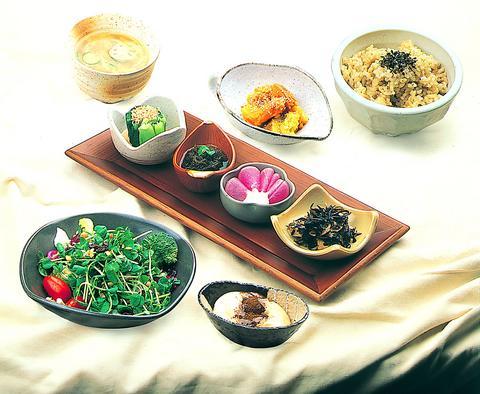
PHOTO COURTESY OF YOGI HOUSE INTERNATIONALN
A lot of people turn their noses up at macrobiotic meals because they assume the food will have no flavor, said Yogi House owner Tu Shu-feng (涂淑芬).
Tu's is the first purely macrobiotic restaurant to open on the island and although a meal of organic vegetables, beans and whole grains might sound too healthy to be appetizing, the set dinners offer some of the tastiest dishes in the city.
The meal consists mostly of whole grain starches, then vegetables and fruit and only a small meat, seafood or bean portion. A macrobiotic diet is not strictly vegetarian, but meat and dairy are often substituted with a soy-based product.
Main courses at Yogi House consist of a selection of noodle dishes including Japanese soba or sesame noodles, a long list of hot pots such as spicy-sour Thai with soy milk, and a few unique offerings like pumpkin burgers or tropical curry.
Tu recommends the macro classics to anyone wanting to sample a typical macrobiotic meal. Served with four vegetable side dishes, which vary depending on the season, the classic combines both steamed pumpkin and a bowl of long-grain brown rice as its starch base. The vegetable portions are small, but each is served in its own distinctly flavored sauce. On this particular visit, the veggies included marinated shitake mushrooms, stewed carrots and bamboo, seaweed in grape vinegar and sweet potato leaves in a sesame paste.
The second most popular and highly recommended dish is the pumpkin burger, which is actually more like a sandwich made with mashed pumpkin, lettuce, tomato and served on multi-grain bread. It also comes with a side order of pasta that uses a fresh tomato and basil sauce.
A little more than two weeks since its opening, Yogi House might not be the only macrobiotic restaurant for long. Having studied in Japan, Tu is currently offering prospective restaurant owners lessons on how to prepare the meals. Given the growing number of organic groceries and eateries in Taipei city, macrobiotics may well be one fad that lingers on.


The problem with Marx’s famous remark that history repeats itself, first as tragedy, the second time as farce, is that the first time is usually farce as well. This week Chinese Nationalist Party (KMT) Chair Cheng Li-wun (鄭麗文) made a pilgrimage to the People’s Republic of China (PRC) “to confer, converse and otherwise hob-nob” with Chinese Communist Party (CCP) officials. The visit was an instant international media hit, with major media reporting almost entirely shorn of context. “Taiwan’s main opposition leader landed in China Tuesday for a rare visit aimed at cross-strait ‘peace’”, crowed Agence-France Presse (AFP) from Shanghai. Rare!

What is the importance within the Chinese Nationalist Party (KMT) of the meeting between Xi Jinping (習近平), the leader Chinese Communist Party (CCP), and Cheng Li-wun (鄭麗文), the leader of the KMT? Local media is an excellent guide to determine how important — or unimportant — a news event is to the public. Taiwan has a vast online media ecosystem, and if a news item is gaining traction among readers, editors shift resources in near real time to boost coverage to meet the demand and drive up traffic. Cheng’s China trip is among the top headlines, but by no means

A recent report from the Environmental Management Administration of the Ministry of Environment highlights a perennial problem: illegal dumping of construction waste. In Taoyuan’s Yangmei District (楊梅) and Hsinchu’s Longtan District (龍潭) criminals leased 10,000 square meters of farmland, saying they were going to engage in horticulture. They then accepted between 40,000 and 50,000 cubic meters of construction waste from sites in northern Taiwan, charging less than the going rate for disposal, and dumped the waste concrete, tile, metal and glass onto the leased land. Taoyuan District prosecutors charged 33 individuals from seven companies with numerous violations of the law. This

Sunflower movement superstar Lin Fei-fan (林飛帆) once quipped that the Democratic Progressive Party (DPP) could nominate a watermelon to run for Tainan mayor and win. Conversely, the DPP could run a living saint for mayor in Taipei and still lose. In 2022, the DPP ran with the closest thing to a living saint they could find: former Minister of Health and Welfare Chen Shih-chung (陳時中). During the pandemic, his polling was astronomically high, with the approval of his performance reaching as high as 91 percent in one TVBS poll. He was such a phenomenon that people printed out pop-up cartoon


 RSS
RSS