


They were not happy about the size of the stage, but the show must go on and the performers of Beijing People's Art Theater (北京人民藝術劇院) are in Taipei to stage Tea House (茶館) by Lao She (老舍), a classic of modern Chinese drama known for, among other things, the size of its cast.
"This is big theater," said Liang Guan-hua (梁冠華), one of the show's stars, waving his arm at the diminutive stage.
With over 50 named characters spanning three generations, Tea House is a big production, in many ways, and the tiny stage of the Sun Yat-sen Memorial Hall does cramp its style somewhat.
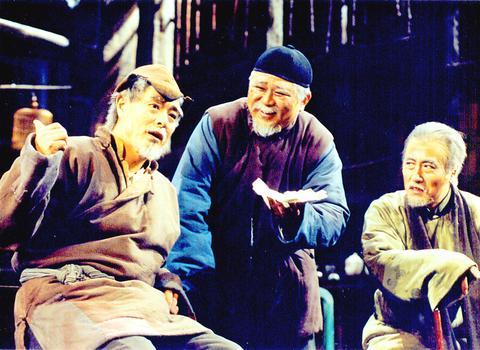
PHOTO COURTESY OF NEW ASPECT
During rehearsals there was talk of removing some of the elaborate props because of the lack of space. There were also some grumbles about the venue's notoriously poor lighting and sound system. Staff at the theater said they were trying to resolve the problems.
Tea House has been a hit in China where it been performed over 200 times, but its appeal in Taiwan is less certain. The play, which was written in 1958, is an established classic but it is also showing its age.
The style it was written in is heavily melodramatic and contemporary politics has also affected how we see the events depicted ? the last days of the Qing Empire, the Nationalist interlude and the rise of communism.
What saves it is Lao She's deep love for old Beijing, its language, its habits and most of all, its common people. These elements lift the
production. Not surprisingly, a lot of top class talent has been brought over from China by the troupe, not least the three lead actors Liang, Pu Chun-xin (
(
Overall, Tea House has an overwhelmingly nostalgic quality, intentionally so, for Lao She clearly loved the old world of Beijing's tea houses, though it was the communist revolution that made him famous which destroyed them.
Tea House in Taipei in 2004 is definitely something of an anachronism, but there is still plenty of charm and skill on display. It won't change the way you see things, but its does, for some brief moments bring back aspects of China that have all but disappeared.
Tea House, which opened yesterday, will run through to July 8 with performances at 7:30pm at the Sun Yat-sen Memorial Hall. Tickets are NT$1,000 to NT$3,000 and are available through ERA ticketing or from the venue.

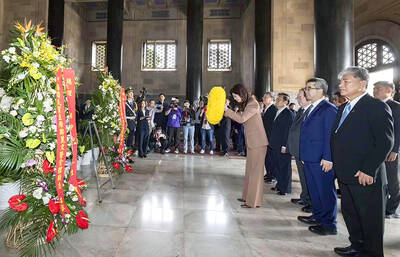
The problem with Marx’s famous remark that history repeats itself, first as tragedy, the second time as farce, is that the first time is usually farce as well. This week Chinese Nationalist Party (KMT) Chair Cheng Li-wun (鄭麗文) made a pilgrimage to the People’s Republic of China (PRC) “to confer, converse and otherwise hob-nob” with Chinese Communist Party (CCP) officials. The visit was an instant international media hit, with major media reporting almost entirely shorn of context. “Taiwan’s main opposition leader landed in China Tuesday for a rare visit aimed at cross-strait ‘peace’”, crowed Agence-France Presse (AFP) from Shanghai. Rare!
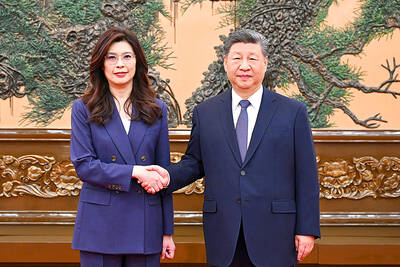
What is the importance within the Chinese Nationalist Party (KMT) of the meeting between Xi Jinping (習近平), the leader Chinese Communist Party (CCP), and Cheng Li-wun (鄭麗文), the leader of the KMT? Local media is an excellent guide to determine how important — or unimportant — a news event is to the public. Taiwan has a vast online media ecosystem, and if a news item is gaining traction among readers, editors shift resources in near real time to boost coverage to meet the demand and drive up traffic. Cheng’s China trip is among the top headlines, but by no means
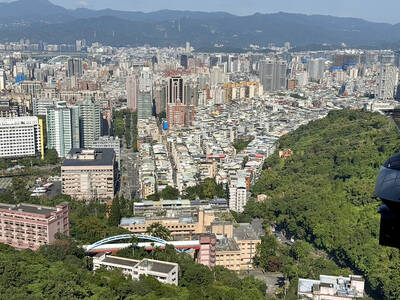
A recent report from the Environmental Management Administration of the Ministry of Environment highlights a perennial problem: illegal dumping of construction waste. In Taoyuan’s Yangmei District (楊梅) and Hsinchu’s Longtan District (龍潭) criminals leased 10,000 square meters of farmland, saying they were going to engage in horticulture. They then accepted between 40,000 and 50,000 cubic meters of construction waste from sites in northern Taiwan, charging less than the going rate for disposal, and dumped the waste concrete, tile, metal and glass onto the leased land. Taoyuan District prosecutors charged 33 individuals from seven companies with numerous violations of the law. This

Sunflower movement superstar Lin Fei-fan (林飛帆) once quipped that the Democratic Progressive Party (DPP) could nominate a watermelon to run for Tainan mayor and win. Conversely, the DPP could run a living saint for mayor in Taipei and still lose. In 2022, the DPP ran with the closest thing to a living saint they could find: former Minister of Health and Welfare Chen Shih-chung (陳時中). During the pandemic, his polling was astronomically high, with the approval of his performance reaching as high as 91 percent in one TVBS poll. He was such a phenomenon that people printed out pop-up cartoon


 RSS
RSS