


Wait! The holiday season isn't over yet. Fifteen days after the Lunar New Year comes Lantern Festival (
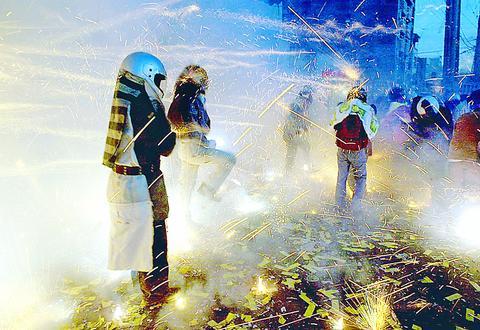
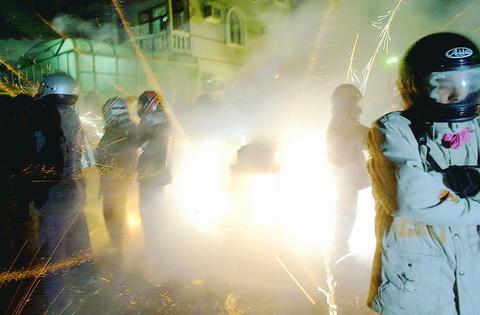
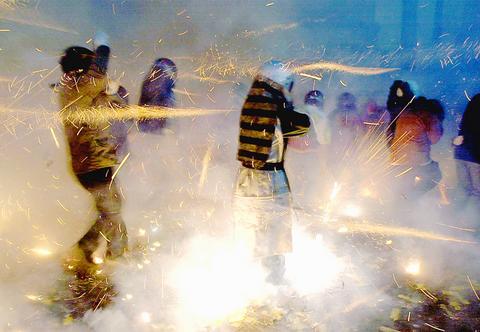
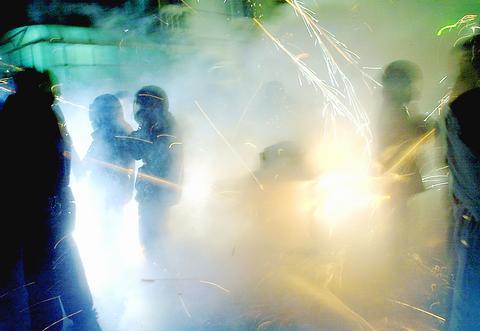
Yenshui. The Tainan County township's name has become synonymous with the fireworks event held there every year on Lantern Festival. It's a kind of fireworks display literally turned on its head -- a "trial by fireworks," it's been called -- wherein participants are pelted with fireworks shot at them from all angles. The fact that everyone is outfitted in their best improvised armor has not stopped the event from sending dozens of people to the hospital each year with minor burns and bruises -- and sometimes worse.
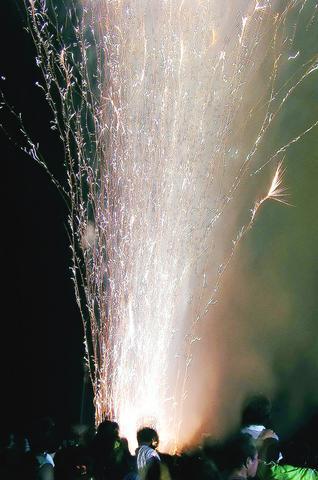
And no wonder. The so-called "good part," according to participants, is when a wall the size of a shipping container and packed with racks of bottle rockets and high-caliber launch tubes is unleashed and up to 20,000 explosives are fired into the crowd.
"It's a lot of fun before it starts," said Ben Sebold after his first -- and avowed last -- time taking part in the event. "But when it becomes deafening and relentless and dangerous you start looking for a way out."
It has its supposed origins in the aftermath of a plague that began in 1875 and which is said to have decimated the town's population. The townspeople prayed to the goddess Kuanyin and entreated the deity Kuankung to visit their town. They lined the streets with lanterns to light his way and heralded his arrival with fireworks. It must have been a cold day that first year of the festival because someone in the crowd got the idea that Kuankung would be a warmer if they aimed the fireworks his way. Now getting plugged with a Roman candle is considered auspicious.
Those interested in the event but unsure of what they're getting in to might first view a short film clip of a past year's event available on the Web at http://www.gio.gov.tw/info/festival_c/mpg/twj01.mpg. As you'll see, the Yenshui event, which goes from dusk until around 5am, is as much for spectators as for those hoping for a lucky wallop and because of this the surrounding streets are packed. Bear in mind that the density of people -- and of smoke! -- can be off-putting for some, as can being hit by a stray projectile. It can be almost as hellacious for those on the sidelines as for those in the fray.
A more heavenly form of Lantern Festival fun is found in Taipei County's backyard, high in the hills in Pinghsi Township. Thousands of paper lanterns rise to the sky, set off by groups of visitors and local school kids. The effect is something like a thousand small campfires taking to the sky, each bearing its owner's wishes of wealth, health and general good fortune in the coming year.
The local tradition didn't have such an auspicious start. To hear residents of Pinghsi tell it, their ancestors, the first Han settlers to the area, often fell victim to Aboriginal locals who were incensed at the Chinese for stealing their land. Remote as the place was, getting up and down the mountain was a considerable journey. The villagers of Pinghsi decided to use sky lanterns to let their friends and relatives lower down the mountain know they were safe. The custom continued and has since become part of the annual Lantern Day festivities.
The problem with visiting Pinghsi on this night, as with Yenshui, is the sheer mass of people. The carriages taking revelers up the mountain from Rueifang train station to the Pinghsi terminal are crowded, so the more rambunctious climb in the windows and hang from the doorways. Going up the mountain by car, while a great deal more comfortable, can be frustrating as the mountain road is choked with traffic. Your best bet is to arrive early -- long before sunset when the lanterns are let loose -- and either leave early if taking the train, or stay late if you've come by car. None of this, however, should put you off of one of the most divine sights to be seen in Taiwan. The fun started yesterday and will run for a week, ending on Lantern Festival night.
Somewhere between heaven and hell is Taipei (limbo?), where residents are treated to the annual Lantern Festival activities held in and around Chiang Kai-shek Memorial Hall. Each year, a giant lantern of the year's zodiac animal is lit to much fanfare. While the monkey overlooking the memorial hall looks like something out of Planet of the Apes it's by no means the only sight to see. As with years past, Aiguo East Road and Xinyi Road will be lined with large lanterns of various themes, made by local schools, businesses and organizations. Several of the lanterns will come from abroad.
A special feature this year will be a "Tunnel of Lights" incorporating the underground walkway from CKS Memorial Hall MRT station to Ximen station on Zhonghua Road, where the Taipei City Government plans to have graffiti and student paintings on display.
The hullabaloo will all take place on Thursday, but for those wanting to avoid crowds, the displays will all remain through Sunday, Feb. 15. Some 100,000 handheld monkey lanterns -- the kind children swing at each other -- will be given away starting at 3pm from Thursday to Sunday this coming week.
Taking the MRT is the best way to get to CKS Memorial Hall while the displays are lit as traffic controls will be in place through Feb. 14. Speaking of Feb. 14, the lantern display along the memorial hall makes for a romantic Valentine's Day stroll. And you thought the holiday season was over!
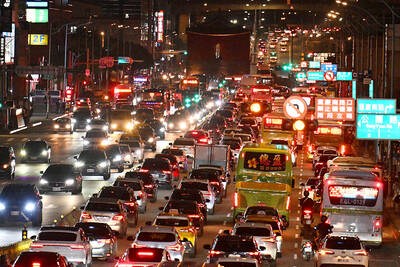
By global standards, the traffic congestion that afflicts Taiwan’s urban areas isn’t horrific. But nor is it something the country can be proud of. According to TomTom, a Dutch developer of location and navigation technologies, last year Taiwan was the sixth most congested country in Asia. Of the 492 towns and cities included in its rankings last year, Taipei was the 74th most congested. Taoyuan ranked 105th, while Hsinchu County (121st), Taichung (142nd), Tainan (173rd), New Taipei City (227th), Kaohsiung (241st) and Keelung (302nd) also featured on the list. Four Japanese cities have slower traffic than Taipei. (Seoul, which has some

In our discussions of tourism in Taiwan we often criticize the government’s addiction to promoting food and shopping, while ignoring Taiwan’s underdeveloped trekking and adventure travel opportunities. This discussion, however, is decidedly land-focused. When was the last time a port entered into it? Last week I encountered journalist and travel writer Cameron Dueck, who had sailed to Taiwan in 2023-24, and was full of tales. Like everyone who visits, he and his partner Fiona Ching loved our island nation and had nothing but wonderful experiences on land. But he had little positive to say about the way Taiwan has organized its

The entire Li Zhenxiu (李貞秀) saga has been an ugly, complicated mess. Born in China’s Hunan Province, she moved to work in Shenzhen, where she met her future Taiwanese husband. Most accounts have her arriving in Taiwan and marrying somewhere between 1993 and 1999. She built a successful career in Taiwan in the tech industry before founding her own company. She also served in high-ranking positions on various environmentally-focused tech associations. She says she was inspired by the founding of the Taiwan People’s Party (TPP) in 2019 by Ko Wen-je (柯文哲), and began volunteering for the party soon after. Ko
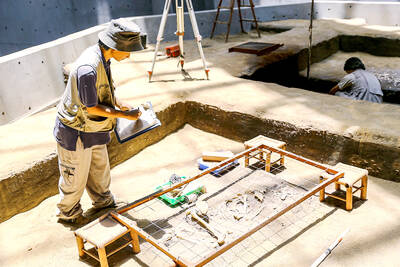
Writing of the finds at the ancient iron-working site of Shihsanhang (十 三行) in New Taipei City’s Bali District (八里), archaeologist Tsang Cheng-hwa (臧振華) of the Academia Sinica’s Institute of History and Philology observes: “One bronze bowl gilded with gold, together with copper coins and fragments of Tang and Song ceramics, were also found. These provide evidence for early contact between Taiwan aborigines and Chinese.” The Shihsanhang Web site from the Ministry of Culture says of the finds: “They were evidence that the residents of the area had a close trading relation with Chinese civilians, as the coins can be


 RSS
RSS