


Chinese legend holds that a Ming
dynasty (1368 to 1644) man named Wan Hu (
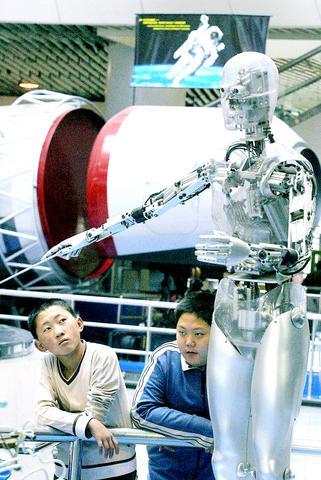
PHOTO: AP
A roar followed. After the smoke dissipated, the chair was gone, along with Wan Hu. It was unclear if what was purported to be the world's first manned rocket ever made it to the skies.
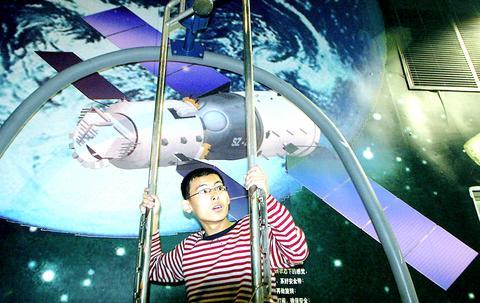
Today, China is counting down the days to its first manned space launch and hoping to avoid the same fate as Wan Hu, thanks to advanced space technology.
China, long mired in poverty but growing fast after more than two decades of market reforms, is eager for the prestige that would come with being just the third country capable of putting people into space.
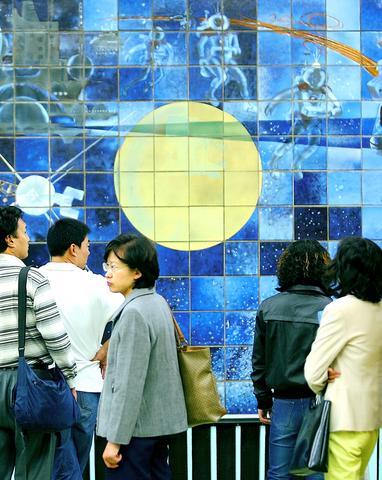
"With the launch of the Shenzhou spacecraft, China lifts its technological image into the heavens, bypassing the rest of the advanced-engineering nations," said Anthony Curtis, editor of Space Today Online.
Yu Maochun of the US Naval Academy said, "The manned space program is an essential part of the Communist Party's near fanatical quest for international respect and dignity, which [in] itself is a normal phenomenon among many rising powers in
history."
Failure looms large
A successful launch, on the heels of Beijing's winning bid to host the 2008 Olympics, could fuel nationalism and boost the Communist Party's credibility as China seeks a place on the world stage alongside the great powers.
A failure would be a loss of face and would raise questions about the necessity of a space program in a country where 140 million people live in abject poverty, or on less than US$1 a day.
"For China, as with all perilous endeavors, the chance of a deadly public failure looms large. By linking national pride and CCP [Chinese Communist Party] credibility, Beijing is jeopardizing both," Joshua Eisenman, a fellow at the New American Foundation, a public policy think tank in Washington, wrote in Singapore's Straits Times.
China has cloaked its space program in secrecy, ostensibly to avoid embarrassment in the event of failure.
Stung by a string of failed satellite launches in the 1980s and 1990s, China has kept recent lift-offs quiet, announcing them only after success was confirmed.
The date of the launch of the next Shenzhou -- meaning "Divine Ship" -- is a state secret but is expected around the Oct. 1 National Day holidays. Repeated requests to interview space officials have been rejected.
China's first astronauts -- dubbed taikonauts from taikong (太空), the Chinese word for space -- are faceless. China has yet to tell the world who they are, other than that they were plucked from the ranks of top fighter pilots in the airforce.
Military applications
There are no public details on the launch's budget, though it is believed to be a fraction of US manned space flight costs and is covered under rapidly expanding military outlays.
The launch by China is going ahead despite the loss of the US space shuttle Columbia, which disintegrated in February while re-entering the atmosphere. Seven astronauts died.
Experts said China's space program had no big technology breakthroughs but would incrementally improve existing space technologies such as computers, materials, electronics, rockets, guidance and life support.
It comes as no surprise that China's space program may have military applications.
"As the Soviet Union used its Soyuz capsules and Salyut space stations in the 1970s and 1980s to spy from space and carry out other forms of military research, so will the Chinese," said Curtis of Space Today Online.
Yu of the US Naval Academy said: "This project may boost China's R&D on strategic missile programs, but the cost will be enormous for China."
China has hinted at more starry-eyed space plans. State media have reported on designs for a lunar probe that would be a step towards sending Chinese to the moon.
One giant misstep for China?
Hard economic realities may temper those dreams.
China is running a record 320 billion yuan (US$39 billion) deficit this year. While the economy is flourishing, the health of the financial system is precarious and any sharp downturn could quickly squelch loftier ambitions for space.
Some analysts were critical of the
planned moon landing.
"A wasteful program such as the planned moon landing conducted by a developing country is just a small step for mankind and a giant misstep for China," Yu said in a wry twist on Neil Armstrong's famous quote.
Human boots have not trod on the moon since the US Apollo program ended with the Apollo XVII mission in 1972.
The Soviet Union was the first to put a man in space when Yuri Gagarin reached orbit in 1961. Weeks later, Alan Shepard became the first American in space, although an American didn't orbit Earth until John Glenn did so the following year.
Experts said China may be joining the exclusive space club four decades late, but its entry could trigger a space race in Northeast Asia with Japan and even South Korea.
"The launch of Chinese astronauts will capture the attention of everyone, especially opinion leaders," Curtis said. "That could breathe new life into the US space program as Americans realize that competition has returned after disappearing for a time since the fall of the Soviet Union."

Just after 6am, I walked up to the ticket gate at Taipei Main Station and entered the Taiwan Railway platform without scanning any ticket; instead, I flashed the Sanrio Fun Rail pass on my phone to the gate worker and was admitted. I found my train and prepared to board. My destination? This very same station. I was embarking on a 13-hour journey on one of two round-the-island trains operated by ezTravel. They run each day, one counterclockwise around the island and one clockwise. They differ in a number of ways from an ordinary Taiwan Railway train and can make for
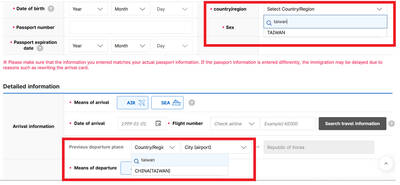
Jason Han says that the e-arrival card spat between South Korea and Taiwan shows that Seoul is signaling adherence to its “one-China” policy, while Taiwan’s response reflects a reciprocal approach. “Attempts to alter the diplomatic status quo often lead to tit-for-tat responses,” the analyst on international affairs tells the Taipei Times, adding that Taiwan may become more cautious in its dealings with South Korea going forward. Taipei has called on Seoul to correct its electronic entry system, which currently lists Taiwan as “China (Taiwan),” warning that reciprocal measures may follow if the wording is not changed before March 31. As of yesterday,

The Portuguese never established a presence on Taiwan, but they must have traded with the indigenous people because later traders reported that the locals referred to parts of deer using Portuguese words. What goods might the Portuguese have offered their indigenous trade partners? Among them must have been slaves, for the Portuguese dealt slaves across Asia. Though we often speak of “Portuguese” ships, imagining them as picturesque vessels manned by pointy-bearded Iberians, in Asia Portuguese shipping between local destinations was crewed by Asian seamen, with a handful of white or Eurasian officers. “Even the great carracks of 1,000-2,000 tons which plied

On Thursday, former Taipei mayor and founder of the Taiwan People’s Party (TPP) Ko Wen-je (柯文哲) was sentenced to 17 years in prison and had his civil rights suspended for six years over corruption, embezzlement and other charges. Seven others related to the case were also handed prison sentences, while two were found not guilty. It has been a bad week for the TPP. On Tuesday, prosecutors charged Chinese immigrant Xu Chunying (徐春鶯) with suspicion of taking part in Beijing-directed election interference. Xu has strong links to the TPP, which once offered her a party list legislator nomination. Tuesday also


 RSS
RSS