


Fan Zong-pei (范宗沛) took to the podium to receive the award for Best Original Score at the 1996 Golden Horse Awards (金馬獎) for his work on the movie Connection by Fate (超級大國民), the composer and cellist had no idea that he'd soon be dubbed Taiwan's "genius of the score."
This is a tag that the thickset cellist with the ever-present happy-go-lucky air brushes aside. But it certainly can't be denied him. Since his 1996 success, virtually all of Fan's television drama and film scores have been nominated for awards.
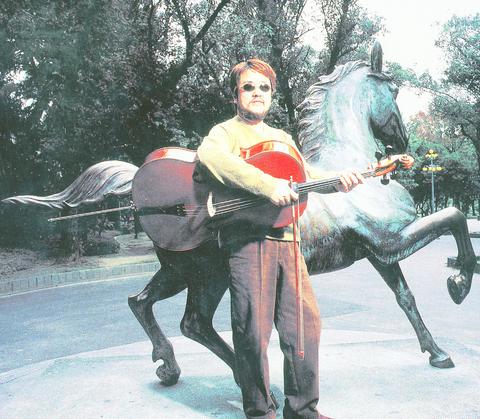
Aside from the Golden Horse, Fan's compositions have been singled out for distinction by judges at the Golden Bell (金鐘獎) -- the nation's TV awards -- the Asia Pacific Film Festival (亞太影展) and the Golden Melody Awards (金曲獎).
Not that he lets this success go to his head.
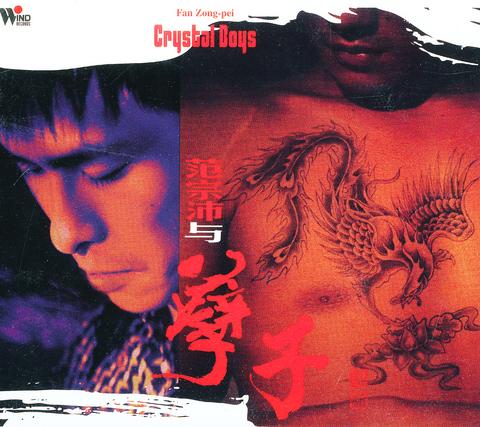
Ask Fan what it felt like to be the recipient of the 1997 Golden Melody Award in the category of Best Instrumental Album for his Sound of Armour (
Press him further, however, and he'll admit that the event was probably the turning point of his career. For the previous nine years Fan was the lead cellist with the National Symphony Orchestra (NSO,
"Obviously I was pretty nervous as to how my first album would be received. After all, it was my first such venture and I realized the future of my solo career depended upon it," explained Fan.
While Fan repeated his 1996 Golden Horse success last year for his work on the short independent flick Voice of Waves (
In 1999, Fan scored a hat trick for the television channel with his music for the hugely successful Once Upon a Time (
With this year's Golden Bell Awards set to take place at Taipei's Chungshan Hall (中山堂) this coming Friday, pundits are already predicting that his latest work will be a strong contender for an award.
Fan still hasn't got used to all the accolades even though he has been nominated for some kind of award every year for the past six years.
"None of my scores have been what you'd describe as uplifting music. I set out to create moods with my scores and this sees me toying with slow, deep and quite gloomy melodies," he said.
"My most recent composition, because of its topic, was certainly no exception. I'd have to admit that it was one that warranted little, if any, joy."
Penning the score for a 20--episode PTS adaptation of Kenneth Pai's (
"After I record scores I like to give recordings to friends so that they can give me feedback. I felt pretty bad doing this for my latest project, though," stated Fan with a smirk. "I felt obliged to warn one close friend that if he was in any way depressed, he should not listen to it."
While eagerly awaiting the results of next week's award ceremony, Fan is enjoying a lull in his music writing career. He is instead taking the time to concentrate on a personal project -- one which looks set to see the classically trained cellist moving into the field of electronica in some rather unique ways.
Spending long hours ensconced in a recording studio, Fan is currently learning all there is to know about loops, ambient, drum'n'bass as well as various forms of traditional Chinese opera.
According to Fan, the project, although still very much in its initial stages, will be ready some time in October. And while he has not chosen a venue in which to premiere the composition, he is certain that it will attract a larger audience than much of his previous material.
"Obviously the combination of electronica, traditional Chinese instruments and opera means that the work will be a lot less downbeat than many of my scores," he said. "I don't know whether people will want to dance to it, but it is going to be more upbeat and listener friendly than the works I'm best known for."

Taiwan’s overtaking of South Korea in GDP per capita is not a temporary anomaly, but the result of deeper structural problems in the South Korean economy says Chang Young-chul, the former CEO of Korea Asset Management Corp. Chang says that while it reflects Taiwan’s own gains, it also highlights weakening growth momentum in South Korea. As design and foundry capabilities become more important in the AI era, Seoul risks losing competitiveness if it relies too heavily on memory chips. IMF forecasts showing Taiwan widening its lead over South Korea have fueled debate in Seoul over memory chip dependence, industrial policy and
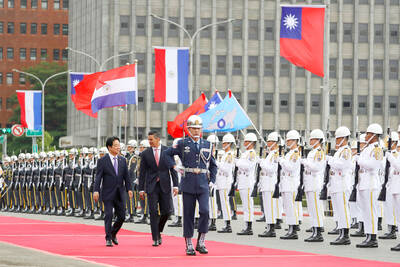
“China wants to unify with Taiwan at the lowest possible cost, and it currently believes that unification will become easier and less costly as time passes,” wrote Amanda Hsiao (蕭嫣然) and Bonnie Glaser in Foreign Affairs (“Why China Waits”) this month, describing how the People’s Republic of China (PRC) is playing the long game in its quest to seize Taiwan. This has been a favorite claim of many writers over the years, easy to argue because it is so trite. Very obviously, if the PRC isn’t attacking Taiwan, it is waiting. But for what? Hsiao and Glaser’s main point is trivial,
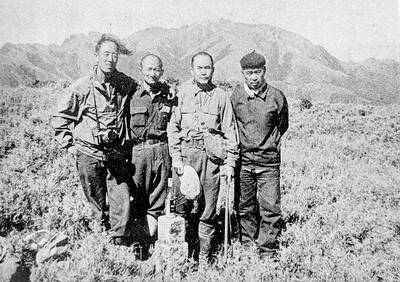
May 18 to May 24 Gathered on Yangtou Mountain (羊頭山) on Dec. 5, 1972, Taiwan’s hiking enthusiasts formally declared the formation of the “100 Peaks Club” (百岳俱樂部) and unveiled the final list of mountains. Famed mountaineer Lin Wen-an (林文安) led this effort for the Chinese Alpine Association (中華山岳協會). Working with other experienced climbers, he chose 100 peaks above 10,000 feet (3,048m) that featured triangulation points and varied in difficulty and character. The list sparked an alpine hiking craze, inspiring many to take up mountaineering and competing to “conquer” the summits. A common misconception is that the 100 Peaks represent Taiwan’s 100 tallest

Yesterday, the Democratic Progressive Party (DPP) nominated legislator Puma Shen (沈伯洋) as their Taipei mayoral candidate, the Chinese Nationalist Party (KMT) put their stamp of approval on Wei Ping-cheng (魏平政) as their candidate for Changhua County commissioner and former legislator Tsai Pi-ru (蔡壁如) of the Taiwan People’s Party (TPP) has begun the process to also run in Changhua, though she has not yet been formally nominated. All three news items are bizarre. The DPP has struggled with settling on a Taipei nominee. The only candidate who declared interest was Enoch Wu (吳怡農), but the party seemed determined to nominate anyone


 RSS
RSS