


To many who live in Taipei, the 24-hour 7-Eleven convenience store is an integral part of daily life, especially for those who live alone or who keep unusual hours. Almost everyone knows a 7-Eleven clerk in their neighborhood store, a person they say "hi" to every day, often seeing them more regularly than friends or relatives. Obviously there is huge potential for interesting developments between customers and 7-Eleven clerks.
Teng Yung-hsing's (
Love at 7-11 tells the story of a composer and film writer and his encounter with a girl who takes care of his daily purchases at the 7-Eleven store.
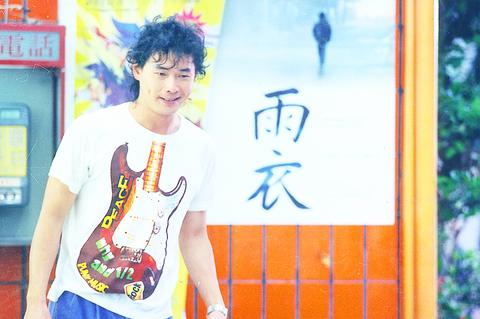
PHOTO COURTESY OF TENG YUNG-HSING
Teng adds two of his own storylines to enrich this rather slender conceit -- the filmmaker's fascination with a Japanese geisha and another college student's romance with a Japanese girl in Taiwan studying Chinese.
Together Teng has created a endearing romance within the urban solitude of his characters' lives, but the three stories fail to connect and the audience never really becomes engaged with the characters or their emotions.
Tsai (Huang Pin-yuan), the main character, works nights and sleeps during the day. Before going to sleep he always visits the nearby 7-Eleven to buy a rice ball and low-fat milk. He has a very regular schedule. One day, the piggy bank in which he collects coins breaks and so he starts to make all his purchases with coins.
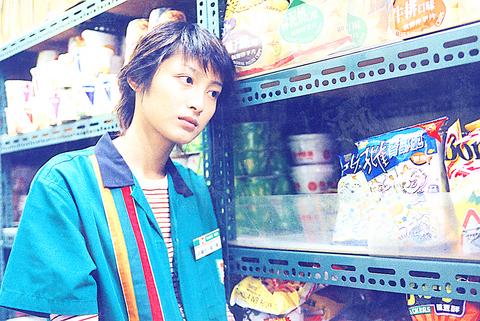
PHOTO COURTESY OF TENG YUNG-HSING
Hsiao-feng (Ko Huan-ju), a new member of staff at 7-Eleven, notices this guy who always uses coins and comes to the shop at 10:30am every day. She writes about this guy in her diary, calling him "Mr. Low-fat Milk."
Tsai is working on a documentary about a geisha called Kikuliu who lives in Kyoto. As he goes over the tapes he begins to realize an affection for her. He writes a song called "Raincoat" in memory of that special interview in Japan with her. Meanwhile, a Tainan college student is having a language exchange with a Japanese girl, Ameko, who has just retired from being a geisha. Unsurprisingly, intimacy leads to romance. Ameko tells the college student of a quaint Kyoto custom -- when a boy wants to show his love for a girl, he asks her to share a raincoat with him.
At the same time, when Hsiao-feng's slacker boyfriend comes to the 7-Eleven looking for her, he bumps into Mr. Lo-fat Milk.
Before making this film, Teng was a senior director of commercials for many years. He shows confidence in expressing sentiments through images but his biggest problem in the film lies in connecting the images to make a story.
Although the atmosphere is good, the story is too loosely structured. The more convincing part is the college boy's romance with the Japanese girl. The geisha documentary gives us interesting information about a geisha's life in modern Japan, but it seems irrelevant to the whole story.
In the director's statement that precedes the credits, Love at 7-11 is in memory of a glimpse and a dream, an unfulfilled romance that needed to be nurtured more. The story presented here, as well as the actors in the film, also needed a bit more nurturing.

Just after 6am, I walked up to the ticket gate at Taipei Main Station and entered the Taiwan Railway platform without scanning any ticket; instead, I flashed the Sanrio Fun Rail pass on my phone to the gate worker and was admitted. I found my train and prepared to board. My destination? This very same station. I was embarking on a 13-hour journey on one of two round-the-island trains operated by ezTravel. They run each day, one counterclockwise around the island and one clockwise. They differ in a number of ways from an ordinary Taiwan Railway train and can make for
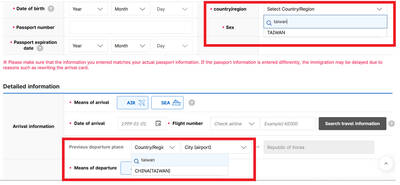
Jason Han says that the e-arrival card spat between South Korea and Taiwan shows that Seoul is signaling adherence to its “one-China” policy, while Taiwan’s response reflects a reciprocal approach. “Attempts to alter the diplomatic status quo often lead to tit-for-tat responses,” the analyst on international affairs tells the Taipei Times, adding that Taiwan may become more cautious in its dealings with South Korea going forward. Taipei has called on Seoul to correct its electronic entry system, which currently lists Taiwan as “China (Taiwan),” warning that reciprocal measures may follow if the wording is not changed before March 31. As of yesterday,
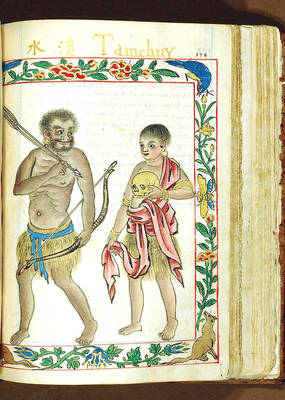
The Portuguese never established a presence on Taiwan, but they must have traded with the indigenous people because later traders reported that the locals referred to parts of deer using Portuguese words. What goods might the Portuguese have offered their indigenous trade partners? Among them must have been slaves, for the Portuguese dealt slaves across Asia. Though we often speak of “Portuguese” ships, imagining them as picturesque vessels manned by pointy-bearded Iberians, in Asia Portuguese shipping between local destinations was crewed by Asian seamen, with a handful of white or Eurasian officers. “Even the great carracks of 1,000-2,000 tons which plied

On Thursday, former Taipei mayor and founder of the Taiwan People’s Party (TPP) Ko Wen-je (柯文哲) was sentenced to 17 years in prison and had his civil rights suspended for six years over corruption, embezzlement and other charges. Seven others related to the case were also handed prison sentences, while two were found not guilty. It has been a bad week for the TPP. On Tuesday, prosecutors charged Chinese immigrant Xu Chunying (徐春鶯) with suspicion of taking part in Beijing-directed election interference. Xu has strong links to the TPP, which once offered her a party list legislator nomination. Tuesday also


 RSS
RSS