


For Steve Huison, his role as a British rail track worker in the film Navigator is not just a character he played, but long an issue of concern. The English actor, known internationally as one of the male strippers in The Full Monty, was in Kaohsiung, the city of workers, to join the first International Labor Film Festival yesterday.
Many people likely remember Huison's role as the weakly, unemployed man who tried to commit suicide before Robert Carlye saved him and talked him into joining his comical strip show. But in reality, he is not feeble at all. The son of communist parents, he is not only well-known in film and theater, but a social activist -- a dirty name in Huison's words.
This is perhaps how Huison came to work so closely with renowned filmmaker Ken Loach, who is well-known for his sharp and brilliantly told stories about social concern for the plight of workers. His films include Bread and Roses (1999), My Name is Joe (1998) and Land and Freedom (1995). Loach recently received a nomination for the upcoming 2002 Cannes International Film Festival for his latest work, Sweet 16.
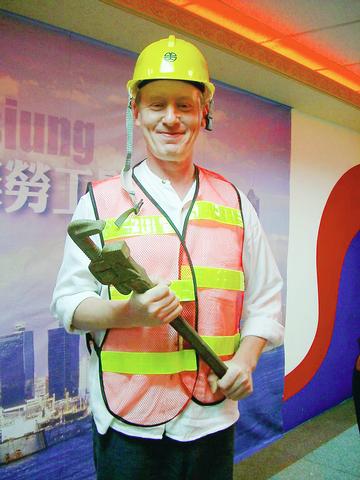
PHOTO: YU SEN-LUN, TAIPEI TIMES
Huison is in Kaohsiung representing Loach's 2001 work, Navigator, as the festival's opening film, and to share the British labor experience with unions in Kaohsiung.
"The film tells a story of real people and real feelings, facing the privatization of state-owned businesses, which is also happening here in Taiwan," Huison said.
Navigator focuses on the privatization of British Rail in 1995. Problems arose when the tracks were divided among different businesses and workers were laid off or forced to adapt to new management. Maintenance costs were cut dangerously low and the ensuing chaos results in the tragic death of a rail track maintenance worker.
Loach's use of a hand-held camera fluently blends black humor with the workers' plight to show the absurdity of privatization.
Also joining the festival as a guest is US documentarian Vivian Price, who has focused on female construction workers around the world. Her film Hammering it Out: Women in the Construction Zone, is a portrait of female construction workers in US. Price said her labor consciousness arose from her own experiences working at construction sites. Price, who has a doctoral degree and is a licensed electrician, said she was fired from one job after another for being a "troublemaker" in the eyes of her employers. She then began filming the plight of female workers.
After arriving Kaohsiung, Price immediately went to local construction sites to film female workers. She said, "I saw the strength in them, some of them have been working for 20 years."
Apart from Hammering it Out and Navigator, there are eight other films showing at the three-day festival which runs from Friday though Sunday. They include Oscar-winner American Dream, a documentary about laborers' struggle with their employer, a famous meat-product packaging company that makes Spam. Also showing is the French documentary Whatever it Costs, about a catering company staffs' struggle with their bosses.
Entrance for all screenings is free. For schedule information visit http://labor.kcg.gov.tw, or call the Cannes Cinema in Kaohsiung at (07) 321-0663.

The Lee (李) family migrated to Taiwan in trickles many decades ago. Born in Myanmar, they are ethnically Chinese and their first language is Yunnanese, from China’s Yunnan Province. Today, they run a cozy little restaurant in Taipei’s student stomping ground, near National Taiwan University (NTU), serving up a daily pre-selected menu that pays homage to their blended Yunnan-Burmese heritage, where lemongrass and curry leaves sit beside century egg and pickled woodear mushrooms. Wu Yun (巫雲) is more akin to a family home that has set up tables and chairs and welcomed strangers to cozy up and share a meal
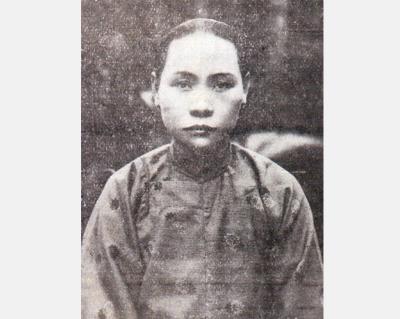
Dec. 8 to Dec. 14 Chang-Lee Te-ho (張李德和) had her father’s words etched into stone as her personal motto: “Even as a woman, you should master at least one art.” She went on to excel in seven — classical poetry, lyrical poetry, calligraphy, painting, music, chess and embroidery — and was also a respected educator, charity organizer and provincial assemblywoman. Among her many monikers was “Poetry Mother” (詩媽). While her father Lee Chao-yuan’s (李昭元) phrasing reflected the social norms of the 1890s, it was relatively progressive for the time. He personally taught Chang-Lee the Chinese classics until she entered public

Last week writer Wei Lingling (魏玲靈) unloaded a remarkably conventional pro-China column in the Wall Street Journal (“From Bush’s Rebuke to Trump’s Whisper: Navigating a Geopolitical Flashpoint,” Dec 2, 2025). Wei alleged that in a phone call, US President Donald Trump advised Japanese Prime Minister Sanae Takaichi not to provoke the People’s Republic of China (PRC) over Taiwan. Wei’s claim was categorically denied by Japanese government sources. Trump’s call to Takaichi, Wei said, was just like the moment in 2003 when former US president George Bush stood next to former Chinese premier Wen Jia-bao (溫家寶) and criticized former president Chen

President William Lai (賴清德) has proposed a NT$1.25 trillion (US$40 billion) special eight-year budget that intends to bolster Taiwan’s national defense, with a “T-Dome” plan to create “an unassailable Taiwan, safeguarded by innovation and technology” as its centerpiece. This is an interesting test for the Chinese Nationalist Party (KMT), and how they handle it will likely provide some answers as to where the party currently stands. Naturally, the Lai administration and his Democratic Progressive Party (DPP) are for it, as are the Americans. The Chinese Communist Party (CCP) is not. The interests and agendas of those three are clear, but


 RSS
RSS