


On his third day off heroin, Wu Chia-chin (
With a groan, he cowered under the sheets of his bed to escape the piercing sunlight when Reverend Simon Lau (
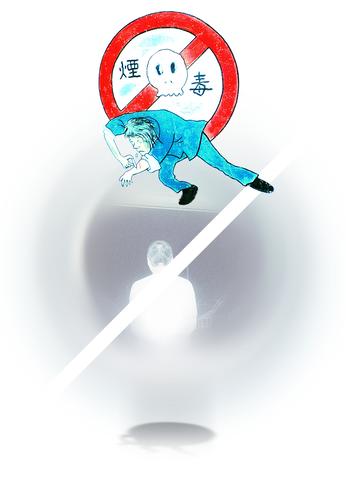
"You look better," Lau said, trying to offer what comfort he could. The mentor who was charged with accompanying Wu in the cabin 24 hours a day through the initial detox phase explained to the reverend that Wu had just finished a violent bout of vomiting, but that he was otherwise doing much better than the previous day. Lau listened, scratching his chin while looking down at Wu who was struggling to form a polite smile and trying to conceal his forearms under his sheets.
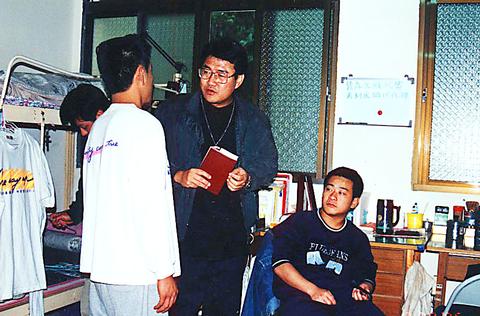
PHOTO COURTESY OF OPERATION DAWN
"You don't need to hide those scars from me. I've been where you are and everything will be fine," the former heroin addict-turned therapist and Christian said.
Then the three huddled and the reverend held Wu's hands as he led a prayer with his booming preacher voice calling for the love and strength of God to protect Wu and guide him through the terrible withdrawal symptoms he was suffering. The mentor chimed in with several "amens" and "praise be's."
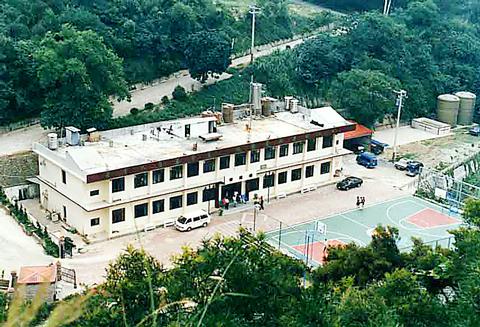
PHOTO COURTESY OF OPERATION DAWN
"This isn't cold turkey. We call it `warm turkey,' because we use God's love to lead the way," Lau later said, as he wandered the expansive grounds of the rehabilitation center set in the hills above Miaoli City. The center's open gate, outdoor basketball court, vegetable gardens, manicured lawns and panoramic view of the town and the mountains beyond make the center appear more like a camp resort than a rehab filled with recovering drug addicts and hardened criminals.

PHOTO COURTESY OF OPERATION DAWN
The universal opinion among the patients at the center, which offers free treatment for one and a half years, is that they are lucky to be there and Wu, three weeks after his admission to the center, was evidence of why. He had gained 8kg, his scars and sores were healing nicely and he walked with a cheerful spring to his step. He said he spent six miserable months on the center's waiting list during which time he shot heroin right up until the day he was admitted. "I hope I make it through this time," he said.
Few options
Fifteen years of failed attempts to quit drugs and three stints in jail totaling eight years for drug offenses have made Wu acutely aware of the golden opportunity he has been handed. Most professionals in the field describe the resources devoted to drug rehabilitation, whether public, private or non-profit, as wholly inadequate and he landed at the rehab center with arguably the highest success rate at preventing addiction relapse in the country.
His luck is based on simple numbers. Though it does not keep track of its admission rates, Lau estimates that Operation Dawn turns away nine out of 10 applicants. Similarly high rates were quoted by the directors of Taiwan's two other Christian-based drug rehabilitation centers, House of Grace (沐恩之家) and Agape House (主愛之家).
"We have space, but neither the funding nor the trained personnel to take in more patients. If we took in more patients, the quality of care would drop and that would be in no one's interest," said Reverend Wang Ming-shih (王銘石), a graduate of Operation Dawn and director of House of Grace, summarizing the situation in the country's Christian rehabilitation centers.
Operation Dawn is the largest of the three with 86 patients currently residing at centers in Miaoli, Taitung, Tainan and Yungho, Taipei County. House of Grace in Pingtung and Agape House in Hualien each currently house 25 patients. The number fluctuates as patients drop out or graduate, but it never exceeds 150 within the Christian charity organizations. The figure is tiny considering that in 2000, the most recent year for which statistics are available, hospitals recorded 41,074 admittances for drug rehabilitation treatment. And that is only the number of drug abusers who took the step to seek treatment.
"The vast majority of drug users try to quit at home, but a serious drug addiction is more powerful than an individual's will to quit. Formal treatment is the best method," said Su Wen-lien (
Professionals involved in treatment and officials at the Department of Health agree that to overcome an addiction to drugs such as heroin, amphetamines, FM2, ketamine and MDMA, or ecstasy, long-term treatment at one of the Christian charity centers, or at a hospital yields the most likely prevention of relapse.
But the problem within the medical system, Su said, is that nationwide only about a dozen hospitals -- the main public ones being the Taipei City Psychiatric Center, Kaohsiung's Kai-Suan Psychiatric Hospital (高雄市立凱旋醫院) and the Tsaotun Psychiatric Center (
Effective long-term care, according to the health department, involves the initial detox phase, which can last up to 10 days depending on the addiction, and then the far more crucial psychiatric counseling and follow-up care that ideally should last for up to one year.
With limited spaces at the few hospitals that offer long-term treatment, addicts must first be admitted to a program and then pay the high treatment costs on their own, which are often equal to or higher than the cost of the person's addiction.
Wu Chia-chin, for example, said his heroin habit cost NT$4,000 to NT$5,000 per day, while an overnight stay in a hospital detox ward can cost upwards of NT$5,000 because the National Health Insurance currently does not cover treatment for addiction to narcotics. The economic incentive to quit, he said, was not there.
Assuming an addict is admitted and can handle the financial burden at a hospital, the cost of the first week residence detox phase is between NT$20,000 and NT$30,000. Following detox, the person is then required to return to the hospital each day to pick up medication and for spot urine tests and counseling.
Heroin addicts, for example, are prescribed naltrexone, an antagonist drug that eliminates the heroin high. A daily dose costs NT$143 at public hospitals, but can be as high as NT$200 at private institutions and it must be followed for six months. According to Su, without complications or relapse, a successful rehabilitation costs at least NT$70,000.
But even at such a high cost, long-term drug rehabilitation treatment is a money-losing endeavor for hospitals, which explains why only a handful actually bother.
"The costs for hospitals that do psychiatric care and follow-up are huge and the results are often poor because relapse rates are high and complications are frequent. There simply aren't the immediate, positive results that make the government think this is a task worth throwing lots of resources at," said Lin Tsang-yaw (林滄耀), staff psychiatrist at the health department's Tsaotun Psychiatric Center.
Reverend Wang of House of Grace has harsher words for the government's efforts in the area of substance abuse rehabilitation. "They're a bunch of bureaucratic paper pushers at the Department of Health and Ministry of Justice. The government does nothing because it's afraid to get involved."
Doing the best it can?
Wu Wen-cheng (吳文正), section chief at the health department's Bureau of Medical Affairs which has formulated policy toward drug rehabilitation, finds the criticism misplaced. He points to his department's most recent statistics to back up his contention that demand has largely been met with an increase in the number of institutions officially offering rehabilitation facilities and personnel from 132 in 1995 to 147 in 2000, and an increase in the number of dedicated bed spaces from 718 to 814 in the same period. He said he was unable to comment on the relative effectiveness of the hospitals, but allowed that "most are stronger in detox phase treatment than in psychiatric care and follow-up."
Yet the strongest evidence, he said, of the government's close attention to the problem was the Statute for Narcotics Hazard Control (
The new law introduced the novel concept of patient-criminal (病犯) and was essentially a compromise between progressives looking toward a decriminalization of drug use and those who were apprehensive about softening the country's iron-fisted judicial stance toward drug users. It reduced sentences and, more significantly, stipulated that patient-criminals, who numbered 21,411 last year, were entitled to treatment for up to one month at an observation detox unit in a hospital, instead of at a detention center or jail.
Though unquestionably well-intentioned, the new law's implementation has proven an unqualified disaster.
"Once the law was implemented, it became obvious that the resources available to undertake the job were simply not there. Cost-benefit analysis showed it wasn't worthwhile to try to meet the conditions set out in the law," said an official at the justice ministry's division of corrections who preferred to remain anonymous. He was citing a report titled A Cost-Benefit Analysis of the Incarceration Costs and Medical Costs of Drug Abuse (
"The `patient' aspect of `patient-criminal' as it is mentioned in the law is ignored in reality." Currently, the justice ministry is working to amend the statute so that treatment at detention centers fall within the parameters of the law and in essence accommodate the problem that the law was originally intended to fix.
The current situation, which is in violation of the law, short-changes patient-criminals by providing less intensive care at overburdened clinics inside the penal system's detention centers and jails where relapse rates upon release are staggeringly high, Su said.
Though relapse rates are impossible to gauge with accuracy, nearly everyone in the field, including the health department's Wu and recovering addicts, finds the department's claim that only 44 percent of patients exiting observation detox units exhibit a risk of relapse to be highly suspect.
Wu Chia-chin found the figure laughable. "I can tell you from experience, jail is no place to get off drugs."
On the wagon
Walking through the Christian rehabilitation centers, it's obvious why demand for treatment at their facilities is enormous.
Not only is the program free, it can extend to over four years if the patients become counselors and continue to live at the centers, which is another means of observation and follow-up. The centers are strict, use neither force nor medication and boast impressively high rates of bringing addicts permanently off drugs -- around 25 to 30 percent at Operation Dawn, according to Lau. As an added benefit, they are also situated in stunning, quiet rural settings that patients say help their recovery.
The centers feel like a community, with patients calling each other "brother" or "sister," and the patients seem genuinely happy to be there and talk openly about their addictions and shady pasts.
By contrast, the Tsaotun Psychiatric Center is a dismal, hulking concrete eyesore set behind a 3m wall topped with barbed wire, where patients are watched through closed-circuit surveillance cameras. When looking through the slat holes in the walls into the rooms, the patients scowl in return and refuse interviews.
Though uncomfortable with the heavy religious content of the counseling, Wu Chia-chin said he is willing to try to adopt Christianity for the sake of leaving his life of crime and decadence behind. "My life was worthless before. I blew all my previous chances and this is probably the best and last one I'll get."
It is not unprecedented that the Christian centers re-admit patients who dropped out midway through their program, but these cases tend to be rare. The few spaces must be offered to the truly committed. Those that fail at the Christian centers are left to face an expensive and sparse medical system if they want to get off drugs or a deficient penal system when they eventually get caught on drugs.
Reverend Lau and Su at the Taipei City Psychiatric Center echoed each other's words in saying that the drug problem will only get worse in the years to come and that more needs to be done on the enforcement, education and medical treatment fronts to confront the problem.
Wu Wen-cheng at the health department agreed, but could not foresee a forceful drive on the government's part to bolster drug addiction treatment. "It's simply not a budgetary priority at this stage. We're hoping civil groups will pick up the slack."

Ajay Verma, a consultant gastroenterologist at Kettering general hospital in Northamptonshire, says our gut is a “complex machine.” “It is constantly providing us with the nutrition we need, initially to grow and develop, and then for us to survive, thrive and repair from injury and illness.” How can we keep it functioning well? Put simply: “Make sure what you put into it is balanced, and that you clear out its waste products adequately,” Verma says. “In a general gastroenterology clinic, the most common conditions we see are irritable bowel syndrome (IBS), gastroesophageal reflux disease, inflammatory bowel disease and constipation,” says Nisha
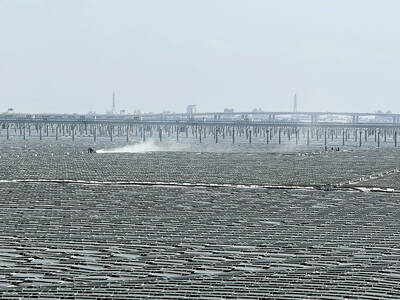
The arithmetic is straightforward and uncomfortable. By the end of 2025, Taiwan had committed itself to a 50-30-20 electricity mix — half natural gas, 30 per cent coal, 20 per cent renewables. The Ministry of Economic Affairs’s (MOEA) own monthly energy reports tell a different story. Natural gas reached 47.8 per cent of generation last year. Coal stood at 35.4 per cent, comfortably above its target ceiling. Renewables came in at 13.1 per cent, well short of the 20 per cent Taipei had pledged a decade earlier. Installed renewable capacity reached roughly half of the 12 gigawatts (GW) the government

Last week US President Donald Trump was asked by a reporter whether he would speak on the phone to the President of Taiwan. “l’ll speak to him. I speak to everybody. We have that situation very well in hand,” Trump said. This marked the second time in a couple of weeks he had said he would talk to the President of Taiwan. In 2016 he famously took a call from then-president Tsai Ing-wen (蔡英文), when he was president-elect. Despite warnings that the apocalypse was nigh because of a phone call, the world quickly forgot about the conversation between two democratically-elected presidents.

May 25 to May 31 Few believed that apples could be cultivated on a commercial scale in Taiwan’s high mountains. When horticulturalist Cheng Chao-hsiung (程兆熊) first proposed the idea in 1955, both American and Taiwanese colleagues dismissed it as implausible, arguing that temperate fruit could not be reliably grown on a subtropical island, especially on rugged terrain. However, it was this terrain in the Central Mountain Range where many Chinese Civil War veterans were resettled in the late 1950s. With limited job prospects and no family in Taiwan, they were placed on cooperative farms aimed toward self-sufficiency. Some say the conditions


 RSS
RSS