


Many outstanding performances have been booked for the newly reopened Chungshan Hall in Taipei. The reopening of this venue, after extensive renovations, has great historical resonance for Taipei's arts community. For Liu Feng-Shueh (
The desire to understand the music and dance of our forefathers is a relatively recent phenomenon; most evident in the huge popularity of CDs of music "performed on original instruments." In Taiwan, traditions of nan-kuan music struggle for contemporary relevance, but the restrained beauty of ancient music has great appeal for a minority of admirers.
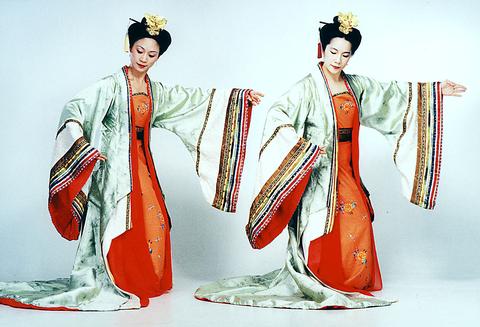
PHOTO COURTESY OF NEO-CLASSIC DANCE COMPANY
According to Liu, the Tang dynasty was the height of China's development in music and dance, but these two subjects have been little researched. "Music [in the Tang dynasty] had some attention dedicated to it in relation to culture," Liu said, "but the relationship between dance and music has not been sufficiently studied." Spurred on by a desire to understand her own culture better, Liu has dedicated a lifetime to re-creating ancient Tang dance, which has been very influential for both China and Japan.
Watching The Singing of Spring Orioles, one of the pieces in the program, you get a feeling of a dance which is recognizably Chinese, but which has a restrained and monumental dignity that is totally different from the boisterousness of Beijing Opera and is closer in mood to something like Japan's No drama. Neo-classical, which is considered a contemporary dance group, faced a considerable challenge in adapting to this new -- or old, depending on how you look at it -- style of dance.
"In modern dance, the emphasis is on large movements, stretching yourself or scrunching yourself up real small," Liu said, "It wasn't easy to achieve the restraint that is needed for this kind of dance."
Much of Liu's research was done in the imperial court in Japan, were valuable manuscripts have been preserved. The sixth century was a period of great cultural ferment for China and Liu pointed out the strong influence of Central Asia in many of the dances. In the dance Pa Tou a mask is used -- rather than the conventional Chinese painted face -- and many of the movements have elements of shamanistic ritual. In a sense, these dances are a formulistic representation of the great philosophical movements of that period, with aspects of Islam, Buddhism, Taoism and Confucianism.
Liu emphasized the importance of the historical research that has gone into creating these pieces and only minutes into the performance you will see that this is quite different from imitation or modernized Tang-style dance with its balletic movements that are totally at odds with the Confusion dignity that lies at that heart of pieces such as Spring Orioles.
While not particularly lively, this is a chance to enjoy new concepts and also the outstanding execution of what is probably as close as we will ever get to those glory days of Chinese dance and music.
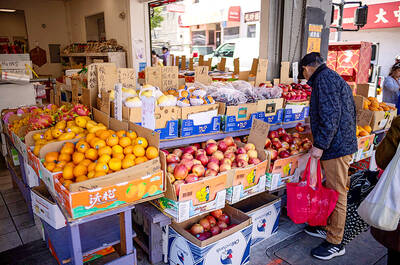
Ajay Verma, a consultant gastroenterologist at Kettering general hospital in Northamptonshire, says our gut is a “complex machine.” “It is constantly providing us with the nutrition we need, initially to grow and develop, and then for us to survive, thrive and repair from injury and illness.” How can we keep it functioning well? Put simply: “Make sure what you put into it is balanced, and that you clear out its waste products adequately,” Verma says. “In a general gastroenterology clinic, the most common conditions we see are irritable bowel syndrome (IBS), gastroesophageal reflux disease, inflammatory bowel disease and constipation,” says Nisha
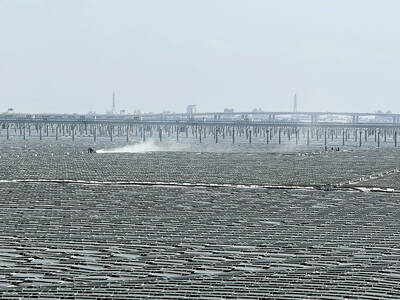
The arithmetic is straightforward and uncomfortable. By the end of 2025, Taiwan had committed itself to a 50-30-20 electricity mix — half natural gas, 30 per cent coal, 20 per cent renewables. The Ministry of Economic Affairs’s (MOEA) own monthly energy reports tell a different story. Natural gas reached 47.8 per cent of generation last year. Coal stood at 35.4 per cent, comfortably above its target ceiling. Renewables came in at 13.1 per cent, well short of the 20 per cent Taipei had pledged a decade earlier. Installed renewable capacity reached roughly half of the 12 gigawatts (GW) the government

Last week US President Donald Trump was asked by a reporter whether he would speak on the phone to the President of Taiwan. “l’ll speak to him. I speak to everybody. We have that situation very well in hand,” Trump said. This marked the second time in a couple of weeks he had said he would talk to the President of Taiwan. In 2016 he famously took a call from then-president Tsai Ing-wen (蔡英文), when he was president-elect. Despite warnings that the apocalypse was nigh because of a phone call, the world quickly forgot about the conversation between two democratically-elected presidents.
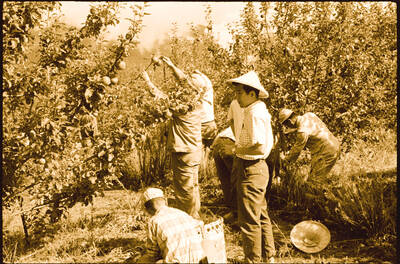
May 25 to May 31 Few believed that apples could be cultivated on a commercial scale in Taiwan’s high mountains. When horticulturalist Cheng Chao-hsiung (程兆熊) first proposed the idea in 1955, both American and Taiwanese colleagues dismissed it as implausible, arguing that temperate fruit could not be reliably grown on a subtropical island, especially on rugged terrain. However, it was this terrain in the Central Mountain Range where many Chinese Civil War veterans were resettled in the late 1950s. With limited job prospects and no family in Taiwan, they were placed on cooperative farms aimed toward self-sufficiency. Some say the conditions


 RSS
RSS