


Based out of an isolated mountain retreat located on Laochuan Mountain (老泉山) in the Taipei suburb of Mucha, Taiwan's U Theatre (優劇場) is one of the nation's most reclusive performance troupes.
Since its founding in 1988, U Theatre has ventured down form its mountain hideaway on only a couple of dozen occasions. The most memorable of which took place in 1996, when the troupe set out on a 600km odyssey that saw them traversing the island's mountainous hinterland on foot and performing at temples scattered throughout the central mountain range.
Under the guidance of artistic director and founder Liu Ching-ming (
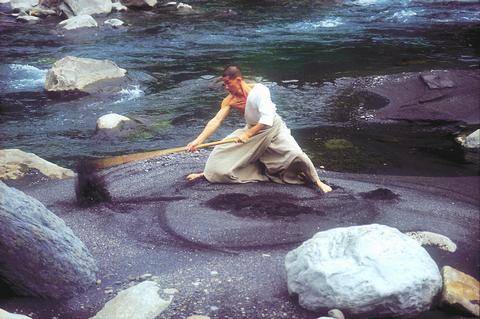
PHOTO: COURTESY OF U THEATRE
The troupe was experimenting with traditional lion-dance drumming in the early 1990s. At that time, percussionist Huang Chih-wen (
"I guess living as we do in the mountains has led itself to the mystery that surrounds us," said Coai Lin (林益慶), U Theatre's manager. "But it's really the only place we can live. There we can prepare ourselves both mentally, physically and spiritually in a natural and unpolluted environment."
The troupe follows a strict lifestyle. There's no skulking off to the bar between rehearsals for troupe members. Instead, martial arts and meditation play a major part in the daily lives of the troupe.
"Physical and mental wellbeing go hand-in-hand with our performances," said Lin. "Our performances aren't easily explainable shows with a story line. We use percussion as a base, but the true meaning of the show lays within the mood projected by the players."
Lifestyle isn't the only aspect that sets U Theatre apart from its theatrical peers. Unlike other groups who stage two or three productions annually, U Theatre restricts itself to one fresh production every couple of years.
Since Huang revamped U Theatre in 1993, the troupe has only produced four original works: U Theatre Sacred Drumming (優人神鼓. 1994), Voyage of Self Discovery (心戲之旅, 1995), Days of Planting Flowers (種花的日子, 1997) and The Sound of the Ocean (聽海之心, 1998).
"We don't see the need to produce a new show every year, as we believe that, before we can move on, we must ensure that we have explored all aspects of previous shows," said Lin. "We're still honing and performing The Sound of the Ocean.
Although U Theatre will not be premiering Meeting with Manjusri Bodhjsattva until mid-December, the limited number of performances, coupled with the troupe's immense popularity, mean that tickets are selling quickly.
Performance Notes
What: Meeting with Manjusri Bodhjsattva (持劍之心)
When & Where: The Hsinchu Cultural Center (新竹市立文化中心) on Dec. 14 and Dec. 15 and at Taipei's Novel Hall (新舞臺) Dec. 18 to Dec. 21. All shows begin at 7:30pm.
Tickets: Tickets for Hsinchu performances cost from NT$400 to NT$1,000 and for Taipei shows from NT$400 to NT$1,200. Tickets for both venues are available through all national ticketing outlets.

Ajay Verma, a consultant gastroenterologist at Kettering general hospital in Northamptonshire, says our gut is a “complex machine.” “It is constantly providing us with the nutrition we need, initially to grow and develop, and then for us to survive, thrive and repair from injury and illness.” How can we keep it functioning well? Put simply: “Make sure what you put into it is balanced, and that you clear out its waste products adequately,” Verma says. “In a general gastroenterology clinic, the most common conditions we see are irritable bowel syndrome (IBS), gastroesophageal reflux disease, inflammatory bowel disease and constipation,” says Nisha
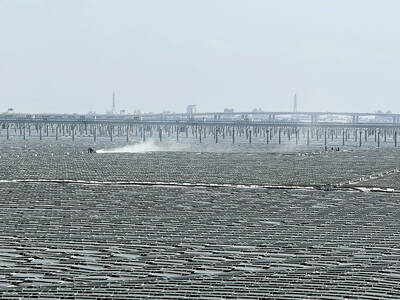
The arithmetic is straightforward and uncomfortable. By the end of 2025, Taiwan had committed itself to a 50-30-20 electricity mix — half natural gas, 30 per cent coal, 20 per cent renewables. The Ministry of Economic Affairs’s (MOEA) own monthly energy reports tell a different story. Natural gas reached 47.8 per cent of generation last year. Coal stood at 35.4 per cent, comfortably above its target ceiling. Renewables came in at 13.1 per cent, well short of the 20 per cent Taipei had pledged a decade earlier. Installed renewable capacity reached roughly half of the 12 gigawatts (GW) the government

Last week US President Donald Trump was asked by a reporter whether he would speak on the phone to the President of Taiwan. “l’ll speak to him. I speak to everybody. We have that situation very well in hand,” Trump said. This marked the second time in a couple of weeks he had said he would talk to the President of Taiwan. In 2016 he famously took a call from then-president Tsai Ing-wen (蔡英文), when he was president-elect. Despite warnings that the apocalypse was nigh because of a phone call, the world quickly forgot about the conversation between two democratically-elected presidents.
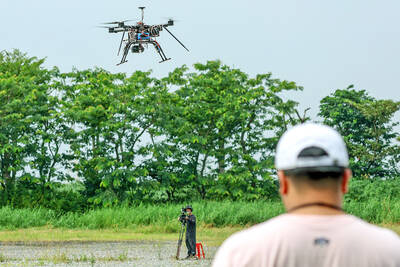
Taiwan’s drone exports are taking off, fuelled by the war in Ukraine, as Taiwanese companies seek a stake in the fast-growing global market for unmanned aerial vehicles (UAV). Low-cost drones used for reconnaissance and strikes are in high demand as governments around the world boost defense spending in the face of intensifying conflicts. A relative new player in the increasingly competitive industry, Taiwan’s pitch is to be an “Asian hub” for the production of UAVs and components free of Chinese materials, or “non-red.” That means its UAVs can be up to three times more expensive than their Chinese competitors, like the world’s biggest


 RSS
RSS