


One can say that the Tao Te Ching (道德經) changed Goran Malmqvist's life.
Unable to appreciate the 6th-century Chinese classic in its original linguistic splendor, the young Swede tried to fathom Lao Tzu's (老子) wisdom in French, German and English. But the differing translations of the same passages only confused him further. Finally he sought the help of the great sinologist, Bernhard Karlgren, and was so dazzled by the hint of poetic possibilities in Karlgren's interpretations that he changed his course of studies from Latin to Chinese.
In 1948, near the end of the Chinese Civil War, Malmqvist went to the heartland of China to study regional Chinese dialects. In an ancient monastery of Sichuan Province, he lead the ascetic life of a Buddhist initiate, doing cleaning chores and studying. Except instead of Buddhist scriptures, he studied Tang and Sung poetry under the monastery's head, who was a classic scholar-turn-monk but who deviated wildly from the traditional rules of abstinence. Between puffs of opium and quaffs of rice wine, the head monk taught this young student to write poems in classical Chinese. Before his return to Sweden, Malmqvist also found time to fall in love with an opera-singer, who later became his wife.

PHOTO: CHEN CHENG-CHANG, TAIPEI TIMES
After Karlgren's death, Malmqvist became the most prominent Swedish sinologist. He continued his mentor's work of teaching about the great Chinese classical writers at the University of Stockholm and translating such poets as Tao Yuan-ming (陶淵明) and Su Tung-po (蘇東坡) into Swedish. In 1985, he became the first sinologist ever to be elected into the venerated Swedish Academy.
Founded by Gustaf III in the 18th century for the aim of maintaining the "purity, vigor, and majesty" of the Swedish language, the Swedish Academy consists of 18 life-long members, all scholars or writers.
Since 1901, the Academy assumed literary importance on a global scale, being charged with the task of accepting nominations from around the world for the Nobel Prize in literature and deciding on a winner. Many of the laureates in the first half of the century are now forgotten and accusations of euro-centrism have long dogged the world's most prestigious literary prize. The addition of the sinologist into the academy was clearly intended to correct the earlier imbalance in the judging. Since his election into the academy, Malmqvist switched his focus from ancient to contemporary Chinese literature and has made frequent trips to Taiwan, Hong Kong and China, making many friends among Chinese writers.
Needless to say, since his election, many in Taiwan have placed great hopes on seeing a writer writing in Chinese winning Nobel.
Chinese authors showered him with books and would repeatedly ask: "who is the most likely Chinese to win the Nobel?" or: "Who's your favorite Chinese living writer?" Malmqvist would typically provide only evasive answers to these queries, saying he liked a bit of everything. And he was speaking the truth, as Chinese writers were often dazzled by his deep knowledge of and passion for contemporary Chinese letters.
When Gao Xingjian (
But not many of Malmqvist's or Gao's friends in Taiwan were surprised. In recent years, the pool of possible Chinese-language contenders for a Nobel Prize had narrowed considerably. The choice ultimately boiled down to three usual suspects, the poet Bei Dao (北島), the novelist Li Rui (李瑞) and Gao, as they are the three Chinese authors, thanks to the efforts of Malmqvist, best known in Sweden. With the only exception of France, where Gao has lived in exile since 1988, Sweden was the only western country in which Gao's works were available in translation.
Malmqvist first knew of Gao's writings in the 1980s. During a trip to Beijing, he tried to meet Gao, but it was not until Malmqvist had translated a number of Gao's plays into Swedish and had them produced in Stockholm did Gao finally met his Swedish champion.
Malmqvist was also one of the first readers of Gao's masterpiece, Soul Mountain. In fact, Malmqvist had undertaken a translation of the 700-page novel into Swedish before its Chinese publication. When he found Gao's handwriting difficult to decipher, he contacted Gao's friends in Taiwan to find a publishing house for the book.
Immediately following the 2000 Nobel announcement, Malmqvist was briefly caught up in controversy. Forum, the original Swedish publisher of Soul Mountain, had received a request from Gao asking for termination of contract. So, just 10 days before the Nobel announcement, the Swedish publication rights of the book went to another publisher, Atlantis, which was owned by a friend of Malmqvist. When Forum learned that they just lost a Nobel winner, they cried foul and raised questions of a conflict of interest. And no one was more happy to point the finger at Malmqvist than authorities in Beijing who had viewed the choice of Gao for the Nobel as a backhanded attack on its political legitimacy.
Beijing, who has banned Gao's works since the 1980s, continues to blacklist the writer, despite his being the first Chinese-language Nobel winner. According to Chinese officials, there are at least 200 writers better than Gao in China. When newspapers in Beijing discovered the Forum-vs-Atlantis dispute, they avidly picked up the story and widely painted Malmqvist as a self-interested merchant of literature. Malmqvist has stridently denied all accusations.
Without question, he was the prime mover behind last year's Nobel with the power to recommend authors to his colleagues at the Swedish Academy. As for the letter Forum received from Gao, he explained that the author had sent it in summer, but that the letter had gone lost in the mail and didn't reach its addressee until October.
After the fog was cleared and all the misunderstandings explained, the two houses in Stockholm settled into post-Nobel peace. Atlantis got the publication rights for Soul Mountain and Forum got a story collection titled A Fishing Rod for my Grandpa.
The 77-year-old Malmqvist has retired from Stockholm University and has just finished editing Frontier Taiwan : an anthology of modern Chinese poetry, which will be published simultaneously in the US by Columbia University Press, in Taiwan by Rye Field and in China by Beijing Literature Publishing House.
He is currently in Taipei and will give a lecture in English Feb. 2 at 4pm at the Taipei International Book Exhibition on problems a translator encounters when introducing Chinese literature to readers abroad.

Taiwan’s overtaking of South Korea in GDP per capita is not a temporary anomaly, but the result of deeper structural problems in the South Korean economy says Chang Young-chul, the former CEO of Korea Asset Management Corp. Chang says that while it reflects Taiwan’s own gains, it also highlights weakening growth momentum in South Korea. As design and foundry capabilities become more important in the AI era, Seoul risks losing competitiveness if it relies too heavily on memory chips. IMF forecasts showing Taiwan widening its lead over South Korea have fueled debate in Seoul over memory chip dependence, industrial policy and
“China wants to unify with Taiwan at the lowest possible cost, and it currently believes that unification will become easier and less costly as time passes,” wrote Amanda Hsiao (蕭嫣然) and Bonnie Glaser in Foreign Affairs (“Why China Waits”) this month, describing how the People’s Republic of China (PRC) is playing the long game in its quest to seize Taiwan. This has been a favorite claim of many writers over the years, easy to argue because it is so trite. Very obviously, if the PRC isn’t attacking Taiwan, it is waiting. But for what? Hsiao and Glaser’s main point is trivial,
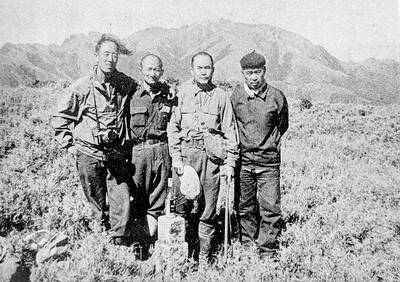
May 18 to May 24 Gathered on Yangtou Mountain (羊頭山) on Dec. 5, 1972, Taiwan’s hiking enthusiasts formally declared the formation of the “100 Peaks Club” (百岳俱樂部) and unveiled the final list of mountains. Famed mountaineer Lin Wen-an (林文安) led this effort for the Chinese Alpine Association (中華山岳協會). Working with other experienced climbers, he chose 100 peaks above 10,000 feet (3,048m) that featured triangulation points and varied in difficulty and character. The list sparked an alpine hiking craze, inspiring many to take up mountaineering and competing to “conquer” the summits. A common misconception is that the 100 Peaks represent Taiwan’s 100 tallest

Yesterday, the Democratic Progressive Party (DPP) nominated legislator Puma Shen (沈伯洋) as their Taipei mayoral candidate, the Chinese Nationalist Party (KMT) put their stamp of approval on Wei Ping-cheng (魏平政) as their candidate for Changhua County commissioner and former legislator Tsai Pi-ru (蔡壁如) of the Taiwan People’s Party (TPP) has begun the process to also run in Changhua, though she has not yet been formally nominated. All three news items are bizarre. The DPP has struggled with settling on a Taipei nominee. The only candidate who declared interest was Enoch Wu (吳怡農), but the party seemed determined to nominate anyone


 RSS
RSS