


After four years in New York, Yang Ming-dye brings home a ground-breaking art form, turning an ancient craft into an modern art form. Based on the traditional techniques of glass work, but with the inclusion of a wide variety of other techniques and media, Yang presents us with abstract glass sculptures that are a new kind of multimedia art.
Some critics have suggested that Yang is the first local artist to make use of glass, an often merely utilitarian material, in sculpture. While glasswork has been popular in Taiwan for ornamental work, Yang has taken the medium to a new level with his multimedia abstract forms.
On view, you will see glass fired into translucent forms, many in undefined, cloud-like shapes. Some contain colored silk screen prints which create a webbed effect not unlike a crumpled old map. This effect is an extension of Yang's skill in printmaking, for which he has won many awards. His ability to embed objects into his kiln-fired sculptures greatly enhances their appeal.
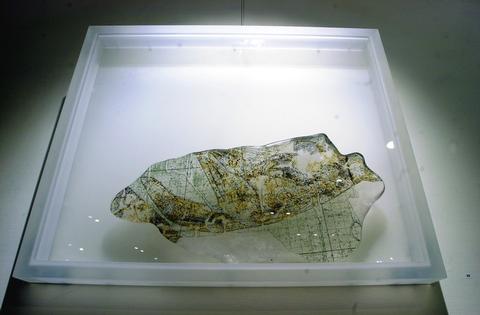
PHOTO: CHEN CHENG-CHANG, TAIPEI TIMES
Some of the patterned glass clouds hang in the air supported by almost invisible steel wires. The combination of the cloud motif with the map-like imbedded objects creates a strong suggestion of aspirations toward travel.
Yang's shy demeanour hides a forceful artistic personality that is clearly willing to take risks. His subjects are also ambitious. He creates a world under the sky with his glass clouds with imprinted maps on them. His glass world is a lot cleaner and freer than this real world we are in, his work inevitably suggests.
The exhibition also contains paper sculpture, standup pieces looking like fragments of large broken ceramic pots, and framed screen prints of abstract maps inspired by cracked and crazed walls of apartments he lived in during his early days. These are similar to the maps embedded in his abstract glass sculptures.
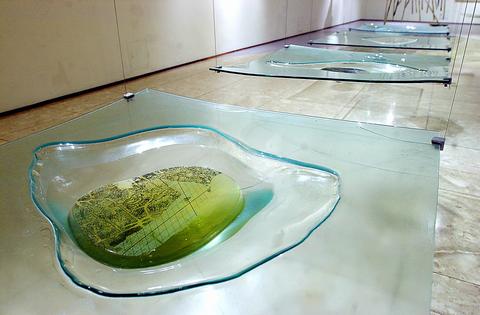
PHOTO: CHEN CHENG-CHANG, TAIPEI TIMES
A few of the works on display are in wax and acrylic. One extraordinary piece is a large cloud wrapped in thin plastic sheet, also imprinted with map-like patterns. A glass cloud fragment hanging in the air overlooks the ground sheet, symbolizing the earth from the point of view of an onlooker.
Yang's pioneering show has already created a sensation in local art circles, boosting the numbers of people visiting the art center. The show, as a showcase for cutting edge glass work clearly appeals to a much wider audience than art collectors. For those interested in making a purchase, Yang's glass clouds are priced from NT$7,000.
Wang Wan-chun is a self-confessed loner, a theme that underscores much of his recent work
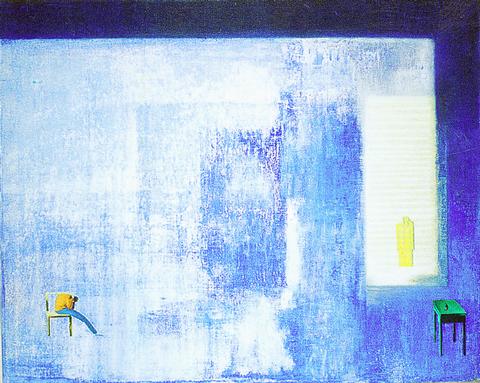
PHOTO: HANART GALLERY TAIPEI
For the 44-year-old artist, the canvasses of washed out acrylic colors are a reflection of his state of mind. Wang Wan-chun uses acrylic paint instead of brighter oil paints, rolling it onto the canvas to create images of emptiness, and a sense of being unsettled and lost.
"I don't like gravity," says Wang who appears shy even while presiding over his own solo exhibition. "I am floating, restless."
So are the figures in his paintings. They usually have pale faces and attenuated bodies, appearing at different corners of the canvas, having no relation to each other. They seem to be lost, drifting, and wandering towards nowhere.
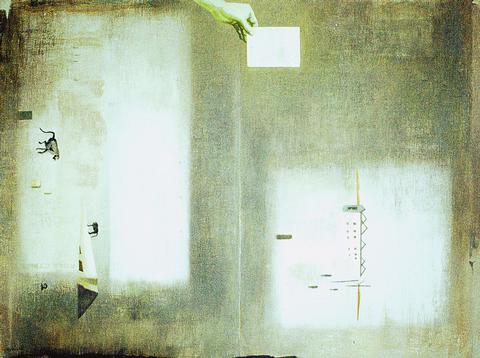
PHOTO: HANART GALLERY TAIPEI
One work, called Twenty-fourth Second (1/24秒) is placed right at the entrance of the show, is a great introduction to his work. A pale-looking man without any facial expression and a woman without facial features look as if they have been randomly pasted on to canvas. Visual Images and Conceptual Images (視象與意象) has small figures turning their back to the viewer. Against a pale beige background, they look like they are in the middle of a walk without a sense of direction.
Wang has always been a loner. He has traveled in the desert of northwestern China and married a woman from that desolate place. But even after his marriage, his work continues to reflect feelings of loneliness and pain.
According to Wang, in order for his wife to get residency in Taiwan, Wang had to stay in Singapore with her for the last two years. It was two years of total isolation for him. No family besides his wife, no friends and no exhibitions, Wang stayed in his studio and painted, a boring and empty kind of life style that stymied his development.
For Wang, concrete images lost their significance. So his figures, undersized and randomly placed on the canvasses, painted in blocks of washed out color, emphasize that they are merely "stage props" to the mood of emptiness that is Wang's main subject.
"Conceptual images are obscure," says Wang. "Because they are only minor props for the broader canvas."
With a total of 52 paintings on display, this is regarded as a large show. Most of the works on display were produced last year and during his year in Singapore.
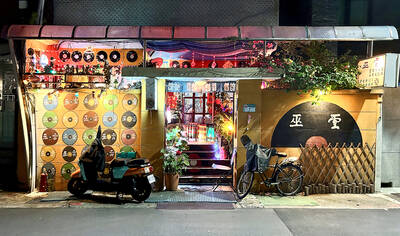
The Lee (李) family migrated to Taiwan in trickles many decades ago. Born in Myanmar, they are ethnically Chinese and their first language is Yunnanese, from China’s Yunnan Province. Today, they run a cozy little restaurant in Taipei’s student stomping ground, near National Taiwan University (NTU), serving up a daily pre-selected menu that pays homage to their blended Yunnan-Burmese heritage, where lemongrass and curry leaves sit beside century egg and pickled woodear mushrooms. Wu Yun (巫雲) is more akin to a family home that has set up tables and chairs and welcomed strangers to cozy up and share a meal
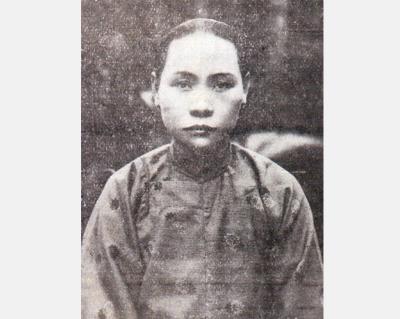
Dec. 8 to Dec. 14 Chang-Lee Te-ho (張李德和) had her father’s words etched into stone as her personal motto: “Even as a woman, you should master at least one art.” She went on to excel in seven — classical poetry, lyrical poetry, calligraphy, painting, music, chess and embroidery — and was also a respected educator, charity organizer and provincial assemblywoman. Among her many monikers was “Poetry Mother” (詩媽). While her father Lee Chao-yuan’s (李昭元) phrasing reflected the social norms of the 1890s, it was relatively progressive for the time. He personally taught Chang-Lee the Chinese classics until she entered public

Last week writer Wei Lingling (魏玲靈) unloaded a remarkably conventional pro-China column in the Wall Street Journal (“From Bush’s Rebuke to Trump’s Whisper: Navigating a Geopolitical Flashpoint,” Dec 2, 2025). Wei alleged that in a phone call, US President Donald Trump advised Japanese Prime Minister Sanae Takaichi not to provoke the People’s Republic of China (PRC) over Taiwan. Wei’s claim was categorically denied by Japanese government sources. Trump’s call to Takaichi, Wei said, was just like the moment in 2003 when former US president George Bush stood next to former Chinese premier Wen Jia-bao (溫家寶) and criticized former president Chen

President William Lai (賴清德) has proposed a NT$1.25 trillion (US$40 billion) special eight-year budget that intends to bolster Taiwan’s national defense, with a “T-Dome” plan to create “an unassailable Taiwan, safeguarded by innovation and technology” as its centerpiece. This is an interesting test for the Chinese Nationalist Party (KMT), and how they handle it will likely provide some answers as to where the party currently stands. Naturally, the Lai administration and his Democratic Progressive Party (DPP) are for it, as are the Americans. The Chinese Communist Party (CCP) is not. The interests and agendas of those three are clear, but


 RSS
RSS