


They're cram schools for driver's licenses. Places where doing is emphasized over understanding. And they're where many of Taipei's new drivers go before they hit the open road.
There are nine government recognized driving schools in Taipei, institutions that almost guarantee that students will get a license at the end of a one-month course. Charging between NT$8,000 and NT$13,000, they put students through a course of training tailored exclusively for the requirements of passing the driving test administered by the Motor Vehicle Supervision Department (台北市監理處).
But in the drive to provide licenses in a timely manner, sometimes driver awareness -- actually understanding the rules and having a feel for the road -- falls by the wayside, according to former students. Yet oddly enough, the number of accidents, injuries and fatalities from vehicle accidents is declining in Taipei -- and in Taiwan (see graphic) -- so they must be doing something right.
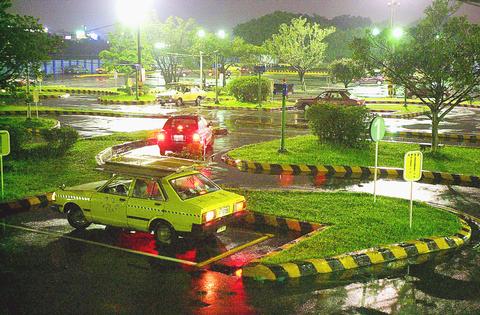
PHOTO: GEORGE TSORNG, TAIPEI TIMES
The Huanan Driving School (
"We cannot say that this course has been established to remedy deficiencies in driver training," said Wu Ming-teh (
Of 48,828 Taipei residents who applied for licenses in 1999, only 2,865 passed through the city's center. Another 24,515 passed through the nine private driving schools, an indication that the quality of instruction at these schools significantly influences the quality of drivers on the street.
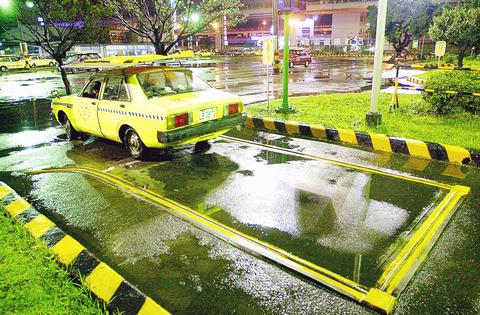
PHOTO: GEORGE TSORNG, TAIPEI TIMES
Many students passing through Huanan will only face real traffic for the first time after they get their license. Real road conditions are at no stage considered a priority in the course. "I just want to get the license," said a student surnamed Chang. "I'll worry about the rest later."
At the practice site, trying to back out through an S bend, Chang ran over a pressure pad, which triggered a siren.
"What are you doing?" the instructor barked through the intercom. "Half a turn to the right, then when the magnet is in line with the post, turn two to the left. I've told you before."
At Huanan, the cars have magnets attached to various points to help student drivers make alignments with pre-placed objects on the course. There are, of course, none of these conveniences on Taipei's city streets.
But even with these amenities, some students still get riled. "Every time the instructor shouts at me, I completely forget what I have to do," said a female student after disengaging herself from the curb, having failed in executing a parallel parking maneuver.
"If you can't remember, then you won't get through the test," said instructor Lin Feng-hsing (
Lin's job is to get people through the driving test in the minimum amount of time without any of the additional payments that would be a consequence of their failing any component of the test. Yet Lin didn't seem particularly interested in explaining why a maneuver needed to be done a certain way -- it was simply wrong to do anything that would involve a deduction in marks during the test.
Students could grind the gears bare during the hill start as long as they did not slide past the pressure pad that set the sirens going. Virtually the whole course was driven in first gear, since "it doesn't matter how slow you go as long as you don't stall." The average speed of drivers on the course was about 10kph.
"Don't fuss with the indicator lights," Lin said, "it's only going to distract you." Not using the indicator when turning involves only a small deduction in marks, not enough to fail.
The Taipei City Drivers Training Center, which includes subjects such as Driving Skills and Driving Ethics in its curriculum, closed its regular driver training course in July due to concerns that it was competing for business with private firms. But Wu, pointing at the numbers, said the center had only accounted for 6 percent of students in 1999.
He also says there has been considerable demand for the center to resume its driver-training course. "If we provide high quality instruction, then the other private driving schools might follow us, and instruction will improve overall."

Just after 6am, I walked up to the ticket gate at Taipei Main Station and entered the Taiwan Railway platform without scanning any ticket; instead, I flashed the Sanrio Fun Rail pass on my phone to the gate worker and was admitted. I found my train and prepared to board. My destination? This very same station. I was embarking on a 13-hour journey on one of two round-the-island trains operated by ezTravel. They run each day, one counterclockwise around the island and one clockwise. They differ in a number of ways from an ordinary Taiwan Railway train and can make for
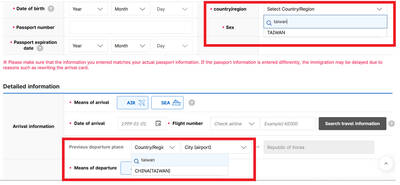
Jason Han says that the e-arrival card spat between South Korea and Taiwan shows that Seoul is signaling adherence to its “one-China” policy, while Taiwan’s response reflects a reciprocal approach. “Attempts to alter the diplomatic status quo often lead to tit-for-tat responses,” the analyst on international affairs tells the Taipei Times, adding that Taiwan may become more cautious in its dealings with South Korea going forward. Taipei has called on Seoul to correct its electronic entry system, which currently lists Taiwan as “China (Taiwan),” warning that reciprocal measures may follow if the wording is not changed before March 31. As of yesterday,

The Portuguese never established a presence on Taiwan, but they must have traded with the indigenous people because later traders reported that the locals referred to parts of deer using Portuguese words. What goods might the Portuguese have offered their indigenous trade partners? Among them must have been slaves, for the Portuguese dealt slaves across Asia. Though we often speak of “Portuguese” ships, imagining them as picturesque vessels manned by pointy-bearded Iberians, in Asia Portuguese shipping between local destinations was crewed by Asian seamen, with a handful of white or Eurasian officers. “Even the great carracks of 1,000-2,000 tons which plied
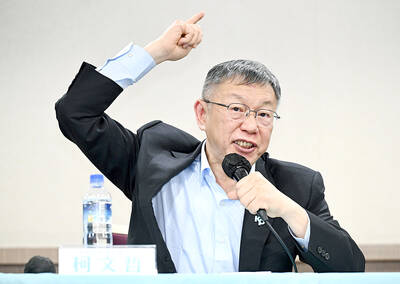
On Thursday, former Taipei mayor and founder of the Taiwan People’s Party (TPP) Ko Wen-je (柯文哲) was sentenced to 17 years in prison and had his civil rights suspended for six years over corruption, embezzlement and other charges. Seven others related to the case were also handed prison sentences, while two were found not guilty. It has been a bad week for the TPP. On Tuesday, prosecutors charged Chinese immigrant Xu Chunying (徐春鶯) with suspicion of taking part in Beijing-directed election interference. Xu has strong links to the TPP, which once offered her a party list legislator nomination. Tuesday also


 RSS
RSS