


Australian soft rockers Air Supply will be playing in Kaohsiung and Taipei on Nov. 17 and Nov. 18.
The band formed in 1975, founded by lead singer Russell Hitchcock and songwriter Graham Russell, and has been entertaining the world with their love songs ever since. Their first album in 1980 yielded three hit songs, including the title song Lost In Love, and singles All Out of Love and Every Woman in the World. Their following albums in 1981 -- The One That You Love -- and 1983 -- Making Love Out of Nothing at All -- were also both big hits at the time.
The band's popularity tailed off toward the end of the 1980s and they broke up in 1988 -- only to come back together in 1991. For their 25th anniversary world tour, they are dusting off some of the old favorites that endeared them to audiences in Taiwan during several visits in the 1990s, such as Strong Strong Wind, Unchained Melody, Without You and Now and Forever. The band will also perform their new song of the year, The Scene, and pepper the show with a few covers.
WHAT: Air Supply: 25th anniversary concert (空中補給站合唱團25週年告別演唱會)
WHEN & WHERE: Nov. 17, Kaohsiung County Fengshan Stadium (
TICKETS: Kaohsiung, NT$1200 and NT$700; Taipei NT$600 to NT$3000.
Luna Sea
Sometimes one gets the feeling that the Japanese group Luna Sea is not so much a band as a religion. The group's fans live their lives in unpolluted devotion to their idols, dressing like band members and call themselves "slaves." In Japan, the dress-up is known as "cosplay," and the band's self-anointed acolytes can easily tell the difference between, say, fellow idolaters "cosplaying" lead singer Ryuichi in his "Rosier" period and those made up as Ryuichi in any of his subsequent transformations.
Next weekend, Luna Sea will test Taiwan fans' willingness to put on a mid-November Halloween show when the band comes to Taipei for what may be the group's last ever concert here. More than halfway through its current tour, Brand New Chaos: Act II, the band announced on Nov. 7 that it would break up after the tour climaxes with two final shows in the Tokyo Dome in December. Speculation about such a break-up has been going on for quite a while in the Japanese media, as most of the band's five members have taken on solo projects within the past few years.
If the breakup does in fact come, it would put an end to the 11 year phenomenon that was one of the most influential bands in contemporary Japan. Luna Sea was probably the most important progenitor of Japan's visual rock movement, a genre which raised the importance of image, costume and stage spectacles to equal or even surpass the traditional emphasis on music alone.
When Luna Sea began living this new direction in the early 1990s, Japan's youth was apparently ready for the audio-visual-lifestyle mixture, as they chose not to dress up only for concerts, but to live their daily lives cosplaying their heroes in Luna Sea and other visually geared rock bands.
Like Luna Sea's music, the look is gothic and glam. Often made-up with white zombie-like faces, kids transform themselves with bleached mop hairdos, fishnet everything, general androgyny and black, black, black. In Tokyo's Yoyogi Park, the plaza in front of the Sendai train station and scores of other locations throughout Japan, these slaves linger night and day to their own strange purposes.
Though Japan definitely has supplied Luna Sea's most devoted following, the five man group is also a pan-Asian sensation that is immensely popular in Korea, Hong Kong and, yes, Taiwan. So far, all of the VIP tickets and about half of the remaining seats have been sold for the upcoming Taipei concert, which is probably the last chance you'll ever have to see whether or not Luna Sea can truly live up to its reputation for concerts that run on like living pandemonium.
WHAT: Luna Sea: Brand New Chaos: Act II
WHERE: Taipei's Chung Shan Soccer Stadium at the corner of Chung Shan North Rd. and Mintsu West Rd. (
WHEN: Next Saturday, November 18 at 7pm. Doors open at 5pm.
ADMISSION: NT$2400 (VIP area - sold out), NT$1600, and NT$1000 (upper deck). Tickets are available through ERA outlets, and selected record stores and. www.tickets.acer121.com.
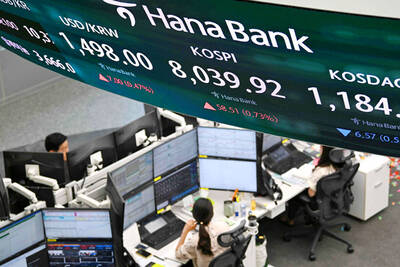
Taiwan’s overtaking of South Korea in GDP per capita is not a temporary anomaly, but the result of deeper structural problems in the South Korean economy says Chang Young-chul, the former CEO of Korea Asset Management Corp. Chang says that while it reflects Taiwan’s own gains, it also highlights weakening growth momentum in South Korea. As design and foundry capabilities become more important in the AI era, Seoul risks losing competitiveness if it relies too heavily on memory chips. IMF forecasts showing Taiwan widening its lead over South Korea have fueled debate in Seoul over memory chip dependence, industrial policy and
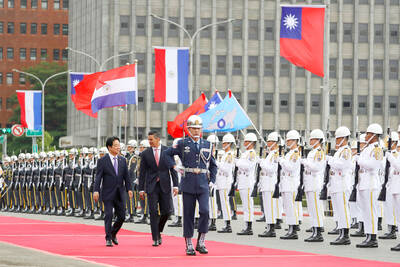
“China wants to unify with Taiwan at the lowest possible cost, and it currently believes that unification will become easier and less costly as time passes,” wrote Amanda Hsiao (蕭嫣然) and Bonnie Glaser in Foreign Affairs (“Why China Waits”) this month, describing how the People’s Republic of China (PRC) is playing the long game in its quest to seize Taiwan. This has been a favorite claim of many writers over the years, easy to argue because it is so trite. Very obviously, if the PRC isn’t attacking Taiwan, it is waiting. But for what? Hsiao and Glaser’s main point is trivial,
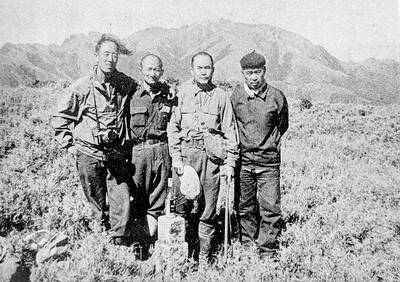
May 18 to May 24 Gathered on Yangtou Mountain (羊頭山) on Dec. 5, 1972, Taiwan’s hiking enthusiasts formally declared the formation of the “100 Peaks Club” (百岳俱樂部) and unveiled the final list of mountains. Famed mountaineer Lin Wen-an (林文安) led this effort for the Chinese Alpine Association (中華山岳協會). Working with other experienced climbers, he chose 100 peaks above 10,000 feet (3,048m) that featured triangulation points and varied in difficulty and character. The list sparked an alpine hiking craze, inspiring many to take up mountaineering and competing to “conquer” the summits. A common misconception is that the 100 Peaks represent Taiwan’s 100 tallest

In a sudden move last week, opposition lawmakers of the Chinese Nationalist Party (KMT) and Taiwan People’s Party (TPP) passed a NT$780 billion special defense budget as a preemptive measure to stop either Chinese leader Xi Jinping (習近平) or US President Donald Trump from blocking US arms sales to Taiwan at their summit in Beijing, said KMT heavyweight Jaw Shaw-kong (趙少康), speaking to the Taipei Foreign Correspondents Club on Wednesday night in Taipei. The 76-year-old Jaw, a political talk show host who ran as the KMT’s vice presidential candidate in 2024, says that he personally brokered the deal to resolve


 RSS
RSS