


With media ranging from photography to animation, Wong Chi-feng's solo exhibition offers a number of surprises, the least of which is a Barbie doll with genitalia.
Using seven installation pieces, the 11-year veteran of Taiwan's art scene mixes pornography, irreverence and camp to delve into issues ranging from cultural imperialism to religious fervor. At the heart of the exhibit is Wong's exploration of Taiwan's receptiveness to foreign popular cultures, especially those from America and Japan.
These issues are examined, for instance, in The Monster of Passion, a multi-tentacled, multi-orificed creature clutching a defenseless Barbie doll in its grip. Where the monster's head should be sits a human skull and a number of flashing light bulbs. The creation is kitschy and X-rated at the same time.
Wong notes that the monster incorporates the themes of sex and death, paralleling a Hollywood tendency to capitalize on the lurid.
"In the 1980s, the Japanese porn industry fell into a slump and they looked to Hollywood for inspiration, incorporating `monsters of passion' into their films and cartoons," Wong says. "The monster in my piece can grab the woman and stick her into any of its orifices. It's like a man who wants to have total control over the female sex."
Whereas The Monster of Passion blends both American and Japanese influences, The Voyeur's Supper focuses purely on Japanese sex culture. This installation is set in a dark dining room with an immaculately laid dinner table. Hanging from the ceiling above the table is the lower half of a female body, legs splayed. An image is projected from between the legs onto the plate below: feces being cut up into smaller pieces with utensils.
Lining the walls on either side of the table are posters of nubile Japanese women smiling broadly, not a stitch of clothing in sight. The far wall holds 100 translucent, dimly-lit glass jars. Upon closer examination the viewer sees sealed containers, each holding a piece of human excrement. Visible behind every jar is a girl's name, age, body measurements, blood type, star sign, and hobbies.
The Voyeur's Supper shows how Wong approaches his subjects with black humor and a note of irreverence. Yet invariably, there are serious messages behind his creations and he hopes people will look beyond the titillating images to consider the cultural implications at play.
Wong believes Japanese influence has been far-reaching in East Asia, and that this may have affected moral values.
Taiwan, he notes, has been especially susceptible to foreign influence, with examples ranging from Dutch and Japanese colonialism to Coca-Cola and Hello Kitty. "Taiwan seems to pick up the bad influences quickly but not the good ones," he says. "For instance, the hidden cameras [in toilets and dressing rooms] or schoolgirls working as prostitutes, these Japanese trends have already hit Taiwan."
For Wong, playing with human emotions and expectations is another motivation for the piece: "The measurements, height, age, these are the ways society assesses a woman's worth. But when one restores the female body to the original state, it's something which excretes, not the perfectly packaged commodity we're presented with in advertisements."
Wong's pieces tend to be multi-layered in meaning. In a photo installation called The Seduction of a Virgin, he manages to address both the Taiwanese affinity for adopting foreign cultures and more universal issues like human sexual relations. In The Seduction, a number of silver flower-shaped frames display photos of a Jenny doll -- the Japanese equivalent of Barbie -- and the all-American Ken as they re-enact scenes from pornographic films. The dolls are both endowed with genitalia, adding to the surreal flavor of the creation. Wong says that he used dolls to emphasize the idea that in pornography humans have been reduced to material objects without the ability to think or make decisions.
The final photo in The Seduction depicts Ken leaving the room as Jenny languishes on the bed, a forlorn expression on her face. Wong's intention was to reflect an age-old problem between the sexes: "After they have done the deed, the male leaves. For the guy it's about the lower half of his body, it's animalistic. But the woman wants something more complete," he says.
This series of photographs was based on Japanese pornographic films like the ones that have flooded Taiwan's underground video markets. Wong, who collects these videos, said that the films were propagating fallacies about human sexual relations: "In [Japanese pornography], the girl is usually forced into having sex, but later the man brings her to a climax and she finds it enjoyable," says Wong. "It's a misleading, problematic concept."
While cultural imperialism may be the focus of the installations in the upper level of the gallery, the lower level houses two works centered on religion. In Fin de Siecle Savior 1, a golden Buddha statue endowed with female genitalia sits in a cabinet surrounded by a number of phalluses. Wong originally created this installation for an exhibition at the Taipei Fine Arts Museum in 1996, adding Fin de Siecle Savior 2 this year as a complementary piece.
In Fin de Siecle Savior 2, the Buddha in the cabinet is brought to life through animation techniques but differs from its still-life counterpart in that it is hermaphroditic. Its life-size shape sways to the beat of a salacious electric organ as the phalli at its feet sway back and forth, prostrating themselves in worship.
Despite appearances, Fin de Siecle Saviors 1 and 2 were not made with sacrilegious intent -- Wong himself is a devout Buddhist. He meant the installation as a statement on the rise of Taiwanese religious sects whose followers were willing to hand over their entire fortunes to sect leaders.
A Taste of Pornography is a warning against the herd mentality that Wong sees dominating Taiwanese culture. One of his main hopes is that his art will encourage debate on problems such as a lack of individuality in Taiwanese society. He is especially keen on having young people discuss his work, so he has organized a number of talks to be held in conjunction with the exhibition.
"I don't want people to walk away having only picked up on the negative aspects of the exhibit. My hope is to warn people against the problems that arise from blindly following others," he says.

Taiwan’s English education system is being pulled apart by three opposing forces. Bilingual Nation 2030 pulls students toward English and global communication. Artificial Intelligence (AI) readiness pulls them toward digital judgment, verification and AI-mediated work. But Taiwan’s old exam culture pulls them back toward memorization, grammar drills, timed reading and correct answers. If the education system keeps using old exams to define success, it risks producing graduates who are neither genuinely bilingual nor genuinely AI-ready, but trained for tasks machines can already perform. The first force is Bilingual Nation 2030. Launched in 2018, the policy aimed to “help Taiwan’s workforce connect

“Taiwan’s Opposition Leader Comes to US With a Message Straight Out of Beijing” read a May 31 headline in the Wall Street Journal. Top US administration officials and members of Congress almost certainly read the WSJ, and if there was a bullet point takeaway that people in Washington should absorb ahead of Chinese Nationalist Party (KMT) Chair Cheng Li-wun’s (鄭麗文) arrival in DC on June 9, that headline is it. The last few columns have discussed this very topic, and the timing is not coincidental. While those top officials likely do not read the Taipei Times, judging by the number

With weighty, anxiety-inducing geopolitical topics dominating the headlines, checking in on the wild and weird state of local politics can take some of the edge off. This November’s elections will determine who will be in charge of fixing potholes in your neighborhood, not the potholes in Taiwan’s complicated geopolitical space. Recently, after an online interview with a Taipei-based journalist, I commented that Taipei journalists never go further than the MRT can take them. He laughed and agreed. Naturally, the Taipei mayoral race is eating up much of the press attention. TAIPEI CITY Democratic Progressive Party (DPP) candidate Puma Shen (沈伯洋) has
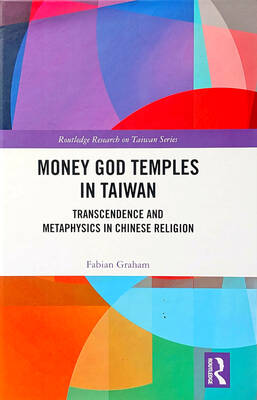
As someone who normally steers clear of books with “transcendence” or “metaphysics” in their subtitles, this reviewer — a casual observer of local belief systems since the 1990s — found Fabian Graham’s Money God Temples in Taiwan a challenging read. Those who’ve only dipped their toes into temple culture will likely need to parse several sections with special care if they’re to keep up with the author, a British ethnographic researcher whose previous books have investigated religious practices among ethnic Chinese in Southeast Asia. This scholarly volume examines a facet of Taiwan’s religious landscape that didn’t exist a century ago, and


 RSS
RSS