


It is mid-afternoon in Fujisawa, Japan. Schoolchildren, rucksacks on their backs, bound into a room where a group of pensioners welcomes them boisterously, before sitting them down to help them with their homework. This group of older people is looked after by some of the pupils’ parents. Up the road, a cluster of university students live above some over-75s. They get half-price rent in return for checking in on them on their way to and from studies.
This multigenerational community I visited in a small town not far from the port of Yokohama is one of 5,000 in Japan.
Sometimes the solutions to the big social challenges of the day are right in front of us; they do not necessarily cost much, but they do require forward thinking and a determination to make them work. Across Europe, these challenges are often shirked.
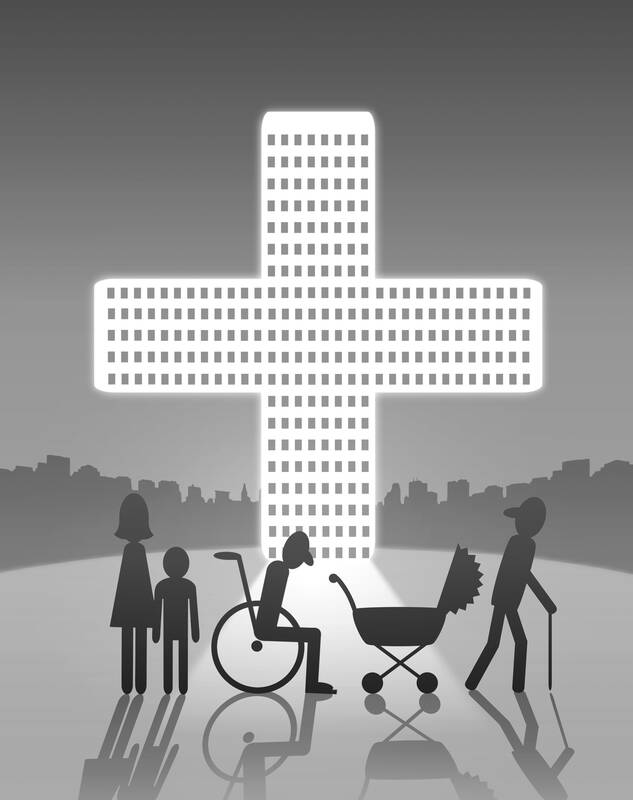
Illustration: Yusha
By 2050, the number of centenarians in Japan could reach almost half a million. The proportion of pensioners is expected to rise to about 40 percent. In some ways, Japan is a victim of its own success, with the world’s highest life expectancy for the past four decades. It is now 87 for women and 81 for men.
Japan has also shown that if you cannot avoid a problem, you might as well confront it. Back in 2000, it introduced the long-term care insurance system, one of the first countries to develop such a public scheme. It is transparent and easy to navigate. Everyone knows what they must pay and when (payments begin on a person’s 40th birthday). Its purpose is to “maintain dignity and an independent daily life routine according to each person’s level of abilities.”
The emphasis is on giving people more of a say in where and how they are cared for. Rather than older people receiving services that are assigned by the state, they are encouraged to choose and contract the services themselves.
For three years, I scoured the world for best practice in addressing the big present and future challenges. The 10 countries and cities I visited, from Japan to Morocco and India to Austria, had some surprising solutions; some were radical, others were simply the product of better organization.
Stories about robots that care for older people, for example, tend to dominate international coverage of Japan’s ageing society. However, I was more impressed by some of the low-tech solutions. In Kawaguchi, a commuter town north of Tokyo, several community general support centers have opened. These are drop-in hubs that provide “lifestyle support” for any older person who wants it. This could be medical advice, help with paying the electricity bill or just company. They are being rolled out in each of Japan’s more than 1,700 municipalities.
What the disparate destinations I studied had in common were resilience, imagination and political courage — qualities that mainstream politicians in Europe have long struggled to demonstrate. And they seem allergic to the other precondition for securing lasting change: serious long-term planning.
With ageing populations, many European economies are creaking under the strain of funding pensions, care services and health. Yet the two areas where European governments remain most politically timid are social care and health reform. All suffer from a lack of doctors, nurses and other care professionals. The German government has just announced a series of cuts to healthcare services to balance the books.
Until recently, France was cited as an example of healthcare success, but the highly centralized system disincentivizes doctors and nurses from working in disadvantaged regions — so-called “health deserts.”
By contrast, Sweden, which has a more decentralized approach, continues to over perform. Spain’s success might be seen as more surprising, with one of the highest life expectancies in Europe. It has a universal national system, which, like Britain’s National Health Service (NHS), is free at the point of delivery, but it is run by its 17 autonomous regions, not by a central monolith.
When it comes to building a transparent system for funding care for older people, the UK is the most abject of all. Successive prime ministers have called for change yet have run away from sensible reforms produced by commissions they established, hoping that, by delaying a problem, it would somehow go away.
Japan and Taiwan, as I discovered, started preparing for the demographic challenge decades ago. Taiwan’s National Health Insurance, for example, unlike Britain’s NHS, is quick, efficient and highly digitized. Medical literacy and patient autonomy are paramount; everyone learns about diet and exercise from a young age, part of a whole-society approach to “owning” your own health. The system has very few general practitioners. Patients usually go straight to hospitals or clinics, where they can expect to have a first consultation within 20 minutes. Or they can book on the app, and their doctor can have a look straight away online. Alongside the speed of delivery, the other remarkable aspect of this system is the cost. At about 8 percent of GDP, it is far cheaper than the European average of 10 to 12 percent.
John Kampfner is the author of Braver New World.
From the Iran war and nuclear weapons to tariffs and artificial intelligence, the agenda for this week’s Beijing summit between US President Donald Trump and Chinese President Xi Jinping (習近平) is packed. Xi would almost certainly bring up Taiwan, if only to demonstrate his inflexibility on the matter. However, no one needs to meet with Xi face-to-face to understand his stance. A visit to the National Museum of China in Beijing — in particular, the “Road to Rejuvenation” exhibition, which chronicles the rise and rule of the Chinese Communist Party — might be even more revealing. Xi took the members
The Chinese Nationalist Party (KMT) and the Taiwan People’s Party (TPP) on Friday used their legislative majority to push their version of a special defense budget bill to fund the purchase of US military equipment, with the combined spending capped at NT$780 billion (US$24.78 billion). The bill, which fell short of the Executive Yuan’s NT$1.25 trillion request, was passed by a 59-0 margin with 48 abstentions in the 113-seat legislature. KMT Chairwoman Cheng Li-wun (鄭麗文), who reportedly met with TPP Chairman Huang Kuo-chang (黃國昌) for a private meeting before holding a joint post-vote news conference, was said to have mobilized her
The inter-Korean relationship, long defined by national division, offers the clearest mirror within East Asia for cross-strait relations. Yet even there, reunification language is breaking down. The South Korean government disclosed on Wednesday last week that North Korea’s constitutional revision in March had deleted references to reunification and added a territorial clause defining its border with South Korea. South Korea is also seriously debating whether national reunification with North Korea is still necessary. On April 27, South Korean President Lee Jae-myung marked the eighth anniversary of the Panmunjom Declaration, the 2018 inter-Korean agreement in which the two Koreas pledged to
As artificial intelligence (AI) becomes increasingly widespread in workplaces, some people stand to benefit from the technology while others face lower wages and fewer job opportunities. However, from a longer-term perspective, as AI is applied more extensively to business operations, the personnel issue is not just about changes in job opportunities, but also about a structural mismatch between skills and demand. This is precisely the most pressing issue in the current labor market. Tai Wei-chun (戴偉峻), director-general of the Institute of Artificial Intelligence Innovation at the Institute for Information Industry, said in a recent interview with the Chinese-language Liberty Times


 RSS
RSS