


As artificial intelligence (AI) becomes increasingly widespread in workplaces, some people stand to benefit from the technology while others face lower wages and fewer job opportunities. However, from a longer-term perspective, as AI is applied more extensively to business operations, the personnel issue is not just about changes in job opportunities, but also about a structural mismatch between skills and demand.
This is precisely the most pressing issue in the current labor market. Tai Wei-chun (戴偉峻), director-general of the Institute of Artificial Intelligence Innovation at the Institute for Information Industry, said in a recent interview with the Chinese-language Liberty Times (the sister newspaper of the Taipei Times), that amid widespread AI use, future workplaces are expected to face a situation where companies have vacancies but no one to fill them, or companies have workers but are unable to use them.
The “2026 Talent White Paper” released by Commonwealth Magazine Group in November last year showed that up to 80 percent of companies are concerned that their employees’ skills would not keep pace with market changes over the next three years. Similarly, a high percentage of companies believe that “insufficient employee skills” is the biggest obstacle to corporate transformation, the report said. Furthermore, the problem of talent shortages is shifting from “not being able to recruit people” to “not being able to find the right people with key skills,” it found.
As Tai said in the interview, concerns about AI-driven unemployment have extended from white-collar office jobs, such as administrative clerks and assistants, to blue-collar factory roles, such as semiconductor testing, warehousing and logistics. In particular, the use of robotic arms and autonomous driving systems has led to machines taking over many repetitive and high-precision tasks, while the adoption of digital twin technology can even accurately simulate remote physical environments, replacing some of the work of inspection and logistics personnel, he said.
This transformation is even more pronounced in the medical sector, based on the results of cooperation between the Institute for Information Industry and some hospitals, Tai said. Simpler tasks include surgical instrument checks by AI to ensure no critical tools are missed in operating rooms and communications between doctors and nurses via voice input to reduce administrative burdens. Even the initial diagnosis of test reports can be completed with the assistance of AI, he added, as the technology acts as a useful tool for healthcare professionals and, in some cases, provides an educational context for patients.
These scenes show a shift in skill requirements and imply a paradox following the rapid adoption of AI in today’s workplaces. On one hand, companies cannot find enough talent for new advanced positions while simultaneously needing fewer workers for routine manual tasks. It is not that companies do not need people; they do. However, they need a different type of talent that knows how to integrate AI, analyze problems and make decisions. AI could be viewed as a form of disruptive innovation that transforms jobs rather than eliminating them, with the workforce undergoing reallocation. The point is that the gap between the jobs people want and the skills companies need seems to widen.
104 Job Bank said that there were about 67,000 job openings related to AI for fresh graduates in the first quarter of this year, a rapid increase in just a few months. If, as Tai observed, this skill mismatch continues to expand, it would be advantageous for those willing to align with AI demand but harmful to others failing to keep up with the trends. As demand for roles associated with AI is expected to increase in the workplace, people are required to stay abreast of the latest trends to remain competitive. There are also calls for companies to expand generative AI training for existing workers to increase productivity.
There are mixed views on the impact of AI on employment structure. However, there is consensus that this structure has been constantly changing with the arrival of the AI era alongside a declining birthrate and an aging society. Although some employees have already used AI at work, the overall AI penetration rate among enterprises remains relatively low, and most companies currently use AI as supporting tools rather than fully reshaping their end-to-end processes. That means the impact of AI on the labor market has not yet been fully realized, and the technology’s long-term effects on productivity and economic growth remain to be seen, even as it could gradually become a core operating system for businesses.
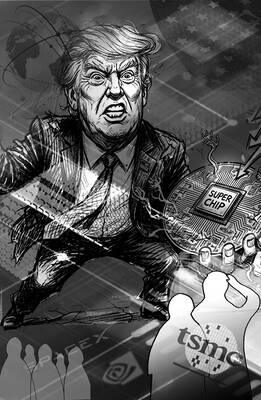
The White House’s decision to take a 9.9 percent stake in Intel Corp is looking like very shrewd business indeed. Since the government bought in at US$20.47 a share last August, the US chipmaker’s surging stock price has delivered the US a US$43 billion return. One of the reasons the investment has so far proved so sound is that the White House has made sure of it. According to The Wall Street Journal, Howard personally pushed deals on Intel’s behalf with some of the most lucrative clients imaginable. They include Nvidia Corp, the company at the heart of the AI
In a Taiwanese university classroom, a lecturer asks in English: “Can anyone give me an example from Taiwan?” Students look down. No one answers. After class, one student writes on the course platform in Mandarin: “I understood the concept, but I didn’t know how to answer in English.” That moment highlights a key issue in Taiwan’s English-medium instruction (EMI) reform: It is not just about more English-taught courses, but whether students can learn, participate and belong. EMI expansion is part of the Bilingual 2030 policy and the Ministry of Education’s BEST Program, aiming to improve English ability, support EMI teaching
The Ministry of the Interior, working with the navy and coast guard, is organizing Taiwan’s first joint exercise simulating escort tankers carrying liquefied natural gas (LNG) and oil through a Chinese blockade. The drills simulate fuel transport along three maritime corridors leading toward Japan, the Philippines and the US. Deputy Minister of the Interior Sawyer Mars (馬士元) said that a blockade of the Taiwan Strait would amount to “almost a 100 percent blockade of the regional energy supply.” Minister of National Defense Wellington Koo said planning to counter a blockade is standard practice in Taipei. While the exercise is limited in
A single photograph can cut through a lot of noise, but it can also be used to misrepresent the truth. At the very least, it can concentrate the mind on something that requires further investigation. On Monday last week, Ma Ying-jeou Foundation CEO Tai Hsia-ling (戴遐齡) and former National Security Council secretary-general King Pu-tsung (金溥聰) held a news conference in which they showed a photograph of former foundation CEO Hsiao Hsu-tsen (蕭旭岑), now Chinese Nationalist Party (KMT) deputy chairman. In the image Hsiao is seated next to Xiamen Taiwan Businessmen Association chairman Han Ying-huan (韓螢煥). The two men were holding


 RSS
RSS