


When it comes to punishments levied against Meta Platforms Inc and Alphabet Inc’s Google over the years, US$6 million for claims that their apps were addictive and caused a mental health crisis might not seem like much. The amount, which a Los Angeles jury on Wednesday ordered to be paid to a 20-year-old woman known as Kaley G.M., is a mere pittance when compared with a US$5 billion fine from the Federal Trade Commission for Meta or a US$3.5 billion penalty for Google from the EU.
However, that would be the wrong way to look at this pivotal moment in big tech accountability. Those other penalties could be chalked up as the cost of doing business. They resulted in little change to the companies’ actual products, the defining characteristic of which is their ability to keep users hooked in order to sell advertising.
The case of Kaley G.M., and a similar case that went against Meta just a day earlier in New Mexico, may well be an inflection point. As the group Mothers Against Media Addiction said in its statement celebrating the verdict, the case in Los Angeles was chosen as a bellwether: Thousands of additional cases are waiting in the wings, lawsuits filed by families and school districts and others in the blast radius of Meta and Google’s design choices, as well as those made by the owners of other apps such as Snapchat and TikTok.
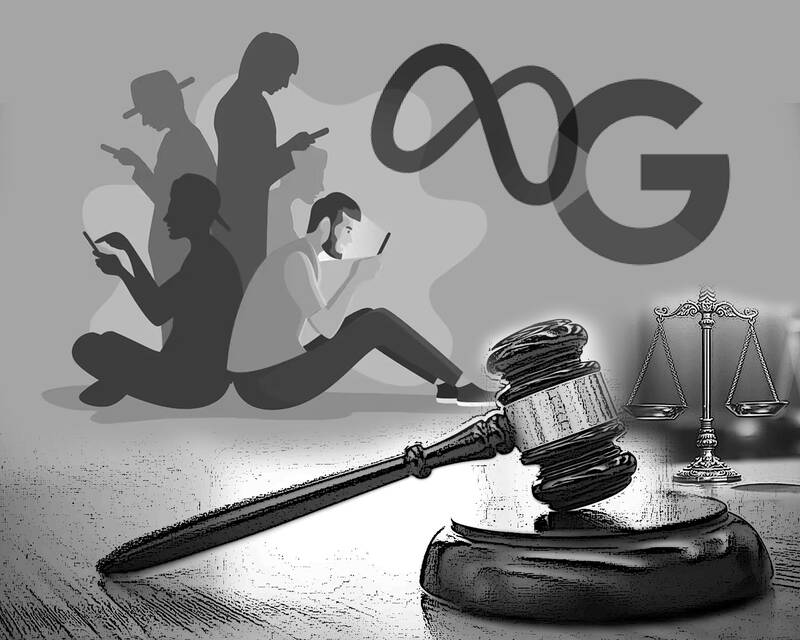
Illustration: Constance Chou
The verdict would give even more momentum to a legal approach that has proved more effective than some previous efforts that stumbled on First Amendment grounds or ran into the notorious Section 230 of the Communications Decency Act — the protection that shields platforms from liability for third-party content.
Instead, relying on tort law — the branch of civil law used by injury claims lawyers, among others — the attorneys in this case removed these questions and replaced them with a different one: What if it could be proved that the very design architecture of the services was responsible for Kaley’s addiction? Features like infinite scroll, autoplay videos, notifications, and beauty filters — all functions that the companies were fully in control of. Mark Lanier, the plaintiff’s attorney in the case, called it the “engineering of addiction.” We have all surely felt it as we use these apps and wonder where the time went.
The day before the Los Angeles verdict, a jury in New Mexico found Meta liable for US$375 million in damages for not protecting young people from online harm, such as sexual predators, in breach of the state’s consumer protection laws. Dozens of other states have filed similar cases.
Both companies said they planned to appeal the cases. They argue there is no proof that their apps are “clinically” addictive. On the stand in Los Angeles, Mark Zuckerberg said it was against the company’s interests to put out an app that its users did not feel good using. Internal company documents were a smoking gun on allegations that Meta knew it was attracting young users. “If we wanna win big with teens, we must bring them in as tweens,” said one document from 2018.
In addition to Meta’s depth of liability in future cases — Bloomberg Intelligence predicts “single-digit billions” for each social media company for broad settlements — the question the company’s investors face is what impact these verdicts might have on the company’s underlying business model.
“It has become increasingly clear that it will only get more difficult for these companies to maintain business as usual as concerns grow louder and scrutiny intensifies,” said eMarketer analyst Minda Smiley. How drastic those changes need to be would depend on how the higher courts handle the appeals. The federal judge overseeing the multidistrict litigation (the grouping of the thousands of other cases) ruled that some of the design features at issue, such as infinite scrolling, were in fact protected by Section 230 — though she ruled that others, such as a failure to provide adequate controls, were not. Expect more heated debate on the most divisive internet law to step up a notch as this case moves to its next phase.
The risk for those who want to see real change is that these victories may stall out without a meaningful rebuilding of the product and protection from the harm many feel it can cause. On the other hand, were the plaintiffs able to continue their winning streak, it could lay down important precedents not just for how social networks do business but also for artificial intelligence companies with their addictive and sycophantic chatbots.
It is too early to say whether these cases are, in Lanier’s words outside court, “a referendum — from a jury to an entire industry — that accountability has arrived.” However, if we cannot yet say it has arrived, it is certainly banging hard on the door. For the first time, these cases have leveled the playing field, one that the lobbyists who have scuttled hopes of effective policymaking could not tilt. Any friction to using these apps could prove bothersome to the companies — eMarketer said that time spent on social networks has plateaued after years and years of growth. Young people, as they have done with many of the vices afflicting generations before them, may be turning their attention elsewhere anyway.
Dave Lee is Bloomberg Opinion’s US technology columnist. He was previously a correspondent for the Financial Times and BBC News. public goodsThis column reflects the personal views of the author and does not necessarily reflect the opinion of the editorial board or Bloomberg LP and its owners.
A recent report concerning a student who is suing his teacher posed the question in its headline: Does failing a student in two subjects constitute bullying? The college student in Chiayi County apparently sought NT$2 million (US$63,603) in state compensation, but a court dismissed the case. The first reaction of many might have been to ask: What has happened to students nowadays? Some say that teachers have lost their authority, while others say students are overindulged. Some even start reminiscing over the days when “whatever the teacher says goes.” However, the real issue might be overlooked if emotional reactions like that are the
When I visited Taiwan last summer, I called on the nation to use its status as a technology superpower to build superweapons. It is obvious to me as I return a year later that Taiwan is now answering that call. By 2030, Taiwan envisions a domestic drone hub, capable of producing large quantities of drones per year. The nation continues to tighten cooperation across the private sector, scientific researchers and the elected government, on creating new and innovative production avenues for defense, while efforts to become central to the “democratic supply chain” are only increasing. Anduril is seeing all of these positive
Singaporean former Prime Minister and current senior minister Lee Hsien- Loong(李顯龍) last month stood on Chinese soil and told Beijing that Singapore cooperates because of “shared interests”, not because of common “ethnic descent,” a significant statement that has upended China’s cognitive warfare tactics of “ethnic nationalism.” Along with using its military buildup and economic growth to expand its international dominance, China has long deployed ethnic politics to promote the idea that all ethnic Chinese around the world, regardless of citizenship, share a tight bond with the Chinese motherland, by which it means the regime of the People’s Republic of China (PRC)

President William Lai Ching-te’s (賴清德) May 20 second-anniversary address was not just a routine policy review; it was damage control. US President Donald Trump’s remarks — that he did not want to see anyone move toward independence and that the delivery of a major Taiwan arms package could depend on the progress of US-China relations — unsettled Taiwan’s public and created an opening for opposition parties to question whether Taiwan was being treated as a bargaining chip in Washington’s dealings with Beijing. Lai’s speech was designed to close that opening. The address covered the expected ground: sovereignty, cross-strait relations, defense spending,


 RSS
RSS