


In diplomacy, words matter. When the world’s richest nations got together in 2022 for their biennial energy meeting, their communique mentioned “net zero” 13 times; in 2024, the references went up to 15. After last week’s gathering? Just one occurrence — and that was to underline the lack of universal support. The word-count collapse is illustrative of the direction of global energy policy: Net zero is, effectively, dead.
The movement was designed to cut carbon emissions to a residual amount by 2050, so total emissions would be equal to those removed either naturally by forests or artificially by carbon sequestration projects. On a net basis, the accumulation of greenhouse gases in the atmosphere would drop to zero.
Even at the peak of its popularity, net zero looked far-fetched. One had to believe, as a matter of a faith, that consumption of oil, natural gas and coal would drop following stylized cliff-like curves. With current energy-related annual carbon emissions running above 35 billion tonnes, reducing them to something that would equal to net zero was an impossible task. On current trends, emissions are likely to remain close to current levels for the next 25 years. Even if countries adopt most of the energy policies they have announced — a big if — they would remain above 25 billion tonnes a year until the middle of the century.
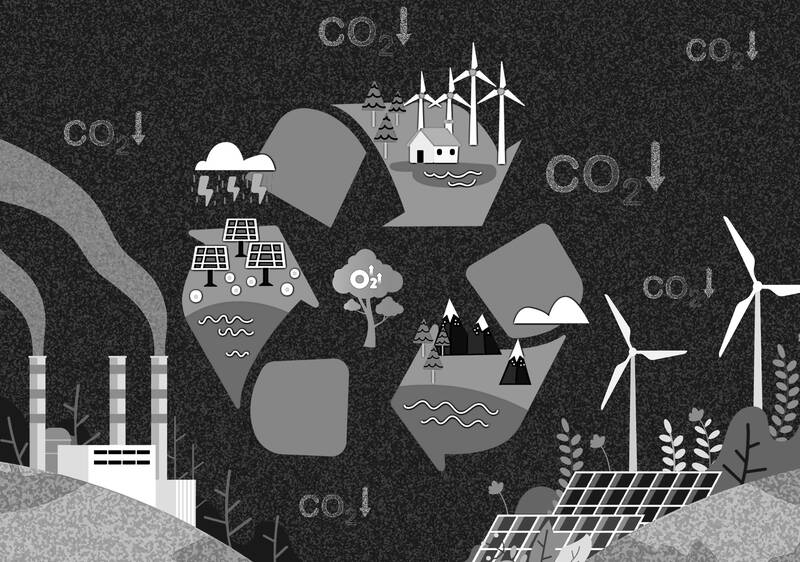
Illustration: Louise Ting
Despite the enormity of the challenge, industrialized countries put net zero as their lodestar — not just for energy and climate, but for industrial and economic policy, too. In 2021, the International Energy Agency (IEA) published an influential report listing more than 400 milestones across multiple sectors needed to “transform the global economy from one dominated by fossil fuels into one powered predominantly by renewable energy like solar and wind.”
For a while, ideology rather than economic or technical realities was the driving force. Climate change was seen as the world’s most important problem, with everything else subordinated. Renewable projects got green lighted even when the grid was not ready, inflating the costs of transforming the system. At times, European nations shut down energy production — say, nuclear power reactors in Germany — when renewables had not yet matured. The idea that trillions of US dollars’ worth of fossil-fuel reserves would be left stranded became pervasive, prompting investors to offload their stakes in oil and gas companies.
However, here we are in 2026 with global demand for oil, natural gas and coal at an all-time high and likely to climb further, a far cry from the trajectory required to achieve net zero. When rich nations got together last week to debate their energy policy, ministers were more worried about the security of energy supplies — and prices. Climate change remains important, but no longer dominates the agenda. IEA executive director Fatih Birol, a longtime cheerleader of the net-zero movement, was paradigmatic of the shift. In his opening speech at the IEA ministerial meeting last week in Paris, he mentioned “energy security” eight times; “affordability” got four citations; “climate,” two. And what about “net zero”? Well, ahem, zero.
Economic needs are driving the shift in emphasis. When I asked then-outgoing Dutch deputy prime minister Sophie Hermans, who chaired the meeting, what was happening, she was blunt: “We see our heavy industry struggling. We don’t want them to simply relocate to produce elsewhere.”
A few nations insisted on keeping the net-zero idea alive — notably the UK and Spain — some merely acknowledged it as a concept, while others basically ignored it. And then there was Chris Wright, the outspoken oil executive turned US energy secretary. He put the probability that the world would hit the target of net zero emissions by 2050 at exactly “zero point zero.”
It would be a mistake to dismiss his comment as just another outburst from US President Donald Trump’s pro-fossil fuel administration. The data back Wright’s view. On oil, for example, the original net zero scenario called for demand to drop to little more than 70 million barrels a day by 2030, and to about 25 million barrels by 2050. With consumption currently running near 105 million barrels a day and set to hit about 106 million next year, it is clear the world has no chance of hitting the interim 2030 target.
Words, meantime, are trickling into policies — and quickly. Days after the IEA meeting, the Danish government, once one of the leaders of the green movement in Europe, said it was considering extending oil and gas drilling in the North Sea.
The justification given by Danish Minister for Climate, Energy and Utilities Lars Aagaard for contemplating keeping fossil fuel development ongoing until, precisely, 2050 is worth reading: “I would have preferred that Europe could make do with green energy, but the reality is different, and I fundamentally believe that it is better for Europe to get gas from Denmark than from countries outside our continent.”
“I don’t think the reality is different from what it truly was five years ago; what’s changed today is the political perception of how costly the energy transition will be,” he added.
However, do not mistake the death of net zero for the end of renewable energy. The latter is very much alive. For the foreseeable future, electricity would be the fastest growing form of energy — and renewables would cover a significant chunk of the increase. The world would remain addicted to fossil fuels, but more of its additional power needs would be covered by solar, wind, hydro, geothermal and other green sources.
While renewables would erode the market share of fossil fuels, it would take a long time. By 2050, global energy-related carbon emissions would remain well above the amount envisaged by net zero, but increasingly it looks like emissions would soon peak as the growth in demand for coal flattens out. Bending the annual curve down toward 30,000 million tonnes — and perhaps even to 25,000 tonnes — looks increasingly realistic. But, at risk of stating the very obvious, that is well above zero.
Javier Blas is a Bloomberg Opinion columnist covering energy and commodities. He is coauthor of The World for Sale: Money, Power and the Traders Who Barter the Earth’s Resources. This column reflects the personal views of the author and does not necessarily reflect the opinion of the editorial board or Bloomberg LP and its owners.
Taiwan’s higher education system is facing an existential crisis. As the demographic drop-off continues to empty classrooms, universities across the island are locked in a desperate battle for survival, international student recruitment and crucial Ministry of Education funding. To win this battle, institutions have turned to what seems like an objective measure of quality: global university rankings. Unfortunately, this chase is a costly illusion, and taxpayers are footing the bill. In the past few years, the goalposts have shifted from pure research output to “sustainability” and “societal impact,” largely driven by commercial metrics such as the UK-based Times Higher Education (THE) Impact
The closure of the Strait of Hormuz has sent the vast Asian chemicals industry into a tailspin. Deprived of the likes of Qatari natural gas and Saudi Arabian oil, the region’s fertilizer and plastics plants are slowing production or even shutting down. Everywhere except China, that is. In petrochemicals, China is unique. As well as a traditional industry that uses oil and gas as feedstock, it has parallel output that relies on its abundant domestic coal. Unsurprisingly, India and other regional powers want to copy and paste the Chinese method. This would not be easy — or climate friendly. The
History might remember 2026, not 2022, as the year artificial intelligence (AI) truly changed everything. ChatGPT’s launch was a product moment. What is happening now is an anthropological moment: AI is no longer merely answering questions. It is now taking initiative and learning from others to get things done, behaving less like software and more like a colleague. The economic consequence is the rise of the one-person company — a structure anticipated in the 2024 book The Choices Amid Great Changes, which I coauthored. The real target of AI is not labor. It is hierarchy. When AI sharply reduces the cost
US President Donald Trump recently repeated his claim that “Taiwan stole America’s chip industry,” reigniting public debate on the issue. As a former Taiwanese minister of economic affairs and an entrepreneur deeply involved in semiconductor supply chain development, I feel a responsibility to clarify this misunderstanding. From the perspective of global industrial evolution and the economic principle of comparative advantage, such a statement appears overly simplistic and risks obscuring the essence of the issue. The rise of Taiwan’s semiconductor industry was not built on “replacing America,” but rather emerged as a result of countries pursuing different development paths within the


 RSS
RSS