


South Korea’s equity benchmark yesterday crossed a new milestone just a month after surpassing the once-unthinkable 5,000 mark as surging global memory demand powers the country’s biggest chipmakers.
The KOSPI advanced as much as 2.6 percent to a record 6,123, with Samsung Electronics Co and SK Hynix Inc each gaining more than 2 percent.
With the benchmark now up 45 percent this year, South Korea’s stock market capitalization has also moved past France’s, following last month’s overtaking of Germany’s.
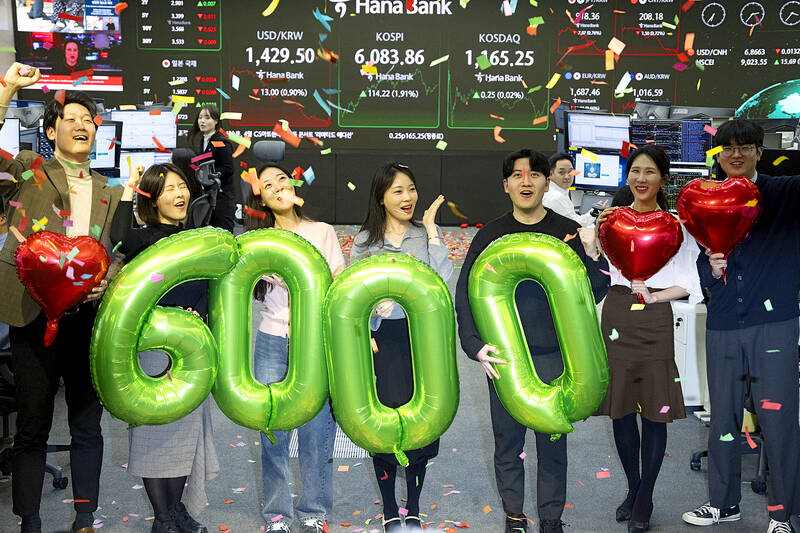
Photo: EPA
Long overlooked by foreign funds, despite being undervalued, South Korean stocks have now emerged as clear winners in the global market.
The so-called “artificial intelligence (AI) scare trade” has proven a boon for the country, where software stocks play only a minor role and hardware manufacturers continue to drive the market higher.
Corporate governance reforms have helped fuel the rally, with the South Korean legislature expected to pass a bill later yesterday requiring companies to cancel treasury shares.
“With the KOSPI now at 6,000, upside from here is likely to be more incremental, and sustainability will depend on earnings delivery and a meaningful broadening beyond a handful of semiconductor heavyweights,” said Jung In-yun, chief executive officer at Fibonacci Asset Management Global. “Absent that, some consolidation or rotation across sectors wouldn’t be surprising.”
The US Supreme Court’s decision on Friday last week to strike down US President Donald Trump’s “reciprocal” tariffs is also seen as a boost for South Korean equities.
Tiffany Hsiao, portfolio manager at Matthews, expects South “Korean exporters tied to US consumer demand — particularly in electronics and components — would benefit from any reduction in tariff uncertainty.”
There are early signs that retail investors, who have traditionally favored US stocks over local ones, are returning home. Such a shift, if sustained, could drive the next leg of the rally.
Late last month, South Korea’s market value overtook Germany’s, and this week it climbed to US$3.76 trillion, exceeding France’s, despite its much smaller economy.
Such a swift advance might normally spark concern and some market watchers are closely monitoring valuations.
“I was looking at buying KOSPI futures, but given the relative move in KOSPI the past month, it’s a tough call to initiate new longs,” said Matthew Haupt, portfolio manager at Wilson Asset Management in Sydney.
Samsung share prices have nearly quadrupled since the start of last year, while those for SK Hynix have jumped sixfold.
However, analysts remain broadly bullish, citing that South Korea’s two leading chipmakers are likely to continue to benefit from the ongoing memory crunch and sustained AI demand.
Citigroup Inc and Macquarie Capital raised target prices overnight, with Macquarie’s forecast for Samsung implying a 65 percent upside from the current share price.
Nomura recently raised its target on the KOSPI gauge to as high as 8,000 in the first half of the year, citing a memory supercycle, earnings in the AI capex chain and defense sector, and a re-rating of the physical AI supply chain.
“If [South] Korea can accelerate its corporate value reform and structural improvement of the KOSDAQ, we expect a further re-rating beyond 8,000,” Nomura analysts including Cindy Park and Dongmin Lee wrote in a note.
The path to 8,000 also hinges on whether the South Korean government can deliver the reforms promised through multiple revisions of the Commercial Act, the nation’s main business law, Park and Lee wrote.
The latest proposal, requiring the cancelation of treasury shares, would eliminate a mechanism that governance experts say conglomerate owners have used to reinforce control with minimal direct holdings.
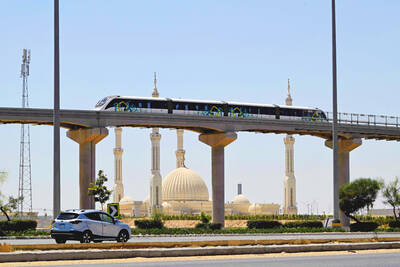
Cairo’s new monorail slices across the city skyline, running above the familiar chaos of blaring horns and aging buses’ exhaust fumes that mark rush hour below. The US$4.5 billion monorail, opened this month, is among Egypt’s most prominent new transport projects, part of a debt-funded infrastructure drive criticized for sapping state finances while bringing limited benefits to most of the country’s 109 million people. “It feels like you’re in a different country,” said Ramy Sayed, a restaurant manager, aboard a driverless Innovia 300 train. “No noise, no traffic, we’re not used to this.” The eastern line runs 56km from the bustling middle-class
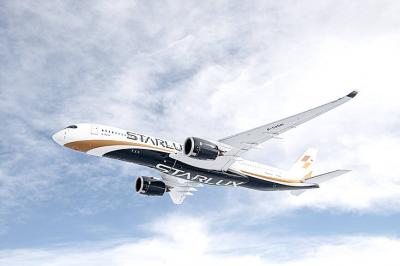
Starlux Airlines Co (星宇航空) today unveiled a long-haul network expansion plan at a shareholders’ meeting in Taipei, including direct flights to Barcelona, Spain, and Zurich, Switzerland, as well as a service connecting Taipei, Sydney and New Zealand. Starlux is to become the first Taiwanese carrier to offer non-stop services to the two European cities, while the inaugural oceanic route is expected to expand transit opportunities within the Australia-New Zealand market, Starlux said. Flight services to Chicago, Dallas, Washington and New York are under evaluation, the airline added. Prior to the shareholders’ meeting, the airline earlier this year announced that it would be
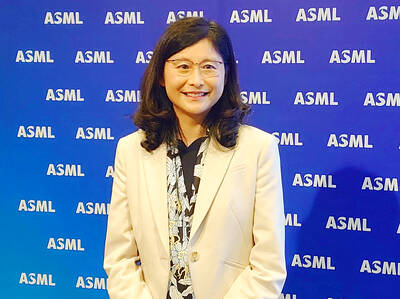
Netherlands-based semiconductor equipment supplier ASML Holding NV yesterday said that it is planning to hire an additional 1,000 people in Taiwan this year in response to growing demand from clients. ASML had previously planned to recruit 600 people this year, but that the plan has been adjusted upward, ASML vice president and ASML Taiwan general manager Grace Wang (汪佳慧) told reporters. ASML has a workforce of more than 4,500 in Taiwan, accounting for about 10 percent of its global total, Wang said. This year’s recruitment campaign would focus on adding people in the customer support, manufacturing and supply chain domains to assist ASML
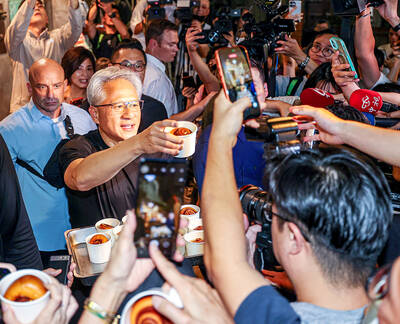
Nvidia Corp yesterday announced that CEO Jensen Huang (黃仁勳) would attend an employee meeting in Taipei tomorrow to celebrate the launch of the company’s Taiwan headquarters project. Huang would attend a gathering at the site of Nvidia’s planned headquarters in Beitou Shilin Technology Park (北投士林科技園區), the company said in a statement. After arriving in Taiwan on Saturday last week, Huang told reporters that he plans to meet with Quanta Computer Inc (廣達) chairman Barry Lam (林百里) and Taiwan Semiconductor Manufacturing Co (TSMC, 台積電) chairman C.C. Wei (魏哲家), and would attend the groundbreaking ceremony for Nvidia’s Taiwan headquarters tomorrow. Nvidia has not yet applied


 RSS
RSS