


History is a compass for navigating geopolitical uncertainty and safeguarding political autonomy. When great powers revert to Cold War-style zero-sum thinking, trust collapses, civic space contracts and international norms fracture. The danger deepens when crisis situations are exploited to target dissent under a facade of legality. Post-2019 Hong Kong warns how national security regimes can weaponize law to suppress pluralism, dismantle democratic governance and silence civil society in the name of order.
The erosion of rights in Hong Kong carries profound lessons for Taiwan’s defense of autonomy and the future of cross-strait relations. These lessons are urgently relevant to the nation as it faces mounting military pressure, and legislative disputes over budgets and defense priorities.
Washington’s assertive posture toward smaller states, from military intervention in Venezuela to talk of direct control over Greenland, reveals a recurring dilemma of contemporary geopolitics: External guarantees might secure short-term survival, but can also erode long-term sovereignty and undermine respect for international norms.
Meanwhile, Iran’s youth-led uprisings reflect a global pattern of dissent in which digitally connected and morally driven young people confront regimes that mistake coercion for consent. From Taiwan’s Sunflower movement to protests in Hong Kong and Myanmar, we learn that democratic legitimacy cannot be commanded; it must be continuously earned.
For Taiwan, democratic resilience must be cultivated from the bottom up. Three lessons stand out:
First, democracy thrives on accountability, not fear. Empowering civic institutions is essential to sustaining democratic substance. Democracy is more than periodic elections; it depends on durable mechanisms of checks and balances. Electoral integrity, judicial independence, a free press and a vibrant civil society form the armor against constitutional decay. Where these safeguards weaken, laws cease to protect and instead become a tool of domination. Democratic leadership is grounded in trust and responsibility, not imposed through coercion or emergency rule.
Second, legal clarity and strategic alliances deter aggression more effectively than ambiguity. Deterrence should be embedded in law and multilateralism. Freedom of navigation has long anchored stability in the western Pacific, even as China and the US show tendencies toward unilateral rulemaking. Taiwan’s security and prosperity continue to rest on international norms and coordinated partnerships with like-minded regional actors. While the US’ Taiwan Relations Act might buy time and flexibility for Washington, legal clarity and multilateral commitments generate endurance and deterrence.
Third, youth engagement is foundational to good governance. Tehran’s streets remind us that legitimacy must be interactive and rooted in civic participation. Citizens ultimately measure governments by tangible results: housing affordability, job opportunities and distributive fairness. Taiwan’s experience under Chinese Nationalist Party (KMT) authoritarianism offers a sobering lesson: When enforcement power centralizes and accountability blurs, institutions drift from serving the public to ensuring regime survival. Therefore, engaging with young people channels their activism into constructive efforts that strengthen democracy.
In today’s fractured global landscape, Taiwan’s strongest defense is a democracy that citizens can test, contest and reform. Resilience cannot be outsourced. Strategic prudence entails deterring threats wisely, governing transparently and listening seriously to young people whose futures are at stake.
Joseph Tse-Hei Lee is a professor of history at Pace University in New York.
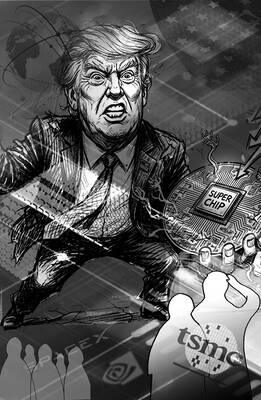
The White House’s decision to take a 9.9 percent stake in Intel Corp is looking like very shrewd business indeed. Since the government bought in at US$20.47 a share last August, the US chipmaker’s surging stock price has delivered the US a US$43 billion return. One of the reasons the investment has so far proved so sound is that the White House has made sure of it. According to The Wall Street Journal, Howard personally pushed deals on Intel’s behalf with some of the most lucrative clients imaginable. They include Nvidia Corp, the company at the heart of the AI
The Ministry of the Interior, working with the navy and coast guard, is organizing Taiwan’s first joint exercise simulating escort tankers carrying liquefied natural gas (LNG) and oil through a Chinese blockade. The drills simulate fuel transport along three maritime corridors leading toward Japan, the Philippines and the US. Deputy Minister of the Interior Sawyer Mars (馬士元) said that a blockade of the Taiwan Strait would amount to “almost a 100 percent blockade of the regional energy supply.” Minister of National Defense Wellington Koo said planning to counter a blockade is standard practice in Taipei. While the exercise is limited in
A single photograph can cut through a lot of noise, but it can also be used to misrepresent the truth. At the very least, it can concentrate the mind on something that requires further investigation. On Monday last week, Ma Ying-jeou Foundation CEO Tai Hsia-ling (戴遐齡) and former National Security Council secretary-general King Pu-tsung (金溥聰) held a news conference in which they showed a photograph of former foundation CEO Hsiao Hsu-tsen (蕭旭岑), now Chinese Nationalist Party (KMT) deputy chairman. In the image Hsiao is seated next to Xiamen Taiwan Businessmen Association chairman Han Ying-huan (韓螢煥). The two men were holding
I first met Professor Ray Jiing (井迎瑞) as a film and documentary student at Shih Hsin University’s (SHU) Department of Radio Television and Film in 1988. The following year, he went on to become the director of the Chinese Taipei Film Archive — forerunner of the Taiwan Film and Audiovisual Institute (TFAI). Over his eight-year tenure, Jiing rescued and restored over 200 classic Taiwanese films. In 1997, he established the Graduate Institute of Studies in Documentary and Film Archiving at Tainan National University of the Arts (TNNUA), and I joined the program in his third cohort of students. Beyond a


 RSS
RSS