

The saga of Sarah Dzafce, the disgraced former Miss Finland, is far more significant than a mere beauty pageant controversy. It serves as a potent and painful contemporary lesson in global cultural ethics and the absolute necessity of racial respect. Her public career was instantly pulverized not by a lapse in judgement, but by a deliberate act of racial hostility, the flames of which swiftly encircled the globe.
The offensive action was simple, yet profoundly provocative: a 15-second video in which Dzafce performed the infamous “slanted eyes” gesture — a crude, historically loaded caricature of East Asian features used in Western contexts — captioned with an inflammatory reference to Chinese people.
In today’s world, a physical gesture steeped in colonial-era malice is neither a “joke,” a “misunderstanding” nor, as she called it, a “temple massage.” It is a cultural weapon. When Dzafce deployed it, she aimed a direct insult at the global Chinese diaspora and the wider Asian community.
Her response to the crisis was a textbook example of poor crisis management. Her initial defense — absurdly claiming she was trying to alleviate a headache by massaging her temples — followed by the classic “a friend posted it” excuse — did not signal remorse. Instead, it exposed a deep arrogance and a profound disregard for the severity of the offense.
Even more infuriating were her subsequent actions. The defiant social media post from a business class seat, which was widely interpreted as a mocking display of privilege, only deepened the public outrage.
This arrogance, distressingly, found supporters among some Finnish right-wing politicians, who openly defended her and even mimicked the discriminatory gesture, showing that the issue transcended mere personal misconduct to touch upon systemic societal biases.
However, the power of unified public opinion proved overwhelming. Her business contracts were canceled one after another, pageant organizers swiftly revoked her title and she was ultimately forced to deactivate her social media accounts, marking the complete termination of her public life.
The speed and thoroughness of her downfall underscore a critical development: Global public opinion, particularly driven by Asian communities and forces for justice, has an unyielding, zero tolerance line against racial discrimination. For public figures, discrimination is no longer just a risk of embarrassment, it is a guaranteed act of self-immolation.
The Dzafce incident is but the latest manifestation of a deeper, ongoing cultural struggle. As our readers are acutely aware, for generations, ethnic slurs have been used as a tool to diminish and dehumanize Asians. The “slanted eyes” gesture is the visual twin of verbal assaults such as “Chink” or “Ching-chong.”
My comprehensive study identifying more than 50 English anti-Chinese or anti-Asian slurs is a sobering reminder that this prejudice is not random; it is historically and linguistically codified.
Understanding this arsenal of bigotry — from anatomical insults such as slope-head to cultural slurs such as banana (implying the person is “yellow on the outside, white on the inside”) — is crucial. This awareness is not about dwelling on offense, but about strategic empowerment. We must know the tools of our detractors to effectively counter them.
The beauty of global digital connectivity is that it ensures these gestures and slurs could no longer fester unchecked in local corners. When prejudice emerges, it is instantly illuminated by a global spotlight.
Miss Finland’s story is ultimately a victory for dignity. It confirms that the power to demand respect now firmly resides with the people. By acting in a unified condemnation, we send an unmistakable signal: Every act of prejudice, visual or verbal, would be met with an immediate and decisive reckoning.
The cost Sarah Dzafce paid was heavy, but it serves as a crystal-clear warning to anyone contemplating a racist “joke”: The world is watching, and your career is not worth the price of disrespecting billions.
Hugo Tseng has a doctorate in linguistics, and is a lexicographer and former chair of the Soochow University English Department.
Taiwan’s domestic political situation is following recognizable political rhythms, while the international environment surrounding Taiwan is undergoing a major transformation. Within Taiwan, there are ongoing battles between the legislative and executive branches over the budget, and between cities and the central government over resources. Tensions between political parties dominate headlines and consume much of the attention of party leaders. Jockeying is underway for local elections this November and national elections in 2028. And the longstanding philosophical debate inside Taiwan over how best to protect Taiwan and promote the good life remains unresolved. Amidst all of this, Taiwan continues to function well. It
In an article published on Tuesday in The Atlantic, titled “Will Taiwan Just Give Up?”, journalist Simon Shuster emphasizes the unpredictability of the US as an ally under US President Donald Trump and cites diminishing faith in the US as a contributor to what he sees as waning determination to resist China. As the title suggests, Shuster views a deal between Taiwan and China as an increasingly inevitable alternative to a costly war — one that Taiwan, lacking reliable allies and military capabilities, would eventually be destined to lose. He focuses on Chinese Nationalist Party (KMT) Chairwoman Cheng Li-wun (鄭麗文) — her
With candidate registration for this year’s local elections closed on Sept. 4 and the elections less than 80 days away, Democratic Progressive Party (DPP) Legislator and Taipei mayoral candidate Puma Shen’s (沈伯洋) rapidly growing popularity has become the focus of political talk shows and online discussions over the past week, heating up the mayoral election race in Taipei. Local media headlines and political pundits have picked up his supporters’ slogan “ocean current” (洋流) — a play on the last character of Shen’s name, which literally means “ocean” (洋), and the character (流), which can mean “current,” “flow” or “trend” — to
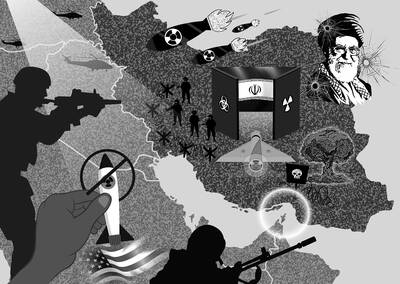
When was the last time you heard a meaningful proposal to prevent Iran from developing a nuclear arsenal? There has been nothing on the subject since the June Memorandum of Understanding between the US and Iran; the promised 60 days of talks to settle questions around Tehran’s uranium-enrichment program never began and have long since expired. When the war was launched, on Feb. 28, a resolution of the nuclear dispute was prominent among the dizzying array of US and Israeli aims to explain the attack. But as should be clear by now, the attempt was entirely reliant on achieving regime change. That


 RSS
RSS