


For the first time in almost 36 years, a Parisian derby will be played in French soccer’s top flight when reigning champions Paris Saint-Germain FC take on the nouveau riche Paris Football Club (PFC) today.
Not one of the players involved in today’s match — PFC’s 38-year-old third-choice goalkeeper Remy Riou is almost certainly not going to be involved — was born the last time there was a Parisian derby in Ligue 1.
That was on Feb. 25, 1990, when Moroccan midfielder Aziz Bouderbala scored a brace as Racing Paris 1 beat PSG 2-1 at the Parc des Princes home that they shared.
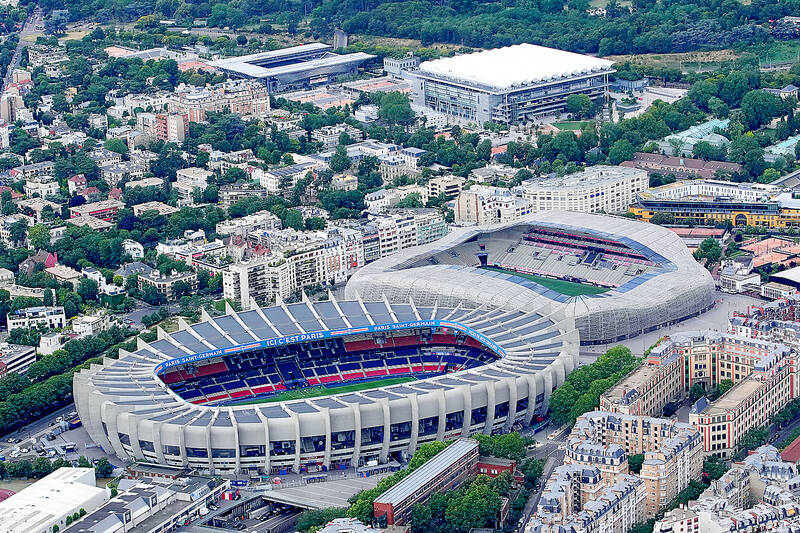
Photo: AP
“There was a real rivalry,” said former PSG captain Jean-Marc Pilorget, who also twice coached PFC.
“We were starting to gain national recognition, we had won the French Cup [in 1982 and 1983] and then we were champions [in 1986],” added Pilorget, a defender who played 435 times for PSG. “The PSG project was starting to take shape.”
“Matra were putting a great team together, [Jean-Luc] Lagardere had invested a lot of money — they were a completely new Racing, full of ambition,” he said, referring to a former name of Racing Paris 1. “We really didn’t want to lose those matches.”
Wealthy businessman Lagardere had invested heavily in soccer in the early 1980s and even managed to pinch France midfield stalwart Luis Fernandez from the newly crowned champions PSG in 1986.
The 48,000-capacity Parc des Princes was sold out for derby matches in those days — although interest quickly waned.
Lagardere withdrew his backing in 1989, and Racing, one of the oldest clubs in France and founded in 1896, were relegated at the end of the next season.
Paris had to wait until another wealthy backer — this time the Arnault family which owns LVMH — invested in PFC last year, helping them to gain promotion from Ligue 2, to be able to watch a Ligue 1 derby again.
It would not be the first derby between PSG and PFC — who began life as a single entity.
A phoenix PFC club — with no players nor place in the league pyramid — was created in 1969 due to a French Football Federation plan to establish a major team in the capital.
In 1970, the new club merged with second division Stade Saint-Germain — a team from the Parisian suburbs — to form an early PSG.
After just two seasons, that club split into the two entities that exist today: PSG and PFC.
PFC remained in the top flight, with PSG beginning their independent existence in the third division.
They spent only one season in the same league — the 1978/79 first division — drawing both matches, with PFC relegated at the end of that campaign.
“At that time it was a match like any other — there was no enthusiasm, hardcore fans didn’t exist, there was no [live soccer on] television... it was the Middle Ages,” former PFC midfielder Jean-Jacques Amorfini said.
“On top of that, we were in the relegation zone all season, PSG were in the bottom half, it was nothing like what is coming,” he added. “This new derby is great for Paris and for the two clubs.”
The Parc des Princes was less than half full for the last PSG-PFC derby on Dec. 17, 1978 — it would be bursting at the seams today.
Since the first French soccer championship in 1894, when all six teams were Parisian, there have been a number of different rivalries in the country’s capital.
Since those early years when Standard Athletic Club, the White Rovers and Club Francais were the dominant teams of the nascent championship, top flight derbies have become increasingly rare.
They mostly involved Red Star, a now-second division side who were formed a year after Racing, but moved in 1909 to the northern suburb of Saint-Ouen.
Those two shared a rivalry in the 1930s and 1940s, while Red Star locked horns in the top flight with Stade Francais — who like Racing are more known for their rugby team — between the 1940s and 1960s.
Red Star were in decline by the 1970s, last relegated from the top flight in 1975, but not before they had battled in the first division against both the individual PFC and PSG entities, and their combined predecessors.

Greek swimmer Kristian Gkolomeev was the only athlete to “beat” a world record on Sunday at the Enhanced Games, winning the men’s 50m freestyle at the divisive competition where athletes were free to take performance-enhancing substances. His time of 20.81 seconds — which is not considered official — came in the final event of the night in Las Vegas, sparing the blushes of organizers who made claims that multiple world records would be surpassed due to a sophisticated doping regime. Gkolomeev, who was wearing a synthetic “supersuit” long banned at events such as the Olympics, outpaced Australia’s Cameron McEvoy’s 20.88 set in

Fred Kerley is competing unaugmented against drug-fuelled athletes at this weekend’s Enhanced Games and still hopes to race in the 2028 Olympics, the suspended former 100m world champion said on Friday. Arguably the biggest name at the divisive event in Las Vegas, where doping is permitted, the US sprinter said he had chosen not to take any of the banned substances including testosterone and steroids that his competitors have been using. “I don’t need it. God gave me fast feet for a reason. And I’m here to showcase my talent,” Kerley said. Kerley last September became the first US competitor and first track
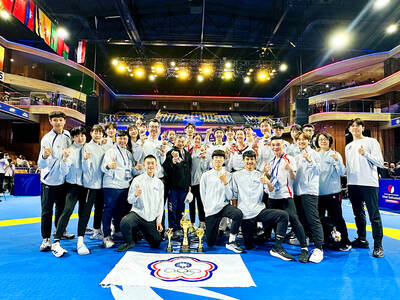
VICTORY ABROAD: The team took home a fistful of medals and secured spots for the autumn’s Asian Games, scheduled for September in Nagoya Taiwan’s women’s team captured the overall title at the Asian Taekwondo Championships in Mongolia on Sunday, finishing with two golds, one silver and one bronze medal. The strong showing, led by gold medalists Wang Chieh-ling and Chang Jui-en secured the full quota of available spots for Taiwan at the Asian Games in Nagoya, Japan, in September. Wang opened Taiwan’s medal run by winning gold in the women’s under-46kg class on Thursday, the first day of competition. Liu Yu-yun later earned a silver in the under-49kg class. On the final day on Sunday, Chang won Taiwan’s second gold medal in the under-62kg event, and
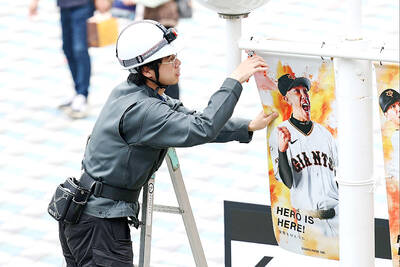
The manager of the Yomiuri Giants, one of Japan’s most popular baseball teams, resigned yesterday after he was arrested for allegedly physically attacking his teenage daughter. Shinnosuke Abe allegedly grabbed the 18-year-old and forced her to the floor at their home in central Tokyo on Monday evening, reported national broadcaster NHK and Kyodo News, citing unnamed police sources. “Leaving like this really means I’m causing you a lot of trouble, and I feel truly sorry about that,” Abe told a hastily arranged news conference, his eyes red with tears. The former star catcher, who is among baseball-obsessed Japan’s most recognized sports figures,


 RSS
RSS