


Chinese Nationalist Party (KMT) legislators have twice blocked President William Lai’s (賴清德) special defense budget bill in the Procedure Committee, preventing it from entering discussion or review. Meanwhile, KMT Legislator Chen Yu-jen (陳玉珍) proposed amendments that would enable lawmakers to use budgets for their assistants at their own discretion — with no requirement for receipts, staff registers, upper or lower headcount limits, or usage restrictions — prompting protest from legislative assistants.
After the new legislature convened in February, the KMT joined forces with the Taiwan People’s Party (TPP) and, leveraging their slim majority, introduced bills that undermine the Constitution, disrupt constitutional order and encroach upon executive authority. These include the “contempt of legislature” charge and amendments to the Constitutional Court Procedure Act (憲法訴訟法), which effectively paralyzed the operations of the Constitutional Court and the justices’ powers.
The blue-white coalition has also used its majority coercion to forcibly pass legislation detrimental to national development and citizens’ livelihoods, drastically cutting and freezing the budgets for national defense, diplomacy, economic development, social welfare programs and more, greatly harming the nation’s development and the public’s interests. On cross-strait issues, the KMT has gone so far as to echo the Chinese Communist Party’s (CCP) “one China” principle, block the passage of national security legislation and seek to amend the Anti-Infiltration Act (反滲透法) in an attempt to use China to control Taiwan.
Since losing the Executive Yuan, the KMT has failed to cherish Taiwan’s democratic system, refused to earnestly listen to public opinion and failed to put forward sound national policies. Instead, it has reversed its former stance of fighting communism and restoring the nation, adopting a pro-China position and currying favor with the CCP to disrupt Taiwan.
After Taiwan’s democratization, kind-hearted Taiwanese gave the KMT a chance to redeem itself through merit. After former president Chen Shui-bian (陳水扁) left office in 2008, former president Ma Ying-jeou (馬英九) won back the top office for the KMT, serving two consecutive terms. Yet he disregarded the views of the majority of Taiwanese and, under the pretext of the so-called “1992 consensus” and the “one China” framework, steered the nation onto a pro-China path.
Last year, the improper delineation of legislative districts caused the KMT to receive fewer total nationwide votes than the Democratic Progressive Party (DPP), but win slightly more legislative seats. However, the party failed to cherish the opportunity. Instead, embittered by three consecutive defeats in presidential elections, it acted out of spite and self-interest.
While the CCP intensifies its efforts against Taiwan, the KMT — with no regard for national security or public interest — has joined forces with the TPP to propose and pass bills that would paralyze executive authority, sideline Lai, obstruct governance and ultimately harm Taiwanese, all in an attempt to seize back power.
If the DPP is unable to break free from the complacent and rigid mindset that it should not “stir up trouble” while in power, it would inevitably fail to reverse the situation. In turn, Taiwan would be unable to cope with the severe challenges the CCP poses, as well as domestic and international pressure — let alone move forward.
Enduring grievances are usually for the greater good, but once enduring them no longer serves that purpose, it is time to take responsibility. Leaders must step forward firmly and skillfully, letting the country’s long-term interests and the greatest interests of the public guide the way, and do what must be done.
KMT political infighting has severely undermined national development and the interests of Taiwanese. The nation is facing an unprecedented democratic crisis. For the sake of its survival and development, all Taiwanese who support democracy should unite through civil organizations, politics, academia and the media.
Taiwanese should emulate the methods used in the US in the 1960s and 1970s to monitor and reform the US Congress by engaging in sustained, nationwide action: marches, demonstrations, sit-ins, telephone protests, street theater, forums, public hearings, op-eds, television and radio appearances, and discussions on social media.
Through such actions, the public can collectively and continuously monitor problematic legislators, building a powerful force until opposition lawmakers recognize citizen anger, cease their unreasonable behavior and start competing with the ruling party in a more rational manner.
Michael Lin is a retired diplomat, formerly posted in the US.
Translated by Kyra Gustavsen
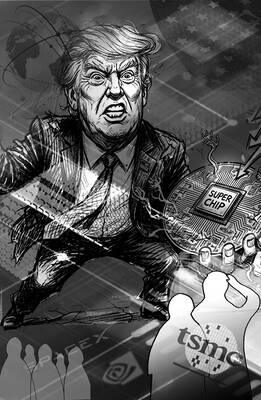
The White House’s decision to take a 9.9 percent stake in Intel Corp is looking like very shrewd business indeed. Since the government bought in at US$20.47 a share last August, the US chipmaker’s surging stock price has delivered the US a US$43 billion return. One of the reasons the investment has so far proved so sound is that the White House has made sure of it. According to The Wall Street Journal, Howard personally pushed deals on Intel’s behalf with some of the most lucrative clients imaginable. They include Nvidia Corp, the company at the heart of the AI
A single photograph can cut through a lot of noise, but it can also be used to misrepresent the truth. At the very least, it can concentrate the mind on something that requires further investigation. On Monday last week, Ma Ying-jeou Foundation CEO Tai Hsia-ling (戴遐齡) and former National Security Council secretary-general King Pu-tsung (金溥聰) held a news conference in which they showed a photograph of former foundation CEO Hsiao Hsu-tsen (蕭旭岑), now Chinese Nationalist Party (KMT) deputy chairman. In the image Hsiao is seated next to Xiamen Taiwan Businessmen Association chairman Han Ying-huan (韓螢煥). The two men were holding
The Ministry of the Interior, working with the navy and coast guard, is organizing Taiwan’s first joint exercise simulating escort tankers carrying liquefied natural gas (LNG) and oil through a Chinese blockade. The drills simulate fuel transport along three maritime corridors leading toward Japan, the Philippines and the US. Deputy Minister of the Interior Sawyer Mars (馬士元) said that a blockade of the Taiwan Strait would amount to “almost a 100 percent blockade of the regional energy supply.” Minister of National Defense Wellington Koo said planning to counter a blockade is standard practice in Taipei. While the exercise is limited in
In a Taiwanese university classroom, a lecturer asks in English: “Can anyone give me an example from Taiwan?” Students look down. No one answers. After class, one student writes on the course platform in Mandarin: “I understood the concept, but I didn’t know how to answer in English.” That moment highlights a key issue in Taiwan’s English-medium instruction (EMI) reform: It is not just about more English-taught courses, but whether students can learn, participate and belong. EMI expansion is part of the Bilingual 2030 policy and the Ministry of Education’s BEST Program, aiming to improve English ability, support EMI teaching


 RSS
RSS