


US President Donald Trump’s airstrikes on boats off the Venezuelan coast have dominated news headlines since September, with the president recently declaring the country’s airspace “closed.” Venezuelans are desperately guessing about their future and wondering whether Trump would make good on his promises to evict their strongman ruler, Venezuelan President Nicolas Maduro, from power. Who would take over, and on what constitutional grounds?
On Nov. 18, the Washington Post jumped headlong into this debate by giving the Venezuelan opposition leader and this year’s Nobel Peace Prize laureate, Maria Corina Machado, a platform to present her new “Freedom Manifesto.”
The accompanying editorial cast Machado as Venezuela’s latter-day cross between former US presidents Thomas Jefferson and James Madison: “America’s founding document,” the paper’s editorial board contends, “clearly inspired” this “precursor to a new Constitution.”
Machado has spent the past year in hiding, evading an arrest warrant issued by Maduro’s regime after its brazen falsification of the July 2024 presidential election results, while the real winner, Edmundo Gonzalez Urrutia, fled into exile.
However, this autumn, Trump and the Norwegian Nobel Committee have unwittingly teamed up to elevate Machado’s profile. By cunningly dedicating her Nobel Prize to the obscenely vain Trump, Machado has deepened US support for the Venezuelan opposition’s cause. She now patiently awaits the outcome of Trump’s campaign to force Maduro out.
FALSE PORTRAYAL
However, the Washington Post’s attempt to drape Machado in the stars and stripes misses what the Venezuelan opposition is about. Associating her with the upcoming 250th anniversary of the US’ Declaration of Independence might well be an effective way to drum up US public support, but it elides Machado’s defining quality: She is a practicing Catholic whose faith shapes her political and economic views alike.
Neither “extremist neoliberal” nor “the smiling face of Washington’s regime-change machine,” Machado is the scion of a long line of Christian democrats in Latin America.
She might see an advantage in depicting Maduro’s overthrow as an “America first” cause, but her own “Freedom Manifesto” gives the lie to this conceit. In it, she hitches herself not to Jefferson or Madison, but to the founding father of Catholic thought, Thomas Aquinas.
The first core value she lists is not liberty but “Dignity: Our Guiding Principle.” For Christian democrats, “dignity” is shorthand for the image of God that can be found in each human being — understood as a person, not as some marginal unit of economic production. The Catholic concept of dignity passed from Aquinas’ own medieval Dominicans to the early Jesuits, and finally to the 19th-century “Thomist” renaissance launched by Pope Leo XIII (the current pope’s namesake), whose pathbreaking encyclical, Rerum Novarum (“Rights and Duties of Capital and Labor”), reconciled the Catholic Church to modernity.
DIGNITY
It was this tradition that lay behind the French philosopher Jacques Maritain’s concept of “human rights” in the 1940s, and nowhere was Maritain read more widely than in Spanish-language America. Among his most famous disciples was Rafael Caldera, a future president of Venezuela (1969 to 1974, and 1994 to 1999) and the founder of a Latin American political movement that served as a bridge for European and US-based anti-communists.
This was Cold War soft power at its most effective. For decades, Venezuela’s capital, Caracas, was known as the “Paris of South America” — long before Buenos Aires promoted itself as such. It held this status until oil prices tumbled in the 1980s, crashing the Venezuelan economy and endowing former Venezuelan president Hugo Chavez’s rebel forces with popular legitimacy. Chavez’s death then brought Maduro’s succession and his dystopian regime.
In a pivotal clause of her manifesto, Machado’s Spanish word persona has been rendered in English as “individual,” but this is a mistranslation. The correct wording should be, “Let dignity serve as the driving force ... that fosters the complete development of each person.”
In Catholic political and social thought, a “person” is a dignity-endowed human being made in God’s image, while an “individual” is shorn of ties to community or nation.
This is not pedantic wordplay, but a fundamental philosophical difference. Machado might be proposing to privatize US$1.7 trillion in state-held Venezuelan assets, but her talk of property rights is a nod to Aquinas and Maritain, not to Friedrich von Hayek or Milton Friedman, let alone to Trump.
Machado’s manifesto uses precisely the same strategy that turned post-Nazi West Germany into a self-styled social market economy which married the market with locally rooted corporatism. Many of Germany’s post-World War II leaders called themselves “Christian democrats,” and the man in charge in Berlin today, German Chancellor Friedrich Merz, leads a party called the Christian Democratic Union.
OPPORTUNITY
Given such deep political and philosophical commitments, Machado’s pandering to Trump should not remotely be seen as defining her.
In the 1960s, West Germany pumped enormous sums into Latin America in hopes of training a generation of anti-communist Catholic politicians who would oppose Soviet interests without surrendering to US foreign policy. Caldera’s tenure as a Christian democratic president almost fulfilled this dream in the 1970s, only to be reversed by his khaki-clad populist successor, Chavez.
Nonetheless, with oil prices declining again this year, the rosary-wearing Machado — if ultimately installed in power — could succeed where Caldera failed.
Her ascendency is a clear sign that Catholicism is regaining salience after decades of suppression by Chavez and Maduro. In October, Pope Leo XIV announced the canonization of the first-ever Venezuelan saints, sparking a national celebration for which Maduro cynically tried to take credit.
Across the US political spectrum, too few people understand how important Catholic thought has been in shaping the Latin American right. If she succeeds, the woman looking to reclaim the idea of a “people’s party” from the Venezuelan left might find closer ideological allies not in Washington, but in Berlin, Paris, Warsaw and Rome. Perhaps Pope Leo XIV already sees in her movement what Pope John Paul II saw in the Solidarity protests that brought down communist rule in Poland: a true revolution of personal dignity.
Piotr H. Kosicki is associate professor of history at the University of Maryland.
Copyright: Project Syndicate
A gap appears to be emerging between Washington’s foreign policy elites and the broader American public on how the United States should respond to China’s rise. From my vantage working at a think tank in Washington, DC, and through regular travel around the United States, I increasingly experience two distinct discussions. This divergence — between America’s elite hawkishness and public caution — may become one of the least appreciated and most consequential external factors influencing Taiwan’s security environment in the years ahead. Within the American policy community, the dominant view of China has grown unmistakably tough. Many members of Congress, as
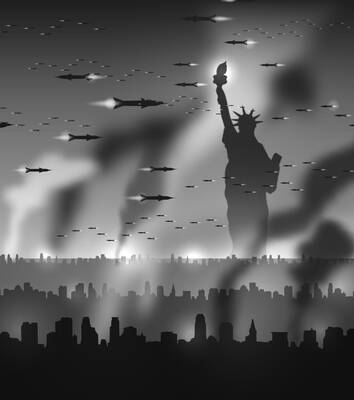
After declaring Iran’s military “gone,” US President Donald Trump appealed to the UK, France, Japan and South Korea — as well as China, Iran’s strategic partner — to send minesweepers and naval forces to reopen the Strait of Hormuz. When allies balked, the request turned into a warning: NATO would face “a very bad” future if it refused. The prevailing wisdom is that Trump faces a credibility problem: having spent years insulting allies, he finds they would not rally when he needs them. That is true, but superficial, as though a structural collapse could be caused by wounded feelings. Something
Former Taipei mayor and Taiwan People’s Party (TPP) founding chairman Ko Wen-je (柯文哲) was sentenced to 17 years in prison on Thursday, making headlines across major media. However, another case linked to the TPP — the indictment of Chinese immigrant Xu Chunying (徐春鶯) for alleged violations of the Anti-Infiltration Act (反滲透法) on Tuesday — has also stirred up heated discussions. Born in Shanghai, Xu became a resident of Taiwan through marriage in 1993. Currently the director of the Taiwan New Immigrant Development Association, she was elected to serve as legislator-at-large for the TPP in 2023, but was later charged with involvement
Out of 64 participating universities in this year’s Stars Program — through which schools directly recommend their top students to universities for admission — only 19 filled their admissions quotas. There were 922 vacancies, down more than 200 from last year; top universities had 37 unfilled places, 40 fewer than last year. The original purpose of the Stars Program was to expand admissions to a wider range of students. However, certain departments at elite universities that failed to meet their admissions quotas are not improving. Vacancies at top universities are linked to students’ program preferences on their applications, but inappropriate admission


 RSS
RSS