


A tragic fire broke out on Wednesday afternoon at the Wang Fuk Court residential complex in Hong Kong’s Tai Po District, a northern suburb near the border with the Chinese mainland.
Several of the buildings, which are more than 40 years old, were undergoing major exterior repairs, and the structures were wrapped in bamboo scaffolding and protective netting.
According to reports, the waterproof tarps and plastic sheeting reacted violently when exposed to flames, allowing the fire to break through the buildings’ fire protection zones and resulting in severe casualties. As of yesterday, at least 128 people had been confirmed dead and others were missing.
The primary task in the investigation into how the fire spread so rapidly should be a comprehensive review of the regulatory mechanism for construction and maintenance materials. Construction safety standards largely focus on preventing falls or ensuring structural integrity, while neglecting the fire resistance management of temporary coverings such as protective netting and tarps. Laws and regulations should be amended to mandate that the bamboo scaffolding, netting and dust-proof cloth used for exterior repairs on high-rise buildings must meet internationally certified flame-retardant standards.
Regulatory authorities should implement source control, requiring construction materials to be accompanied by third-party laboratory combustion test reports prior to entering a site and random inspections should be conducted throughout each phase of construction.
Given the cost-driven logic of most businesses, relying solely on contractors’ discipline or written guarantees would make it difficult to prevent the use of cheap, flammable substitutes. To ensure the effective enforcement of construction safety regulations, appropriate criminal penalties should be imposed on contractors whose contraventions result in disasters.
Repair work on high-rise buildings must incorporate mandatory vertical fire compartmentation in their designs. As demonstrated in the Wang Fuk Court case, continuous exterior scaffolding creates a massive chimney effect in a fire, rendering a building’s internal fire doors and sprinkler systems ineffective.
Construction and maintenance regulations should require that when scaffolding is erected, firebreaks or water curtain systems be installed to block the upward spread of flames.
For projects that involve wrapping the entire building, evacuation routes must be properly planned and carefully evaluated before construction begins.
If residents are to continue to live in a building that is being worked on, it is absolutely essential to first ensure that — in the event of an external fire — they still have safe escape routes and ventilation openings to prevent construction netting from trapping them in dense smoke and heat.
The Wang Fuk Court tragedy should serve as a warning for Asia’s dense cities, particularly amid an era of large-scale urban renewal.
As buildings age, exterior renovations would become more commonplace. If construction safety standards fail to keep pace with maintenance needs, the risk of disaster would be ever-present.
Governments must establish stricter disaster prevention standards applicable to situations where occupied buildings undergo construction at the institutional level, covering everything from material certification, to fire-resistant designs and legal accountability. No aspect can be overlooked.
Roger Lo is a freelancer.
Translated by Kyra Gustavsen
A gap appears to be emerging between Washington’s foreign policy elites and the broader American public on how the United States should respond to China’s rise. From my vantage working at a think tank in Washington, DC, and through regular travel around the United States, I increasingly experience two distinct discussions. This divergence — between America’s elite hawkishness and public caution — may become one of the least appreciated and most consequential external factors influencing Taiwan’s security environment in the years ahead. Within the American policy community, the dominant view of China has grown unmistakably tough. Many members of Congress, as
The Hong Kong government on Monday gazetted sweeping amendments to the implementation rules of Article 43 of its National Security Law. There was no legislative debate, no public consultation and no transition period. By the time the ink dried on the gazette, the new powers were already in force. This move effectively bypassed Hong Kong’s Legislative Council. The rules were enacted by the Hong Kong chief executive, in conjunction with the Committee for Safeguarding National Security — a body shielded from judicial review and accountable only to Beijing. What is presented as “procedural refinement” is, in substance, a shift away from
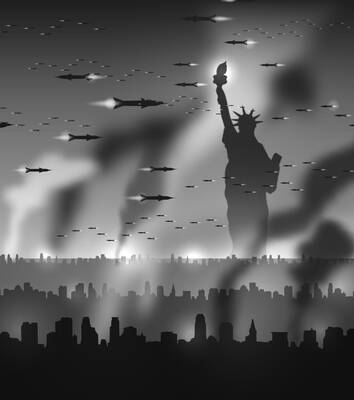
After declaring Iran’s military “gone,” US President Donald Trump appealed to the UK, France, Japan and South Korea — as well as China, Iran’s strategic partner — to send minesweepers and naval forces to reopen the Strait of Hormuz. When allies balked, the request turned into a warning: NATO would face “a very bad” future if it refused. The prevailing wisdom is that Trump faces a credibility problem: having spent years insulting allies, he finds they would not rally when he needs them. That is true, but superficial, as though a structural collapse could be caused by wounded feelings. Something
The shifting geopolitical tectonic plates of this year have placed Beijing in a profound strategic dilemma. As Chinese President Xi Jinping (習近平) prepares for a high-stakes summit with US President Donald Trump, the traditional power dynamics of the China-Japan-US triangle have been destabilized by the diplomatic success of Japanese Prime Minister Sanae Takaichi in Washington. For the Chinese leadership, the anxiety is two-fold: There is a visceral fear of being encircled by a hardened security alliance, and a secondary risk of being left in a vulnerable position by a transactional deal between Washington and Tokyo that might inadvertently empower Japan


 RSS
RSS