

“Can you tell me where the time and motivation will come from to get students to improve their English proficiency in four years of university?”
The teacher’s question — not accusatory, just slightly exasperated — was directed at the panelists at the end of a recent conference on English language learning at Taiwanese universities. Perhaps thankfully for the professors on stage, her question was too big for the five minutes remaining.
However, it hung over the venue like an ominous cloud on an otherwise sunny-skies day of research into English as a medium of instruction and the government’s Bilingual Nation 2030 policy.
The dark cloud also pre-empted my own: What does language learning and testing really mean in an age of on-demand artificial intelligence (AI)?
I ask this question not because I have the answer (nobody does), but because applying old fixes to a new reality is dangerous. We must understand the problems AI presents before we can begin to engineer a solution.
AI can now read, write and translate faster and better than any human. With the rise of wearables and voice-mode assistants on every phone, real-time translation of all four language skills is no longer science fiction.
This means that an 85-year-old Taiwanese great-grandmother, who has never formally studied English, could use ChatGPT’s voice mode on her phone to have a better conversation with a foreigner than a university student who has “studied” English for more than 1,000 hours since elementary school.
For every Taiwanese student who reaches an intermediate stage of proficiency, there are likely 10 who never make it past the elementary level. This is not just inefficient learning, it is a form of childhood theft. My own bilingual daughter had to sit through hundreds of hours of English classes full of Chinese explanations she could not understand, wasting time that could have been spent on actual development.
Yet, the conference felt stuck in a pre-ChatGPT past, just like the bilingual nation policy it strives to align with. Are we thinking enough about the unknown waters we are entering? It feels like sailors charging full steam ahead in a tropical vessel for an arctic expedition, with no thought to the retrofitting needed for the hidden icebergs and freezing temperatures that AI would bring.
These cooling temperatures are creating clouds of important questions that resist clear answers.
First, what is language learning for in the age of AI? At the very least, we should encourage teachers and students to use AI to learn. With thoughtful prompting, AI is a tireless tutor that could create level-specific lessons for reading, evaluate writing and read texts aloud. Tools like ChatGPT and Gemini now offer impressive voice modes that interact with learners in real time, even code-switching between languages; this covers listening and speaking practice.
Second, what does language proficiency mean now? Traditional proficiency scales require thousands of hours to climb. However, in today’s AI-saturated world, everyone is already “functionally bilingual.”
What tips the ability scales now is not raw vocabulary size, but the ability to evaluate the appropriateness of AI output. That is why, in my classes for professionals, I focus on communicative strategies to guide these tools rather than rote learning. My students do not have the time — or motivation — to raise their proficiency the old-fashioned way. Here, AI is a career skill, an amplifier of human ability. Yes, this is AI dependence, but it is a “controlled dependence.”
Reading and writing are the easiest skills to “functionally” master with AI. A text can be summarized instantly; writing is generated flawlessly at a whim. That leaves listening and speaking. These are the first skills we learn as toddlers and remain the most important for authentic connection.
For certain situations, unmediated human interaction is crucial for developing trust with clients, collaborators and superiors.
We might be returning to the prestige of oral communication that defined cultures before the printing press.
The third question is: Who still needs AI-free human proficiency?
If speaking skills become the new gold standard, who really needs to spend years mastering them? The answer is specific: Service providers and professionals whose job is to persuade, relate and build relationships, such as nurses, salespeople and teachers.
This begs a further question about the education system: Does everyone need to be put into the same factory assembly line of English classes from elementary school to college?
Finally, what should language testing measure?
If AI collapses traditional constructs, perhaps language testing should split into two domains: Human proficiency (what you can do face-to-face) and AI-mediated proficiency (what you can do with the tools you actually use).
Most industries already assume AI-mediated communication for reading and writing. How many roles in Taiwan really require unfiltered human interaction? Some, but not many. Maybe testing should reflect that divergence and provide two scores: one for AI-free human proficiency and another for AI-mediated ability.
If we acknowledge these two kinds of proficiency, the teacher’s question from the conference returns in a new light: Where indeed would the time and motivation come from to raise human proficiency when it is no longer needed — nor wanted — by most people?
Nigel P. Daly is a writer, trainer, and researcher on AI and language education. He has a doctorate in English from National Taiwan Normal University.
Taiwan’s domestic political situation is following recognizable political rhythms, while the international environment surrounding Taiwan is undergoing a major transformation. Within Taiwan, there are ongoing battles between the legislative and executive branches over the budget, and between cities and the central government over resources. Tensions between political parties dominate headlines and consume much of the attention of party leaders. Jockeying is underway for local elections this November and national elections in 2028. And the longstanding philosophical debate inside Taiwan over how best to protect Taiwan and promote the good life remains unresolved. Amidst all of this, Taiwan continues to function well. It
In an article published on Tuesday in The Atlantic, titled “Will Taiwan Just Give Up?”, journalist Simon Shuster emphasizes the unpredictability of the US as an ally under US President Donald Trump and cites diminishing faith in the US as a contributor to what he sees as waning determination to resist China. As the title suggests, Shuster views a deal between Taiwan and China as an increasingly inevitable alternative to a costly war — one that Taiwan, lacking reliable allies and military capabilities, would eventually be destined to lose. He focuses on Chinese Nationalist Party (KMT) Chairwoman Cheng Li-wun (鄭麗文) — her
With candidate registration for this year’s local elections closed on Sept. 4 and the elections less than 80 days away, Democratic Progressive Party (DPP) Legislator and Taipei mayoral candidate Puma Shen’s (沈伯洋) rapidly growing popularity has become the focus of political talk shows and online discussions over the past week, heating up the mayoral election race in Taipei. Local media headlines and political pundits have picked up his supporters’ slogan “ocean current” (洋流) — a play on the last character of Shen’s name, which literally means “ocean” (洋), and the character (流), which can mean “current,” “flow” or “trend” — to
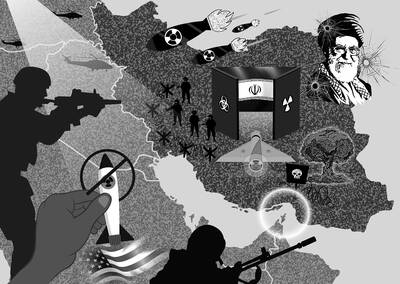
When was the last time you heard a meaningful proposal to prevent Iran from developing a nuclear arsenal? There has been nothing on the subject since the June Memorandum of Understanding between the US and Iran; the promised 60 days of talks to settle questions around Tehran’s uranium-enrichment program never began and have long since expired. When the war was launched, on Feb. 28, a resolution of the nuclear dispute was prominent among the dizzying array of US and Israeli aims to explain the attack. But as should be clear by now, the attempt was entirely reliant on achieving regime change. That


 RSS
RSS